The Pizza Lab: Three Doughs to Know
from http://slice.seriouseats.com/, by J. Kenji López-Alt
We've gone through a lot of pizza styles and recipes here at The Pizza Lab, but I still often get asked "what's the best pizza crust recipe you know?"
Well that's a tough question to answer. I like lager, my wife likes lager, sometimes cider. Different drinks for different needs, if you know what I mean. When I'm in the mood to fire up the grill or heat up the broiler, I might take my time and make a Neapolitan-style lean dough. If I want to relive my childhood without stepping out my apartment door, it's a New York-style. Company coming over and I want to feed a crowd without messing up the kitchen? It's Sicilian-style square pie all the way.
Here's a brief run-down on the three recipes that every home pie-maker should have in their arsenal to tackle all manner of pizza-centric circumstances.
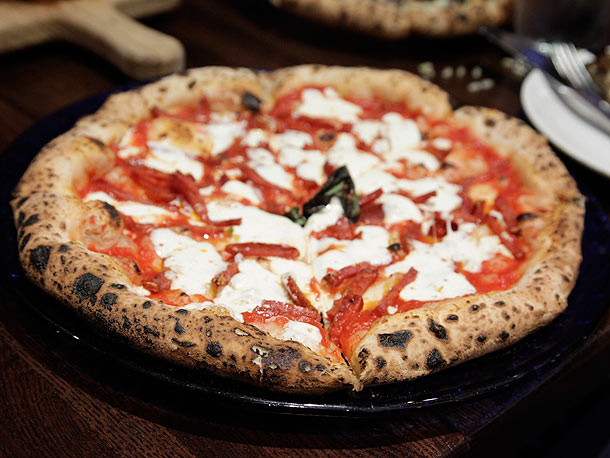
The Classic: Neapolitan-Style Pizza Dough
The Skinny:
Neapolitan pizza is where it all started. In some ways, it's the simplest form of pizza out there—it has the fewest ingredients of any. In other ways, it's the most complicated. Few ingredients and blazing hot temperatures in excess of 900°F mean that the slightest mistakes will amplify in the finished product. Producing a perfect Neapolitan pie is no easy feat, but it's not impossible.
Neapolitan pizza is made from a lean dough—that is, it's got nothing but flour, water, salt, and yeast. No oil, no sugar, nothing. The flour is generally a high-protein flour, often of the Italian "OO" type, which is ground extra fine, giving it a unique texture and the ability to absorb more water without becoming soupy.
With so few ingredients, the key to great Neapolitan pizza crust is a good long fermentation period during which time starches will break down into simpler sugars, yeast will create flavorful by-products, and gluten formation will occur, allowing you to stretch the dough out easily and making for a dramatic rise and good charring in the oven.
The best Neapolitan pies should have a thin, thin layer of crispness to the crust, followed by an interior that is moist, poofy, and cloud-like with good, stretchy chew, and plenty of flavor. Even browning is not what you're looking for. Rather, you want a leopard-spotted look, with many small dark spots surrounded by paler dough. True Neapolitan pies are not stiff—you can't pick them up as a slice—a fork and knife are perfectly acceptable utensils.
Neapolitan pies are traditionally cooked in wood-fired ovens and go from raw to finished in about 90 seconds or so. But baking excellent Neapolitan pizza does not require a fancy oven. There are many hacks that'll allow you to cook up quality pies at home with great spotting and a tender-crisp crust.
What Makes It Unique:
Lean, simple dough cooked at ultra-high temperatures to ensure good puffing and charring before it can dry out and become tough.
Type of Flour:
Any sort of high protein flour, though for the most "authentic" results, use a finely milled Italian-style flour, such as Caputo "OO" or King Arthur's "Italian-Style" flour.
Mixing Method:
No-knead is the easiest method and coupled with a long cold ferment—that is, a retarded rising period in the refrigerator of at least three days and up to five—it makes for a dough that's extremely flavorful with virtually no work involved. Mix up the ingredients, cover it, and just let it sit until you're ready to roll.
The Ratios (for the nerds):
All-purpose or bread flour: 100%
Salt: 2%
Instant yeast: 1.5 %
Water: 65%
Recipe:
20 ounces (about 4 cups) bread flour, preferably Italian-style "OO"
.4 ounces kosher salt (about 4 teaspoons)
.3 ounces (about 2 teaspoons) instant yeast [1 packet dry yeast]
13 ounces water
Combine flour, salt, and yeast in a large bowl and whisk until homogenous. Add water and incorporate into flour using hands until no dry flour remains on bottom of bowl. Cover bowl tightly with plastic wrap and allow to rise at room temperature for 8 to 12 hours.
Turn dough out onto lightly floured surface and divide into four even balls. Place each in a covered quart-sized deli container or in a zipper-lock freezer bag. Place in refrigerator and allow to rise at least 2 more days, and up to 4. Remove from refrigerator, shape into balls, and allow to rest at room temperature for at least 2 hours before baking.
Makes 4 balls of dough
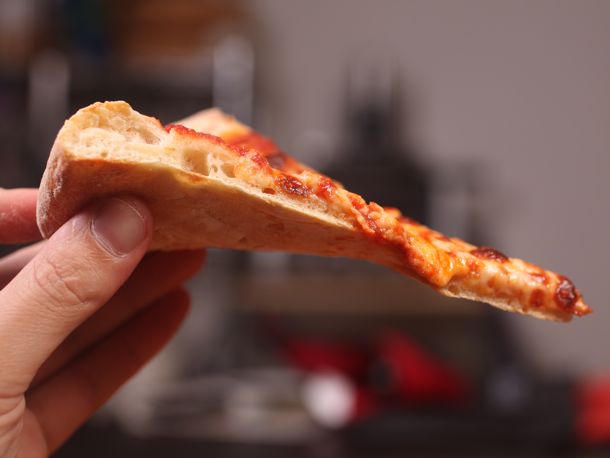
The Modern: New York-Style Pizza Dough
The Skinny:
New York-style pizza dough is an offshoot of Neapolitan-style dough designed to be cooked in a slightly cooler-burning coal-fired (or as is more often the case in modern New York pizzerias, gas-fired) ovens. It's stretched out slightly thicker than a Neapolitan base, though on the scale of pizzas, it's still considered "thin crust."
The crust has to be sturdy enough, but—and this is important—just sturdy enough. Crunchy, tough, or cracker-like are not adjectives that can ever accurately describe a great New York pizza. The slice must crackle and give gently as you fold it, never crack or split. When bent slightly down the center (A.K.A. the "New York Fold"), it should cantilever out straight under its own support.
After the bottom layer of crispness, the next 3-4 millimeters are devoted to a thin layer of soft, slightly chewy, and tender cooked dough. This layer must be as flavorful as the best bread with a savory, wheaty, and complex aroma. The very top 1-2 millimeters of crust—the bit in closest contact with the sauce and cheese—should be a slick, and nearly doughy, though it shouldn't taste raw. This crust-to-sauce interface is one of my favorite parts of the pizza, and should not be taken lightly. Unlike the poofy, leopard-spotted edge of a Neapolitan, a New York pie has a crust that's only slightly raised. It should show some spotting, but in general, will be more of an even golden brown than a Neapolitan.
What Makes It Unique:
New York pizzas take between 12 and 15 minutes to bake. A Neapolitan-style dough would dry out, becoming tough and crackery during this period. New York pizza owes its unique texture and flavor to two key components added to it: oil and sugar. Oil coats individual granules of flour, effectively lowering the total amount of gluten formed and thus creating a more tender finished product, even though it takes a longer time to bake than a neapolitan crust.
Sugar helps the crust to brown more evenly at lower oven temperatures. Without it, you'd end up with a paler, less flavorful crust.
Type of Flour:
Bread flour is best, all-purpose will do just fine.
Mixing Method:
Either the stand mixer or the food processor will do. I prefer the latter, as it develops gluten a bit faster and with New York dough, you can essentially bake it the day after it's made, so no need for the long, slow ferment that best benefits no-knead doughs or stand mixer doughs.
The Ratios (for the nerds):
All-purpose or bread flour: 100%
Sugar: 2%
Salt: 1.5%
Instant yeast: 1.5 %
Olive oil: 5%
Water: 67%
Recipe:
22.5 ounces (about 4 1/2 cups) bread flour, plus more for dusting
.5 ounces (about 1 1/2 tablespoons) sugar
.35 ounces kosher salt (about 1 tablespoon)
.35 ounces (about 2 teaspoons) instant yeast [1 packet dry yeast = 2 1/4 teaspoons]
1.125 ounces Extra Virgin olive oil (about 3 tablespoons)
15 ounces lukewarm water
Combine flour, sugar, salt, and yeast in bowl of food processor. Pulse 3 to 4 times until incorporated. Add olive oil and water. Run food processor until mixture forms ball that rides around the bowl above the blade, about 15 seconds. Continue processing 15 seconds longer.
Transfer dough ball to lightly floured surface and knead once or twice by hand until smooth ball is formed. It should pass the windowpane test. Divide dough into three even parts and place each in a covered quart-sized deli container or in a zipper-lock freezer bag. Place in refrigerator and allow to rise at least 1 day, and up to 5. Remove from refrigerator, shape into balls, and allow to rest at room temperature for at least 2 hours before baking.
Makes enough dough for three 12-inch pies
What’s The Difference Between New York and Neapolitan-Style Pizza?
from https://blog.slicelife.com/
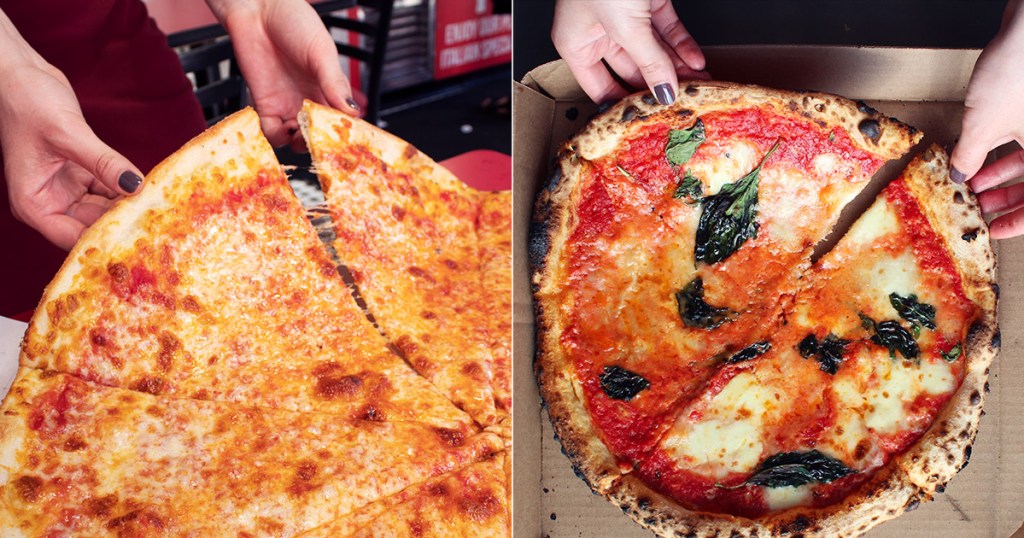
New York-style (left) and Neapolitan (right)
In Italy, pizzas were served as single-serving dishes and intended to be eaten with a fork and knife. Pizza became popular with New Yorkers around the turn of the 20th century, but the city’s working class didn’t always have the time, or money, to enjoy an entire pie. Born out of the legacy of America’s first pizzerias, Patsy’s accommodated the common man by serving individual slices that could be enjoyed on the go. This marked the first major distinction between the two styles, but they would drift even further apart with time:
The Cheese
Early New York pizzerias relied on coal-fired ovens to replicate the high-temperature wood-fired ovens of Italy. But, over time, shops transitioned to gas-powered ovens, which required a change in methodology. Fresh mozzarella was not suitable for the longer cooking times, so chefs replaced it with shredded low-moisture mozzarella. Shredded mozzarella wasn’t in line with Italian tradition, but it had a clear advantage: low-moisture cheese could be used liberally, whereas fresh mozz had to be used lightly to avoid making a pie too soggy. For that reason, Neapolitan pizzas are dotted with gobs of fresh mozzarella, whereas the cheese layer of New York-style pizzas covers the entire pie up to the cornicione.
The Crust
Neapolitan pizza is largely defined by its pillowy, chewy crust. Baked at 700 to 1000° F for 60 to 90 seconds, its crust is lined by a series of dark charred spots and carries a remarkable flavor owing to its highly refined wheat flour base. New York-style pizza, meanwhile, has a much thinner crust with decidedly less chew. It’s a less complex base, but one that’s much better suited to support hefty layers of cheese and toppings.
The Sauce
In Naples, the traditional pizza recipe is upheld by the Associazione Verace Pizza Napoletana, the “Association for true Neapolitan pizza.” Among the many requirements laid out by the VPN’s 11-page manifesto is a mandate to only use tomatoes that are grown and packaged in Italy. The sauce, they say, can only be comprised of tomatoes and salt, allowing the natural acidity of the tomatoes to shine through. But, to achieve balance and add additional flavor, a New York-style pizza sauce includes a dash of sugar, chopped garlic, and herbs such as oregano and red pepper flakes.
Size
In true American fashion, the New York-style pizza eclipses its Neapolitan predecessor. Made as a single-serving dish, the Neapolitan pizza measures roughly 12-inches in diameter. Meanwhile, New York-style pies hover around the 18-inch mark. At that size, the New York-style pizza is designed to be shared, but any pizza can be a personal pizza if you try hard enough.
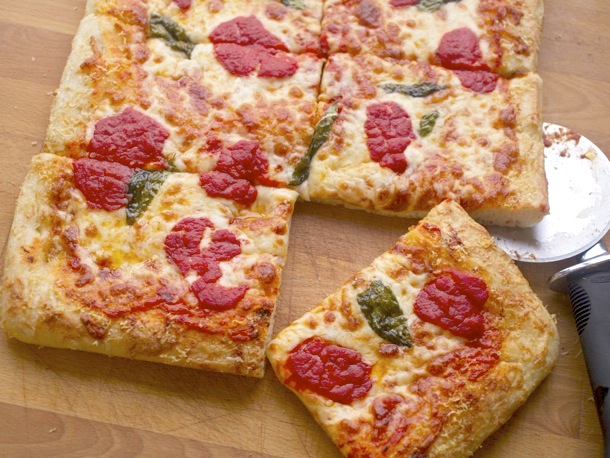
The Best For Parties: Sicilian-style Pizza Dough
from http://slice.seriouseats.com/, by J. Kenji López-Alt
The Skinny:
This is the simplest, most forgiving pie in my arsenal, and the one that I reach for most often when I have company coming over. It's ready to eat within hours of starting, and it doesn't even require any rolling or stretching or messing up your counter. Everything takes place in the bowl of a stand mixer and an oiled sheet tray.
In New York City, it's called Sicilian pizza, and it comes in inch-and-a-half-thick slabs coated with a thick layer of garlic-heavy tomato sauce and melted mozzarella cheese. To a true-blooded Sicilian, the real pizza is sfincione—a thinner, chewier version dotted with salty anchovies and pungent pecorino. Long Islanders refer to square pies Grandma-style (aka nonna-style) pies; chewier, slightly thinner versions of a Sicilian with a garlic-loaded tomato sauce.
In any case, the basic process is the same: make a variant of a New York-style pizza dough, then bake it in a tray loaded with olive oil. As it bakes, the bottom of the pie essentially fries, coming out ultra-crisp and flavorful.
For me, the ideal square pie needs to combine bits of all of these square-pie styles. A soft, moderately chewy, and pliant crust, with a few large bubbles here and there, a distinct sweetness and a fried crispness to the bottom. The end crust should be well-browned with bits of crisp aged cheese, and like in a good New York-style pizza, there should be a thin layer right at the interface between the bread and the toppings where the crumb remains ever-so-slightly doughy and chewy.
For a while I was making my square pie with a cooked potato added to the dough, which added a starchy richness and sweetness to the dough without interrupting gluten formation. These days, I stick with straight flour, making for a much faster, easier finished product, and with this style of pizza, more pie-for-your-time is a good thing.
What Makes It Unique:
With all the oil, crispness, and fryed-ness in this dough, you still develop plenty of flavor even without a slow ferment, which is another thing that makes this dough great for parties. You can start from scratch and have a finished pie in a matter of hours.
The other great thing? With so much water in it (70% hydration!), it basically stretches itself. I mix mine in the stand mixer, dump it into an oiled baking sheet, lightly cover, then wait for it to spread out naturally. All it requires is a bit of stretching by hand at the very end before topping and baking.
Type of Flour:
All-purpose or bread flour. This one is the easiest and most forgiving recipe of all, designed for anyone to make, from really basic pantry staples. No special flour required.
Mixing Method:
A stand mixer makes for the fastest results. It won't work in a food processor as the dough is just a bit too wet and ends up gumming up the works. No-knead methods will work too, but require an 8 to 12 hours of rising.
The Ratios (for the nerds):
All-purpose or bread flour: 100%
Salt: 2%
Instant yeast: 1.5 %
Olive oil: 3%
Water: 70%
Recipe:
Note about Toppings: For a basic topping, roughly puree 1 (28-ounce) can san marzano tomatoes with 1 tablespoon olive oil and kosher salt to taste. Spread 2/3rds of sauce over pizza leaving a 1-inch border all around. Top with half pound grated mozzarella cheese and basil leaves. Drizzle with olive oil before baking and to with grated parmesan as soon as it comes out of the oven.
17.5 ounces (500 grams, about 3 1/2 cups) all-purpose or bread flour
.35 ounces (10 grams, about 2 teaspoons) kosher salt
.18 ounces (5 grams, about 1 teaspoon) instant or RapidRise yeast [1/2 packet dry yeast]
1/2 cup extra-virgin olive oil, divided
12.25 ounces (347 grams, about 1 1/2 cups plus 1 1/2 tablespoons) water, room temperature
Combine flour, salt, yeast, and 2 tablespoons olive oil in bowl of stand mixer (see note for mixer-free version). Whisk to combine. Add water to mixer and mix on medium speed until it comes together and no dry flour remains. Increase speed to medium-high and mix until the dough is stretchy and smooth, about 6 minutes. The dough should stick to the bottom of the bowl but pull away from the sides.
Note: To make without a stand mixer, combine flour, salt, yeast, and olive oil in a large bowl. Whisk to combine, then add water. Stir together vigorously with a wooden spoon until homogeneous, about 3 minutes. Cover bowl with plastic wrap and allow to rest at room temperature for at least 8 hours and up to 15.
Pour remaining olive oil into rimmed baking sheet and spread over entire inner surface with hands. Transfer dough to 13- by 18-inch rimmed baking sheet and rub top surface with oil until thoroughly coated. Cover with baking sheet with plastic wrap and allow to rise at room temperature until dough has spread out to touch nearly each rim of baking sheet, about 2 hours.
30 minutes before baking, adjust oven rack to middle position and preheat oven to 550°F. Carefully remove plastic wrap from pizza dough. Using oiled hands and being as gentle as possible to maintain air bubbles, push and stretch the dough into the corners of the pan by pressing out from the center and lifting each corner and stretching it beyond the edge of the pan. It should pull back until the pan is just filled with dough.
Top pizza as desired (see Note about Toppings above) and bake until bottom is crisp and top surface is bubbling, 15 to 20 minutes total. Allow to cool at room temperature for 5 minutes.
Makes enough dough for one 13- by 18-inch pie
