Homemade Ramen Noodles
recipe by Sonoko Sakai at https://www.bonappetit.com/
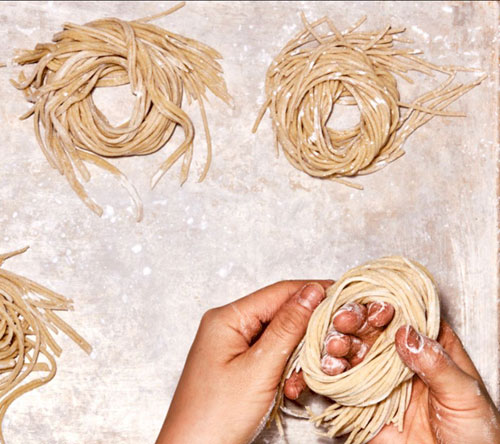
“Many people say that ramen is about the broth,” writes cookbook author Sonoko Sakai. “As a noodle maker, I say the noodles are just as important.” It tracks, then, that we’d go to an expert like Sakai for a lesson in making ramen noodles from scratch. That’s because even if there are plenty of great options for prepackaged dried, refrigerated, frozen, and even instant ramen noodles on the market today, they simply don’t compare to the fresh stuff.
We’ll be honest: Homemade ramen noodles are a lot of work, and Sakai’s recipe requires some elbow grease (kneading by hand!) and special equipment (a pasta maker!), but don’t let that scare you off: It’s worth it, and we’re here to guide you every step of the way.
Light yellow in color and springy in texture, this Japanese noodle’s signature bounce is typically achieved with kansui, an alkaline solution of potassium carbonate and sodium bicarbonate that regulates acidity, stiffening and pigmenting the dough. You can find bottled kansui water at Asian grocery stores, but Sakai uses baked baking soda, which can easily be made at home and has the same alkalinizing effect.
Homemade Ramen Noodles
Adapted with permission from ‘Japanese Home Cooking: Simple Meals, Authentic Flavors’ by Sonoko Sakai. Photograph by Rick Poon. Published by Roost Books. Copyright 2019.
1 cup (266 g) baking soda [recipe only uses 2 tsp.]
4 cups (500 g) all-purpose flour
1½ tsp. Diamond Crystal or ¾ tsp. Morton kosher salt
2 cups (256 g) potato starch or cornstarch
Special Equipment: A pasta maker
Make Baked Baking Soda: Preheat oven to 250°. Spread 1 cup (266 g) baking soda out evenly on a parchment-lined baking sheet and bake 1 hour (baking soda will look exactly the same). Let cool. [NOTE: Recipe only uses 2 tsp.]
An important sciencey note: It will look exactly the same after you’ve baked it, still a fine white powder. You just have to trust that the chemistry worked. If you’re an inherently mistrustful person (I get it), use a scale to weigh your baking soda before and after baking. The weight of the resulting sodium carbonate should be roughly ⅔ of the starting weight, meaning that those extra carbons, oxygens, and hydrogens were successfully expelled as water and CO2.
Place 4 cups (500 g) all-purpose flour in the bowl of a stand mixer. Whisk 2 tsp. baked baking soda, 1½ tsp. Diamond Crystal or ¾ tsp. Morton kosher salt, and 1¼ cups water until baking soda and salt are dissolved. Add to flour in three equal additions, mixing to incorporate with a wooden spoon after each addition. Mix until dough resembles a shaggy ball; knead in bowl just to bring dough together. Cover with plastic wrap and let sit at room temperature 30 minutes. (The dough will look a bit dry, but it will relax and hydrate with time.)
Turn dough out onto a surface and knead until smooth and bouncy, about 5 minutes. Return to bowl and cover with plastic wrap or place in an airtight container. Let rest at room temperature at least 3 hours, or chill up to 12 hours. (If chilling, let dough come to room temperature before making noodles.)
Cut dough into 6 equal strips (about 123 g each). Working one at a time, flatten strips with your hands until just slightly narrower than the width of the pasta maker. Dust dough evenly and generously on both sides with some of 2 cups (256 g) potato starch or cornstarch to prevent dough from sticking. Roll dough through pasta maker 2 times per setting, starting with the widest setting and narrowing until ⅛" thick. (The dough may feel dry and break apart in the beginning, but don’t get discouraged. Simply fold it onto itself and pass it through the machine again.) Cut sheets of rolled dough into 1-ft.-long pieces.
Dust sheets of dough with a generous amount of starch and run each through pasta maker on spaghetti setting, gently wrapping noodles around your hand to form a loose bundle as they exit. Carefully set bundles on a parchment-lined baking sheet and sprinkle with more starch to keep noodles from sticking together.
Do ahead: Baking soda can be baked 1 year ahead; transfer to a jar with a tight-fitting lid and store in a cool place. Noodles can be made 2 days ahead; tightly wrap and chill.
6 servings
