Blawmanger
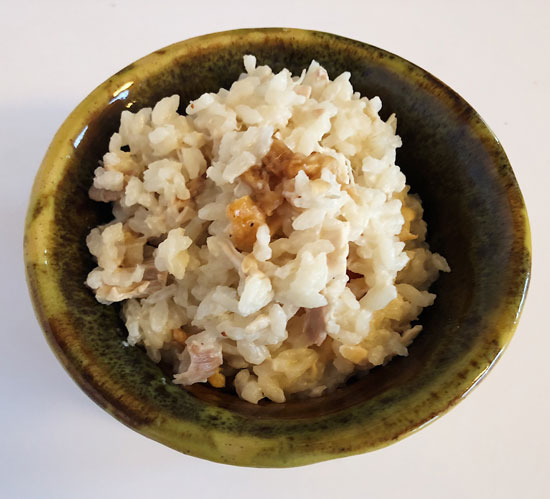
Blawmanger, or blancmange, has a remarkably long history with numerous extant recipes dating back to the thirteenth century. It was a dish that seemed to know no national boundaries. Recipes were included in cookery texts written in every European language. Early versions usually contained minced capon breast, or even fish (or fish spawn) on days when meat was outlawed. Its other common ingredients were rice, almonds, milk or cream, rosewater and sugar. It could be a bland food for invalids or an ornamented dish for gracing the tables at major state events.
There is no clear or precise record of when this dish was invented, though some sources suggest it might have roots in 8th or 9th century Tarragona (Catalonia). Simply named “white dish,” it spread quickly throughout Europe and parts of the Islamic world, usually taking on forms of the French title blanc mengier.
The earliest versions of this recipe call for rice, almond milk and white meat like chicken and capon or pike on meatless “fysch” days. Depending on where you were, the almond milk might be made the usual way with almonds and sweetened water, but was also made savory by steeping the almonds in chicken stock instead. The meat was usually poached and either added directly to the rice during the cooking process or mixed in before serving. The French version was usually less sweet than that of the English, who also liked to garnish with toasted almonds. Italians added rosewater, spices like ginger and cinnamon, or rice flour and Germans were known to color it with violets.
Rice was a luxury item imported from the Middle East and later grown in Italy and Spain, so in the 14th century it was typically only enjoyed by the upper classes who could afford the ingredients. Because of blank maunger’s health properties, soft texture and gentleness on the stomach, it was originally associated with invalids or with people who had special dietary needs.
Much has been written about blancmange, mainly regarding its history in the medieval and early modern period. But very little is ever said about a close relative called jaunmange or jaune mange, a dish, which despite its French name, seems to be an entirely English creation. As its name suggests, it is yellow in colour due to the inclusion of egg yolks in the composition. There are many later recipes for Jaune Mange. The earliest printed recipe the writer knows of at this time is in Charlotte Mason, The Lady's Assistant (London; 1773). Both English and American recipe collections in the nineteenth century frequently include at least one. J. H. Walsh in The British Cookery Book (London: 1864) gives three.
In eighteenth century Britain, where the chicken breast and rice started to be omitted in the early eighteenth century, the dish was more usually thickened with isinglass. By the second half of the eighteenth century blancmange borrowed the name of a native set pudding called flummery, which was originally congealed with oatmeal. In the culinary literature of this period the terms flummery and blancmange are usually interchangeable. Flummeries and blancmanges were frequently allowed to cool in moulds and turned out in a remarkable variety of decorative forms, with an important industry producing both wooden and ceramic moulds for making them in.
Also see Blanc-Manger: A Journey Through Time.
The recipe below is from http://www.godecookery.com/goderec/goderec.htm , James Matterer's collection of medieval recipes
PERIOD: England, 14th century | SOURCE: Utilis Coquinario | CLASS: Authentic
DESCRIPTION: Traditional medieval rice dish
Judging by the many versions of this recipe that appear in period cookbooks, it is certain that most (if not all) medieval cooks were at least familiar with this dish. By the strictest definition, Blawmanger (also known as blankmanger) is any bland, white pottage based on almond milk, and (except for a few fish-day versions) contains ground poultry, thickened with rice flour; the standard English flesh-day version was ground capon (or chicken) with rice and almond milk. In some recipes the poultry is in chunks, rather than ground up. Today's modern blancmange is a type of rice-pudding dessert, much beloved by the English, and only bears a slight resemblance to its medieval forerunner.
ORIGINAL RECEIPT:
28. Blawmanger. Tak þe two del of rys, þe thridde pert of almoundes; wash clene þe rys in leuk water & turne & seth hem til þay breke & lat it kele, & tak þe melk & do it to þe rys & boyle hem togedere. & do þerto whit gres & braun of hennes grounde smale, & stere it wel, & salte it & dresch it in disches. & frye almaundes in fresch gres til þey be browne, & set hem in þe dissches, & strawe þeron sugre & serue it forth.
- Hieatt, Constance B. and Sharon Butler. Curye on Inglish: English Culinary Manuscripts of the Fourteenth-Century (Including the Forme of Cury). London: For the Early English Text Society by the Oxford University Press, 1985.
GODE COOKERY TRANSLATION:
Blancmange. Take two parts of rice, the third part of almonds; wash the rice clean in lukewarm water & turn & boil them til they break and let cool, & take milk and add to the rice and boil together. Add white grease & ground dark chicken meat, & stir well, & salt it and place it in dishes. Fry almonds in fresh grease until brown, & set them in the dishes, and strew on sugar & serve it.
MODERN RECIPE:
- 1 cup rice
- 3 cups Almond Milk
- 1 cup ground cooked chicken, dark meat only
- dash salt
- 1/4 cup fried slivered almonds
- sugar to garnish
Bring to a boil the rice, milk, & salt. Reduce heat, stir in chicken, & cover; allow to cook, stirring occasionally, until liquid is absorbed and rice is fluffy. Garnish with almonds and a sprinkle of sugar.
Other Recipes:
A recipe from The Forme of Cury for Blank Maunger. This is a page from a c.1420s version of the text - courtesy John Rylands Library, University of Manchester. The original text dates from the 1390s. This early English recipe, just like its continental cousins includes shredded capon's breast. Here is a transcription,
Blank Maunger. XXXVI. Take Caponis and seeþ hem, þenne take hem up. take Almandes blaunched. grynd hem and alay hem up with the same broth. cast the mylk in a pot. waisshe rys and do þerto and lat it seeþ. þanne take brawn of Capouns teere it small and do þerto. take white grece sugur and salt and cast þerinne. lat it seeþ. þenne messe it forth and florissh it with aneys in confyt rede oþer whyt. and with Almaundes fryed in oyle. and serue it forth.
Blank Maunger. Take capons and boil them, then take them up. Take blanched almonds, grind them and combine them with the same broth. Put the milk in a pot. Wash rice and add and let it cook. Then take meat of capons, tear it small and add. Take white grease sugar and salt and cast therein. Let it cook. Then mess it forth and garnish it with anise in comfit red or white (sugared anise seeds) and with almonds fried in oil and serve it forth.
For to Make Blank Maunger XXIXXII. Put Rys in water al a nyzt and at morowe waisshe hem clene, afterward put hem to þe fyre fort þey berst & not to myche. ssithen take brawn of Capouns, or of hennes. soden & drawe it smale. after take mylke of Almandes. and put in to þe Ryys & boile it. and whan it is yboiled put in þe brawn & alye it þerwith. þat it be wel chargeaunt and mung it fynelich’ wel þat it sit not to þe pot. and whan it is ynowz & chargeaunt. do þerto sugur gode part, put þerin almandes. fryed in white grece. & dresse it forth.
To Make Blank Maunger. Put rice in water in the night and in the morning wash them clean, afterward put them on the strong fire until they burst but not too much. Then take meat of capons, or of hens. Cut them small. After take milk of almonds and put in the rice and boil it. And when it is boiled put in the meat and cook so that it will be very thick and stir very well that it does not stick to the pot. And when it is done and thick, add a good part of sugar, put in almonds fried in white grease and dress it forth.
Source [Two Fifteenth-Century Cookery-Books, T. Austin (ed.)]
lxxxij - Blamang. - Take Rys, an lese hem clene, and wasshe hem clene in flake Water, and than sethe hem in Watere, and aftyrward in Almaunde Mylke, and do ther-to Brawn of the Capoun aftyrward in-to a-nother almaunde Mylke, an tese it smal sumdele with a pyn, an euer as it wolt caste ther-to, stere it wel; nym Sugre and caste ther-to, then make it chargeaunt; then take blawn-chyd Almaundys, an frye hem, an sette hem a-boue, whan thou seruyst ynne; and 3if thou wolt, thou my3te departe hem with a Cawdelle Ferry y-wreten before, an than serue forth.
Source [Two Fifteenth-Century Cookery-Books, T. Austin (ed.)]
Blamanger. Take faire Almondes, and blanche hem, And grynde hem with sugour water into faire mylke; and take ryse, and seth. And whan they beth wel y-sodde, take hem vppe, and caste hem to the almondes mylke, and lete hem boile togidre til thei be thikk; And then take the brawne of a Capon, and tese hit small, And caste thereto; and then take Sugur and salt, and caste thereto, and serue hit forth in maner of mortrewes.
Here is an a English recipe from the 14th century MS Sloane 468 known as Utilis Coquinario:
28. Blawmanger. Tak the two del of rys, the thridde pert of almoundes; wash clene the rys in leuk water & turne & seth hem til thay breke & lat it kele, & & tak the melk & do it to the rys & boyle hem togedere. & do therto whit gres & braun of hennes grounde smale, & stere it wel, & salte it & dresch it in disches. & frye almaundes in fresch gres til they be browne, & set hem in the dissches, & strawe theron sugre & serue it forth
28. Blawmanger. Take two portions of rice, the third part of almonds; wash the rice clean in lukewarm water and turn and cook them until they break and let it cool, and take the milk and add to the rice and boil them together. And add white grease and meat of chicken cut small, and stir it well, and salt it and dress it in dishes. And fry almonds in fresh grease until they are brown and set them in the dishes, and sprinkle on sugar and serve it forth.
