Bukkenade
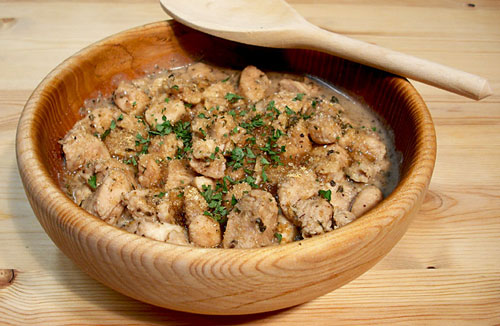
Henne In Bokenade
A dish of this sort was very popular in Medieval England, with Bokenade originally being a dish of stewed veal – later the idea came to include other meats, such as chicken. It is normally placed as a ‘side dish’ to the main roast meats of the first course, or in larger quantities, used as a main dish itself within a course. In esssense a Bokenade (or Buknade) is a gently spiced and thickened stock (broth) with pieces of meat.
There seems to be two different ways to create Bukkenade, which is a potage made of some type of boiled meat, is spiced and and the broth thickened. All recipes add some sort of powdered spice mixture. Ginger, mace and cloves are the most popular spices. Of the eight recipes below, three recipes add onions and four add herbs (only one recipe adds both). Here's where the differences start. The earliest recipes represent one type which is thickened with eggs (5 of the 8 recipes listed below); the other type is made with almond milk (3 of the recipes) and thickened with rice flour or amydon. Two made with almonds or almond milk add lard or grease; the other adds "stiff mylke." One of those made with the egg thickener adds verjuice. One made with almonds adds currants.
To draw some conclusions from this, bukkenade is a potage of boiled meat, spiced with sweet spices (ginger, etc.), and is generally thickened with eggs. Onions and herbs can be added for additional flavor. Bukkenade can also be made with almonds or almond milk for fast days. Grease or lard should be added; onions and herbs can be added for additional flavor.
Ancient Cookery. A. D. 138
XLV. FOR TO MAKE BUKKENADE [1].
Nym god fresch flesch wat maner so yt be and hew yt in smale morselys and seth yt wyth gode fresch buf and cast thereto gode mynced onyons and gode spicerye and alyth [2] wyth eyryn and boyle and dresse yt forth.
[1] Vide No. 52. [2] Stiffen, thicken it.LII. FOR TO MAKE A BUKKENADE.
Tak veel and boyle it tak zolkys of eggys and mak hem thykke tak macis and powdre of gyngyner and powder of peper and boyle yt togeder and messe yt forth.
The Forme of Cury (by Samuel Pegge) original text from about A.D. 1390
Bukkenade. Take Hennes oþer Conynges oþer Veel oþer oþer Flessh an hewe hem to gobettes waische it and hit well. grynde Almandes unblaunched. and drawe hem up with þe broth cast þer inne raysons of Corance. sugur. Powdour gyngur erbes ystewed in grees. Oynouns and Salt. If it is to to thynne. alye it up with flour of ryse oþer with oþer thyng and colour it with Safroun.
Modern English
Bukkenade (a thick and meaty stew). Take hens other (or) Rabbits (or) veal or other flesh and chop it to peices, wash it and hit well (possibly meaning to pound the meat). Grind unblanched almonds and draw them up with the broth, cast therein raisins of curance (dried currants), sugar, powdered ginger, herbs stewed(fried) in grease, onions and salt . If it is too thin, bind/thicken it up with rice flour (or other things) and colour it with saffron
Two Fifteenth-Century Cookery-Books, T. Austin (ed.), 1430
xxvj Vele, kede, or henne in Bokenade. Take Vele, Kyde, or Henne, an boyle hem in fayre Water, or ellys in freysshe brothe, an smyte hem in pecys, an pyke hem clene; an than draw the same brothe thorwe a straynoure, an caste ther-to Percely, Sawge, Ysope, Maces, Clowys, an let boyle tyl the flesshe be y-now; than sette it from the fyre, and a-lye it vp with raw 3olkys of eyroun, and caste ther-to pouder Gyngere, Veriows, Safroun, and Salt, and thanne serue it forth for a gode mete.
Two Fifteenth-Century Cookery-Books, T. Austin (ed.), Harleian MS. 4016, 1450
Buknade. Take veel, keed, or hen, and boyle hem in faire water or elles in good fressh broth, and smyte hem in peces, and pike hem clene; And drawe the same broth thorgh a streynour, And cast there-to parcelly, Isoppe, Sauge, Maces and clowes, And lete boyle til the flessh be ynogh; and then set hit fro the fire, and aley hit vp with rawe yolkes of eyren, and caste thereto pouder ginger, and vergeous, and a litel saffron and salte, and ceson hit vppe and serue it forth.
Two Fifteenth-Century Cookery-Books, T. Austin (ed.), Harleian MS. 4016, 1450
Auter maner buknade. Take rawe Almondes, and blanche hem, and grynde hem, and draw hem thorgℏ a streynour with fressℏ broth and wyne into good stiff mylke; And then̄ take veel, kede, or hen̄, and parboile hem in fressℏ brotℏ, and pike hem clene, and cast him thereto; take Clowes, maces, and herbes, and lete hem boile ynowe; And then̄ caste a lituƚƚ Sugur, pouder ginger, and salt, and serue him fortℏ.
A Noble Boke off Cookry, Probable date: 1467
To mak Buknad
To mak buknad tak vele smale and vele par- boiled then gader up the flesh and fireyn the broth through a stren and put it in to the pot and sett it on the fyer and put ther to onyons mynced pouder of pepper powder of cloves and canelle and in the boil- ing put in the fleshe then tak raw yolkes in a bolle and cast ther to the het brothe and mele it well to gedere and in the setting downe put in the egg and stirr it to geder in the setting down and geve it a litill color of saffron and salt it and serue it.
Buknard
To mak Buknard tak almond mylk and colour it with saffron and fers it with pouder then tak lard of pork well sodene and hewe it small and put them to the mylk and alay it with flour or with amydon and boile it well and florishe it withe pouder and colour it with sanders and serue it.
Redaction:
There are a number of medieval recipes for this dish. This is a version of the more common ones, using beef instead of veal. The result is a pleasantly different and spicy stew, perfect for dunking slices of bread. This recipe seems to be based on the Buknade recipe from Two Fifteenth-Century Cookery-Books.
If hyssop is unavailable, leave it out. If verjuice is unavailable, use 1/4 cup wine and 1/8 cup lemon juice
2-3 lbs. beef, cut into cubes
1 Tbsp. parsley
1 tsp. sage
1 tsp. hyssop
1/2 tsp. cloves
1/4 tsp. mace
4 egg yolks
3/8 cups verjuice
1/2 tsp. ginger
1 tsp. salt
pinch saffron
Put the beef into a large pot along with water to cover - about 8 cups. Bring to a boil, reduce heat, and simmer for 30 minutes. Skim off and discard any scum that forms on the surface. Add parsley, sage, hyssop, cloves, and mace. Stir well and simmer for another 30 minutes, or until the beef is tender. Temper the egg yolks in a separate bowl by slowly whisking in a cup or two of the broth from the pot. Add the remaining ingredients to the pot along with the egg mixture and stir. Remove from heat when as soon as it comes back to a boil.
