Caudell
Caudell is a warm, frothy wine or ale-based drink thickened with eggs and spiced with sugar and saffron that recurred in various guises throughout British cuisine from the Middle Ages into Victorian times. It was thick and sweet, and seen as particularly suitable and sustaining for invalids and new mothers. At some periods of history, caudle recipes were based on milk and eggs, like eggnog. Later variants were more similar to a gruel, a sort of drinkable oatmeal porridge. Like the original forms of posset (a drink of wine and milk, rather than a set dessert), a caudle was usually alcoholic.
The earliest surviving recipe for caudle, from 1300–1325, is simply a list of ingredients: wine, wheat starch, raisins, and sugar to "abate the strength of the wine". Another recipe from the late 14th century has more ingredients and more details on the cooking procedure: mix breadcrumbs, wine, sugar or honey, and saffron, bring to a boil, then thicken with egg yolks, and sprinkle with salt, sugar, and ginger. A 15th-century English cookbook includes three caudle recipes: ale or wine is heated and thickened with egg yolks and/or ground almonds, then optionally spiced with sugar, honey, saffron, and/or ginger (one recipe specifically says "no salt"). In a description of an initiation ceremony at Merton College, Oxford in 1647, caudle is described as a "syrupy gruel with spices and wine or ale added". William Carew Hazlitt provides a number of recipes for caudles and possets in his 1886 book, Old Cookery Books and Ancient Cuisine.
During the Lenten season (from Ash Wednesday until Easter), dairy, eggs and meat animals were forbidden from consumption. Frequently, many conventional receipts from the period have Lenten substitutions using almond milk. The Harleian Manuscripts have two beer caudle recipes that use almonds. While some of the other caudle receipts that use almonds state they are for Lenten use, these two beer caudles do not.
Caudle seems to have been a recipe for comforting: a caudle receipt in The Good Husvvifes Iewell (Thomas Dawson, 1596) is one called "To Make a Caudle to Comfort the Stomacke, Good For An Old Man" (of ale, Muscadine wine, eggs and mace).
Caudles were popular and receipts for caudles appear in the Harleian Manuscripts, manuscripts in the possession of the Royal Society, Liber Cure Curcorum, Le Viandier, A Noble Boke of Cookery, and The Good Husvvifes Iewell. There may be other sources. Hot alcoholic beverages such as syllabubs and possets, as well as sack, toddies and others were also common.
Flemish Caudle
From Le Viandier de Guillaume Tirel dit Taillevent, 1395, page 290, #92, as translated by Terrence Scully
Chaudeau Flament: Flemish Caudle. Set a little water to boil; then beat egg yolks, without the whites, mix them with white wine and pour gradually into your water when it has boiled and cooled a little; then boil it again, watching that it does not burn stirring.
Redaction
1/2 cup water
1/2 cup white wine
3 egg yolks
salt
Take the water and put it on the fire. Take the egg yolks and beat them. Add the wine to the egg yolks, and beat it some more. When the water boils, take it off the heat, and let it cool a bit, then add the wine mixture into the water, stirring it constantly with a whisk. Heat the combined mixture slowly, stirring constantly. When it starts to boil again, take off the heat, add a dash of salt, stir to dissolve the salt, and serve it forth.
ORIGINAL RECEIPT: Harleian MS 4016
PERIOD: England, 15th century
Caudell. Take faire tryed yolkes of eyren, and cast in a potte; and take good ale, or elles good wyn, a quantite, and sette it ouer þe fire / And whan hit is at boyling, take it fro the fire, and caste þere-to saffron, salt, Sugur; and ceson hit vppe, and serue hit forth hote.
- Austin, Thomas. Two Fifteenth-Century Cookery-Books. Harleian MS. 279 & Harl. MS. 4016, with extracts from Ashmole MS. 1429, Laud MS. 553, & Douce MS 55. London: for The Early English Text Society by N. Trübner & Co., 1888.
GODE COOKERY TRANSLATION:
Take fair tried yolks of eggs, and cast in a pot; and take good ale, or else good wine, a quantity, and set it over the fire / And when it is boiling, take it from the fire, and cast there-to saffron, salt, Sugar; and season it up, and serve it forth hot.
MODERN RECIPE:
Egg yolks - "faire tryed yolkes" means yolks separated from the whites.
Ale or wine - use fresh ale (not flat) or a slightly sweet red or white wine.
Saffron
Salt
SugarBeat together the egg yolks and wine/ale; place in a pot over medium to high heat. Bring to a boil while continually stirring with a wire whisk. As the mixture heats up, it will begin to become thick & frothy. (Add more egg yolks if needed - the more egg, the thicker & frothier the result. You want the consistency of a well-whipped milkshake.) As soon as it comes to a boil, reduce heat. Beat in sugar to taste, saffron, and a dash of salt. Taste for seasoning and adjust as needed. Serve at once in small bowls or as a drink in glasses.
Cawdelle Ferry
From Two Fifteenth Century Cookery-Books, Harleian MS. 279 (ab. 1430), p. 15, #47
Cawdelle Ferry. Take yolkys of eyroun Raw, y-tryid fro the whyte; than take gode wyne, and warme it on the potte on a fayre Fyre, an caste ther-on yolkys, and stere it wyl, but let it nowt boyle tylle it be thikke; and caste ther-to Sugre, Safroun, & Salt, Maces, Gelofres, an Galyngale y-grounde smal, & flowre of Canelle; & whan thow dressyst yn, caste blanke pouder ther-on.
Cawdel out of Lente
From Two Fifteenth Century Cookery-Books, Harleian MS. 279 (ab. 1430), p. 33, # 150
Take & make a gode mylke of Almaundys y-draw vppe with wyne of Red, whyte is beterre; if it schal be whyte, then strayne yolkys of Eyroun ther-to a fewe. Put ther-to Sugre & Salt, but Sugre y-now; then when it begynneth to boyle, sette it out, & almost flatte; serue it then forth, & euer kepe it as whyte as thou may, & at the dressoure droppe Alkenade ther-on, & serue forth; & if thou wylt haue hym chargeaunt, bynd hym vppe with fflour [of] Rys, other with whetyn floure, it is no fors. And if thou wolt, coloure hym with Safroun, & straw on pouder y-now, & Sugre y-now, & serue f[orth].
Caudell Ffery
From Two Fifteenth Century Cookery-Books, Harleian MS. 4016 (ab. 1450), p. 91
Take rawe yolkes of eyren and trie hem, and bake hem; and take good wyne, and warme hit ouer the fire in a potte, And cast there-to the yolkes, and stere it well, butt lete hit not boyle til hit be thikke; and then caste there-to sugur and salt, and serue hit forth as mortrewes.
Caudale
From Two Fifteenth Century Cookery-Books, Laud MS. 553, p. 113
Caudele. Nym eyren, & sweng wel to-gedere / chauf ale & do therto / lie it with amydon, do therto a porcion of sugur, or a perty of hony, & a perti of safron); boille hit, & 3if hit forth.
Kaudel Ferre
From Curye on Inglysch: English Culinary Manuscripts of the Fourteenth Century (Including the Forme of Cury), Diuersa Cibaria, p. 45/I, #5
Wyn, amnidoun, reysyns withoute stones to don thrin, sucre vort abaten the streinthe of the wine.
Cawdel Ferry
From Curye on Inglysch: English Culinary Manuscripts of the Fourteenth Century (Including the Forme of Cury), Forme of Cury, p. 107/IV, #43
Take flour of payndemayn and gode wyne, and drawe it togydre; do therto a grete quantite of sugur cypre, or hony claryfied; and do therto safroun. Boile it, and whan it is boiled, alye it vp with yolkes of ayren, and do therto salt, and messe it forth. And lay theron sugar and powdour gynger.
To make a Cawdle for restoritie.
From The Complete Receipt Book of Ladie Elynor Fetiplace, Vol 3, p. 4
Take ale & set it on the fire, and scum it, then put in some sugar to it, & stir it togither till it bee cold, inough to drink, then have two eggs ready beaten whites & yolks, altogither, & put into the ale, & boile some reasins of the sun in red wine, the stones pulled out, & when you put your eggs into the ale, strain the iuice of the reasins in with it, & stir it well togither, & so drink a good draught, three mornings togither, fasting.
To make a Caudle
From The Good Housewife's Jewel by Thomas Dawson (c. 1596) with an introduction by Maggie Black, p. 123
Take a pint of malmsey and five or six eggs, and seethe them, strained, together. So sodden, stir it till it be thick. Lay it in a dish as you do please and so serve it.
To Make a Caudle of Oatmeal
From The Good Housewife's Jewel by Thomas Dawson (c. 1596) with an introduction by Maggie Black, p. 123
Take two handfuls or more of great oatmeal and beat it in a stone mortar, well. Then put it into a quart of ale,and set it on the fire and stir it. Season it with cloves, mace, and sugar, beaten, and let it boil till it be enough. Then serve it forth upon sops.
Caudell Fery
From An Ordinance of Pottage: An Edition of the Fifteenth Century Culinary Recipes in Yale University's MS Beinecke 163, p. 63, #84
Draw yolkes of eyron thorow a streynour. Take a thyn mylke of almondes drawyn with bastard or with osey or with sweet wyn. Set hit on the fyre; stere hit well. When hit ys at the boylyng, have yolks of eyron in a bolle, drawn thorow a streynour; let wyn thereto, & stere evermore welle of quellyng, tyl hit be aleyed so that hit be stondyng. If ought lef of the wyn, kepe hit. Put thy caudell into the pott, & yf hit be nede, set hit on the fyre, sterying alwey; and make hit nowghte to hote for quellyng. Yf hit be to chargeaunt, aley hit with the remenant of the wyn. Dresse hit as a stondyng pottage, and strew on blaunch poudyr. Thu mayst, yf thu wilt, draw payndemayn & make hit up on the same maner. Or thu maysy, yf thu wilt, set clene wyne at the fyre; & when hit ys at boylyng, have yolkes of eyron drawn thorow a streynour inot a bolle. Put wyne therto, sygure & safron: loke hit be stondyng. Serve hit, & strew on blaunch poudyr.
ORIGINAL RECEIPT: An Ordinance of Pottage
83. Caudell. Draw yolkes of eyron thorow a streynour with wyne or with ale, that hit be ryght rennyng; put therto sigure, safron, & no salt. Bet well togedyr; set hit on the fyre on clene colys. Stere welle the bottom & the sydys tyl hit be ynowghe scaldyng hote; thu shalle fele be the staffe when hit begynnys to com. Then take hit of and styre alwey fast, & yf be nede, aley hit up with som of the wyne; or yf hit com to hastyly, put hit in cold watyr to myd syd of the pot, & stere hit alwey fast; & serve hit forth.
- Hieatt, Constance B. An Ordinance of Pottage. An Edition of the Fifteenth Century Culinary Recipes in Yale University's MS Beinecke 163. London: Prospect Books Ltd, 1988.
GODE COOKERY TRANSLATION:
Caudle. Beat egg yolks with wine or ale, so that it is runny; add sugar, saffron, but no salt. Beat well together; set it on the fire on clean coals. Stir well the bottom & the sides until just scalding hot; you will be able to tell when it becomes fluffy. Then take it and stir away fast, & if you need, add more wine; or if it rises too quickly, put it in cold water to the middle of the outside of the pot, & stir it away fast; and serve.
MODERN RECIPE:
5 egg yolks
2/3 cup white wine
sugar to taste
pinch saffronIn a pot, beat together the yolks, wine, sugar, and saffron. Heat the mixture over a medium flame, stirring continually, until the caudle is hot and thick & fluffy. Be careful to not let it burn or scorch or stick to the pot. Serve at once, in small glasses as a drink, or as sauce with desserts. It makes an excellent accompaniment to Payne Foundow, served on the side as a drink or poured over as a sauce.
The amount of sugar used will depend on the type of wine used. I prefer using an inexpensive sweet wine, as the taste of an expensive dry or semi-sweet will be lost. In fact, it has seemed to me that the cheaper & sweeter the wine, the better is the final result! Add just enough sugar to mellow the taste.
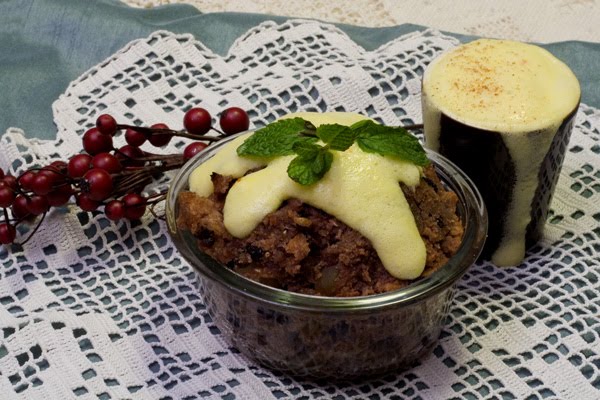
Recipe from http://tastytrix.blogspot.com/
To be honest, I can't remember where I saw this drink referred to as the medieval version of eggnog (though I am certain I did); it's actually frothy white wine or ale thickened with egg yolks, sugar, and saffron. The first time I made it, I didn't get the comparison at all. For one thing, I hardly used any sugar because I don't generally prefer sweet alcoholic beverages. But the result, to me, tasted of strong hot wine and eggs, kind of like spiked egg beaters - not exactly the stuff that pleasant holiday memories are made of, if you ask me.
So I tried it again with more sugar, and this time, it all made sense. I could taste the wine, but it was mellowed by the sugar, and there wasn't any egg-y aftertaste. Caudell can double as a sauce for desserts, such as on medieval bread pudding. I think I've come up with the right proportions, but of course you should adjust it to taste. A little goes a long way
2 egg yolks
Just under 1/3 cup sweet white wine
1/2 -3/4 tbsp sugar, depending on how sweet you'd like it
Grated nutmeg, for garnish
Mix the wine, egg yolk, and sugar in a saucepan. Over medium low heat, whisk continuously until the mixture gets frothy and thick. You'll know when it's ready, because if you have to ask - it's not. Don't stop whisking for a second for fear it will burn or scald!
And it's that simple. You definitely want to drink this while it's still hot.
