English King's & Queen's Coronation & Wedding Banquets
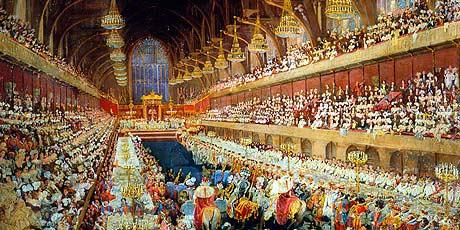
Painting of George IV's coronation banquet in Westminster Hall, 1821
From 1189 to 1821, Westminster Hall was the traditional venue for coronation banquets honouring newly-crowned monarchs. The earliest recorded being those of Prince Henry (crowned in the lifetime of his father, Henry II) in 1170 and of Richard the Lionheart in 1189. The monarch sat on the marble throne at the end of the Hall and was presented with the coronation regalia, and was subsequently borne in procession to Westminster Abbey.
Queens' coronation feasts:
Queens crowned separately from their husbands also had coronation feasts, from Eleanor in 1236 to Anne Boleyn in 1533. By 1377, Westminster Hall had replaced the Lesser Hall (a ceremonial chamber in the medieval palace) as the venue for coronation preliminaries.
Attendants:
Many features of these banquets persisted from early times until that of George IV, the last to be held in the Hall. Music was usually played by the king's minstrels. The citizens of London acted as butlers to the King at every feast, from Richard I to George IV. The Earl Marshal always rode about on his horse keeping order, and he was sometimes accompanied by other officials on horseback.
Richard III's coronation, 1483:
However, one change over the centuries was a probable decline in the numbers taking part from the 3,000 or so fed at Richard III's coronation. As the only surviving royal feast, the coronation banquet also became more of a spectacle, with new galleries built for invited guests.
The King's Champion:
During these banquets, it was traditional for the king's champion to ride into the hall in full armour and challenge anyone to deny the King's right to succeed. This position has been held for over 600 years by the Dymock family; they still hold it today, although they have not been called upon to perform this ceremony since George IV's coronation in 1821.
Too Expensive:
His successor William IV abandoned the coronation banquet altogether in 1830 because he felt that it was too expensive, a precedent followed by all his successors. The presentation of regalia and the procession from the Hall to the Abbey disappeared along with the banquet.
Coronation Menus
The Coronation of Henry IV, 1399
The Coronation of Henry VI, 1429
The Nuptial Table of Henry VII (1486)
The Coronation of Henry IV, 1399
Henry IV was crowned at Westminster in 1399, and what a feast was had! The service of food was quite different in the 14th century. There were three courses at elaborate affairs, with a huge number of dishes in each course, but without any clear distinction between savoury and sweet. The general trend was from the bigger dishes in the first course to the smaller more delicate in the third. Different tables would have received different selections, depending on rank.
The first course:
Braun en peuerarde. (Brawn in a sort of spiced wine pottage).
Viaund Ryal. (A soup of almond milk, wine, and spices)
Teste de senglere enarme. (Boar’s head with tusks)
Graund chare. (Large roasts)
Syngnettys. (Cygnets)
Capoun de haut grece. (Capons, larded)
Fesaunte. (Pheasant)
Heroun. (Heron)
Crustade Lumbarde. (A sort of savoury custard pie with marrow and dried fruit)
Storieoun, graunt luces. (Sturgeon, large pike)
A Sotelte. (A “subtlety” or decorated symbolic piece)
The second course.
Venyson en furmenty. (Venison with Frumenty)
Gely. (Jelly or Aspic)
Porcelle farce enforce. (Stuffed Sucking Pig)
Pokokkys. (Peacocks)
Cranys. (Cranes)
Venyson Roste. (Roast Venison)
Conyng. (Rabbit)
Byttore. (Bittern)
Pulle endore. (Gilded chickens)
Graunt tartez. (Great tarts with game, birds, etc, marrow, spices and eggs)
Braun fryez. (Brawn cooked in a sweet batter)
Leche lumbarde. (A paste of dates, wine, and spices, in slices)
A Sotelte. (A “subtlety” or decorated symbolic piece)
The third course.
Blaundesorye. (A white soup)
Quyncys in comfyte. (Preserved quinces)
Egretez. (Egrets)
Curlewys. (Curlews)
Pertryche. (Partridge)
Pyionys. (Pigeons)
Quaylys. (Quails)
Snytys. (Snipe)
Smal byrdys. (Small birds)
Rabettys. (Young Rabbits)
Pome dorreng. (Meatballs, cooked in a golden batter)
Braun blanke leche. (Brawn cooked with almond milk)
Eyroun engele. (Jellied Eggs)
Frytourys. (Fritters)
Doucettys. (Small cheesecakes)
Pety perneux. (Small tarts)
Egle. (Hedgehog??)
Pottys of lylye. (Pots of Lilies??)
A Sotelte. (A “subtlety” or decorated symbolic piece)
What to choose from such a feast? Some of the ingredients would be impossible to come by today – there is not too much bittern and crane at the butchers nowadays. Some dishes – the sweetened meat dishes for example – would probably not suit most modern palates. There are a few however that sound delicious, and could easily appear at a modern dinner party.
The Coronation of Henry VI, 1429
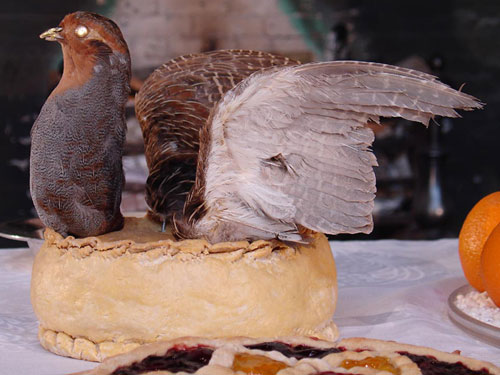
Partridge pie. Among the other delicacies served at the eight year old Henry's feast in Westminster Hall
were "Partryche and Pecock enhackyll". The latter was a cooked peacock mounted in its skin.
Soteltes at the Coronation Banquet of Henry VI
by: John Lydgate (Author), Claire Sponsler (Editor)
from: Mummings and Entertainments 2010
The only child of Henry V, he succeeded to the English throne at the age of nine months upon his father's death. His coronation took place when he was 8 years old.
Sometime before November 6, 1429, Lydgate was apparently commissioned to write verses to accompany the subtleties served at the coronation banquet of Henry VI. Although the verses are not attributed to Lydgate in the surviving manuscripts, MacCracken thinks they are “certainly” by Lydgate, although he dates them to 1432 (MP, 1:xxviii and 2:623) on the grounds that they fit with the other poems Lydgate wrote for the coronation (the Prayer for King, Queen, and People; the Roundel for the Coronation of Henry VI; and the Ballade to King Henry VI upon His Coronation). There were three subtleties (miniature pageants made of confectionary) at the banquet: the first showed Saints Edward and Louis with Henry VI between them; the second featured Henry VI kneeling before Emperor Sigismund and Henry V; the third depicted the Virgin with child, holding a crown in her hand, flanked by Saints George and Denis, who present the kneeling king to her. Lydgate’s verses probably accompanied each subtlety as a written text to explain the meaning of the image; A. Lancashire thinks the verses would probably also have been recited aloud so that everyone in the hall could hear them (London Civic Theatre, p. 125; for a subtlety with dialogue, at Ely in 1479, see I. Lancashire, Dramatic Texts and Records, no. 642). Lydgate’s verses seem to have been special expansions on the short “reasons” that typically accompanied subtleties, and were perhaps requested to enhance the effect, given the importance of the occasion. It is possible that Lydgate was responsible for the design of the subtleties (the “device”), but Kipling believes someone else decided on the emblematic subject matter that the artisans and cooks created and Lydgate was merely assigned the task of writing the accompanying verses or “scriptures” (“Poet as Deviser,” p. 83).
While the occasion was royal, civic and religious leaders would have been present for the banquet (according to one chronicler, Queen Catherine’s coronation banquet in 1421 was “opyn to alle pepull” [The Brut, p. 427]), and Lydgate’s verses touch on themes that would be of concern to all, particularly the vexed issue of the legitimacy of the dual monarchy (see McKenna, “Henry VI of England and the Dual Monarchy,” p. 157) and Henry’s youth. Lydgate stresses the king’s French heritage and his father’s friendship with Emperor Sigismund, which as Griffiths notes was a reminder of “the Lancastrian imperium into which Henry VI was now entering” (Reign of King Henry VI, p. 190), while also advocating a tough line against heretics and invoking various protectors for the young king, including the patron saints of England and France.
Soteltes survives in six manuscripts and in an altered version in Fabyan’s New Chronicles (1516). BL MS Cotton Julius B.i., fols. 79r–80r is the base text for this edition (MP, 2:623–24), collated (Lydgate’s stanzas only) with BL MS Lansdowne 285, fols. 5v–7v.
This manuscript version is a chronicle that preserves the description of the courses and subtleties as well as Lydgate’s eight-line verses. John Russell, who was usher to Humphrey, duke of Gloucester, in his Boke of Nurture (lines 719–94) describes how to serve meals that include subtleties. Subtleties were presumably meant to be eaten: at Windsor in May of 1416, during the visit of Emperor Sigismund, three elaborate subtleties were served to Henry V and the emperor, while the other lords were served subtleties suited to their rank (see BL MS Cotton Julius B.i, fol. 39a). See the recent discussion of the verses and banquet by Epstein, “Eating.”
Coronation Banquet
Henry VI’s coronation banquet in 1429 featured a ‘Custard royal’, with a golden leopard sitting on it; boars’ heads in castles of gold; and a baked meat fashioned in the form of a shield, quartered red and white, and set with gilt lozenges. The second course included a white leche, sat on it was a red antelope with a crown about its neck, with a chain of gold; and a fritter garnished with a leopard’s head and ostrich feathers.
[This was the first cours at his coronacion, that is to say, first, furmentie,1 with venyson. Viande Royal2 plantid with losenges of golde. Borehedes in castelles of earmed with golde.3 Beef. Moton. Signet (swan). Capon stued Heron. Grete pike. A redde lech with lions corven theryn of white.4 Custade Rooial (a pastry) with a leparde of golde sittyng theryn. Fritour like a sonne with a flour de lice therynne. A sotelté, Seint Edward and Seint Lowes armed in cote armours (coats of arms) bryngyng yn bitwene hem the Kyng in his cote armour with this scripture suyng:
1 frumenty, made of boiled grain with sweetened milk (or almond milk), served with venyson
2 Viande Royal - a sweetened, jellied dish
3 Boars heads in pastry castles decorated with gold
4 a slice of red jelly with white lions carved into it
Loo here twoo kynges righte perfit and right good, [perfect]
Holy Seint Edwarde and Seint Lowes: [Louis]
And see the braunch borne of here blessid blode; [their; blood]
Live, among Cristen, moost sovereigne of price,
Enheretour of the floure de lice! [Inheritor; fleur-de-lys]
God graunte he may thurgh help of Crist Jhesu [through]
This sixt Henry to reigne and be as wise [sixth]
And hem resemble in knyghthod and vertue. [him (i.e., Henry V)]
[Here foloweth the second course: that is to wite: Viande blank, barrid of golde. Gely partid (particolored jelly) writen and notid Te Deum Laudamus. Pigge endored (roasted and glazed). Crane. Bitore (Bittern). Conyes. Chikyns endored. Partrich. Pecok enhakyll.5 Greate breame. Leches white6 with an antelop of redde corven theryn, a crowne about his neck with a cheyne of golde. Flampayne poudred with lepardis and floure de lices of golde.7 Fritour (fritter), a lepardis hedde with ii ostrich fethers. A sotelté, th’emperour and the kyng that ded is, armed, and here mantelles of the garters;8 and the kyng that nowe is, knelying bifore hem with this reasoun:
5 roasted peacock served in its plumage
6 A jelly-like dish prepared from various ingredients - fruits, meats, and white sauce - and cut into thin slices
7 Pork pie ornamented with leopards and gold fleur-de-lys
8 their mantles of the Order of the Garter
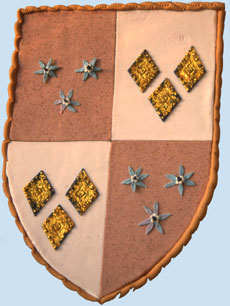
Bakemete is a Middle-English word meaning pie -
literally a 'baked meat'. That above is a re-creation
of one served during the third course of Henry VI's
coronation in 1429. It is described as "a bake mete
lyke a shylde, quarteryd red and whyte, set with
losynges gylt, and floures of borage". The red colour
in this re-creation was achieved with powdered
red sanders wood.
Ageinst miscreauntes th’emperour Sigismound [Against infidels the emperor]
Hath shewid his might which is imperial; [shown]
Sithen Henry the Fifth so noble a knight was founde [Ever since]
For Cristes cause in actis martial; [military deeds]
Cherisshying the Chirch, Lollardes had a falle,
To give exaumple to kynges that succede
And to his braunche in especiall [descendant (i.e., Henry VI) especially]
While he dothe regne to love God and drede. [dread]
[The thrid course sueth (follows); that is to say: Blaunde Surrey9 poudrid with quatrefoilis gilt. Venyson rostid. Egrettes. Curlewe. Cokkes. Plover. Quailis. Snytes (Snipes). Grete birdes. Larkes. Carpe. Crabbe. Lech of three colours. A colde bakemete (a cold meat pie) like a shelde quarterly redde and white, set with losenges and gilt, and floures of borage. Fritour crispes. A soltelté of Our Lady sittyng and hir Childe in hir lappe, and she holdying in hir hand a crowne and Seint George knelyng on that oo (one) side and Seint Denyse on that other side, presentyng the Kyng, knelyng, to Our Lady, with this reason folowyng:
9 a dish of chopped eels or fish, here served white
O blessid Lady, Cristes moder dere, [mother dear]
And thou Seint George, that callid art hir knight;
Holy Seint Denyse, O martir moost entier, [Denis; perfect]
The sixt Henry here present in your sight,
Shewith of grace on hym your hevenly light, [Show]
His tendre yougth with vertue doth avaunce, [increase]
Bore by discent and by title of right [Born; descent]
Justly to reigne in England and in Fraunce.
The Nuptial Table of Henry VII (1486)
Here is the bill of fare for the nuptial feast in 1486 of the first Tudor monarch, Henry VII, as it is given in Account of London by Thomas Pennant, published in 1790.
The ‘warner before the course.’ The Oxford English Dictionary defines ‘warner’ as ‘one who warns or gives warning to others’ – no surprises there. The OED however gives the first reference to this usage as occurring in 1565 – almost eight decades after Henry’s marriage, so clearly an update needs to be notified. The OED also gives another definition of the word ‘warner’ – ‘a mechanical device for giving warning’, citing the first usage as in 1823. In the context of a grand feast, a ‘warner’ was a ‘subtlety’ which preceded (and thus ‘gave warning’ of) the course. Subtelties were impressive structures that were paraded around the hall at intervals during the feast, and were intended to both entertain and to serve as messages of propaganda, religious devotion, or power. They were often made from both edible and non-edible materials, with moving parts and sometimes provided bursts of flame, fountains of wine, and other spectacular displays. In view of the strong mechanical element, it could be suggested that a ‘warner’ at a feast would also fit the OED’s second definition of the word.
First Course.
A Warner byfor the Course
Sheldes of Brawne in Armor
Frumetye wirh Venison
Bruet riche
Hart powdered graunt Chars
Fesaunt intram de Royall
Swan with Chawdron
Capons of high Goe
Lampervey in Galantine
Crane with Cretney
Pik in Latymer Sawce
Heronusew with his Sique
Carpe in Foile
Kid reversed
Perche in Jeloye depte
Conys of high Grece
Moten Roiall richely garnysed
Valance baked
Custarde Royall
Tarte Poleyn
Leyse Damask
Frutt Synoper
Frutt Formage
A Soteltie, with writing of Balads.
Second Course.
A Warner byfor the Course
Joly Ypocras
Mamane with Lozengs of Golds
Pekok in Hakell
Bittowre
Fesawnte
Browes
Egrets in Beorwetye
Cokks
Patrieche
Sturgyn freshe Fenell
Plovers
Rabett Sowker
Seyle in Fenyn entirely served richely
Red Shankks
Snytes
Quayles
Larkes ingraylede
Creves de Endence
Venesone in Paste Royall
Quince Baked
Marche Payne Royall
A colde bake Mete flourishede
Lethe Ciprus
Lethe Rube
Fruter Augeo
Fruter Mouniteyne
Castells of Jely in Temple wise made
A Soteltie
