Cuskynoles
Curye on Inglysch p. 52 (Diuersa Cibaria no. 45)
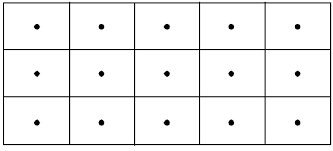
A mete that is icleped cuskynoles. Make a past tempred with ayren, & sothen nim peoren & applen, figes & reysins, alemaundes & dates; bet am togedere & do god poudre of gode speces withinnen. & in leynten make thi past with milke of alemaundes. & rolle thi past on a bord, & sothen hew hit on moni perties, & vche an pertie beo of the leynthe of a paume & an half & of threo vyngres of brede. & smeor thy past al of one dole, & sothen do thi fassure withinnen. Vchan kake is portiooun. & sothen veld togedere othe zeolue manere, ase theos fugurre is imad: [the picture in question is a rectangular grid, five rectangles across and three vertically, with a dot in the center of each little rectangle] & sothe boille in veir water, & sothen rost on an greudil; & sothen adresse. [thorns replaced by th's]
And for those who prefer their Middle English at least semi-translated:
A food that is named cuskynoles. Make a paste [dough] tempered with eggs, & so then take pears & apples, figs & raisins, almonds & dates; beat them together & do good powder of good spices within. & in Lent make thy paste with milk of almonds. & roll thy paste on a board, & so then hew it in many parts, & each part be of the length of a palm & a half & of three fingers of breadth. & smear thy paste all of one deal [half? portion?], & so then do thy filling withinn. Each cake is portion. & so then fold together of the self manner, as this figure is made: [see note above] & so then boil in fair water, & so then roast on a griddle; & so then dress [arrange for serving].
The entire English translation says, discounting bracketted material from Hieatt:
"25. Kuskenole [pastries with fruit filling]. Here is a dish which is called kuskenole. Make pastry with eggs; then take figs, raisins, pears, and apples, and then dates and almonds; beat together and add good mixed ground spice and whole spices. In Lent, make your make your pastry with almonds [i.e. almond butter or cream]. Roll your pastry out on a table and cut into several pieces, one and a half hands long and three fingers in width; then grease the pastry on one side; then put the filling in, dividing it equally among the cakes; then fold together as this diagram illustrates [presumably folding over the pastry and pressing or crimping the edges together, as with ravioli]; then boil in clean water, then brown on a griddle, etc."
From David Friedman, Modernized English:
Make a paste tempered with eggs, & so then take pears & apples, figs & raisins, almonds & dates; beat them together & do good powder of good spices within. & in Lent make thy paste with milk of almonds. & roll thy paste on a board, & so then hew it in many parts, & each part be of the length of a palm & a half & of three fingers of breadth. & smear thy paste all on one half, & so then do thy filling within. Each cake is a portion. & so then fold together of the same manner, as this figure is made: [see below] & so then boil in fair water, & so then roast on a griddle; & so then dress.
Question as to how these are to be made:
From David Friedman
Version 1: Spread 1 T of filling on all of one piece, put another piece over it (sandwich—dough, filling, dough). Using the back of a reasonably thick knife, press the edges and the lines, to give the 3x5 pattern shown.
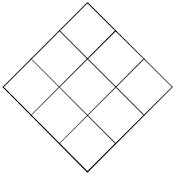
Version 2: An earlier version of this recipe (Two Anglo-Norman Culinary Collections) shows the figure as a 3x3 grid. That fits the text more closely. You cut pieces about 3"x6", spread 1 ½ to 2 t of filling on half of one piece, fold them to 3"x3" with the filling inside, then press a tic-tac-toe pattern with the back of your knife, giving a 3x3 grid of miniature ravioli.