Ember Day Tarts
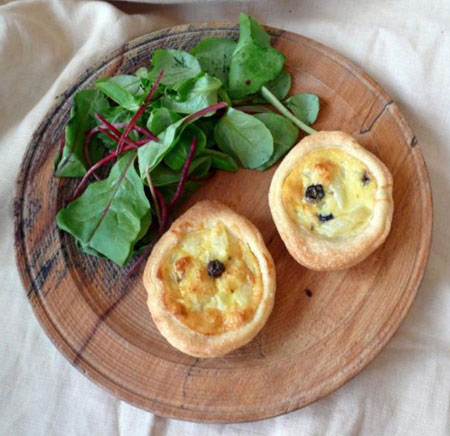 Four times every year in the Catholic calendar, there were "Ember Days" consisting of a Wednesday, Friday, and Saturday These days were roughly equidistant in the circuit of the year and were formerly set aside for fasting and prayer. Meat was forbidden; cheese and eggs, however, were allowed. An 'Ember Day Tart' therefore was a filling dish served instead of meat on these fasting days. The tarts in the recipe are a little like a sweet quiche. Note that no clear distinction was made between sweet and savoury in the medieval era and this would have been served as part of the meal.
The recipe uses galingale (a rhizome in the ginger family), it is well worth finding some as its aromatic taste is not easily replaced. You can use ginger as a substitute but this will give heat rather than a more rounded flavour.
The recipe was originally written down as follows:
Tart in Ymbre day
(Curye on Inglysch, Forme of Cury (1390) recipe # 173, page 136)
Tart in ymbre day. Take and perboile oynoun & erbis & presse out þe water & hewe hem smale. Take grene chese & bray it in a morter, and temper it vp with ayren. Do þerto butter, safroun & salt, & raisouns corauns, & a litel sugar with powdour douce, & bake it in a trap, & serue it forth.
In more modern English:
Take and parboil onion[s] and herbs, and press out the water, and chop them small. Take green cheese and grind it in a mortar, and temper it up with eggs. Add butter, saffron, and salt, and currants, and a little sugar with powder douce, and bake it in an open crust, and serve it forth.
We have cheese, eggs, onions, herbs, and miscellaneous other flavorings, baked in an open crust: essentially a quiche. What else can we say?
The problem of proportions is obvious. Apart from that, there are several other immediate questions. First, what is green cheese? Probably a fresh (as opposed to aged) cheese. This could be anything from (fresh, not aged) cottage cheese to cream cheese to something like cream havarti. It probably is not something like brie, which needs substantial aging, or one of the harder cheeses. (Bleu cheese is probably the wrong direction, as is swiss or cheddar.)
What herbs? Well, what herbs do you have? What herbs go well with cheese and onions? The recipe is deliberately vague.
Powder douce, on the other hand, is not intentional vagueness; instead, it is a reference to a standard medieval premixed combination of spices, much as "curry powder" is a modern combination of spices. The name means "sweet powder". Sugar was definitely one constituent; other probable ones include cinnamon, ginger, mace, and cloves.
Now we compare a second recipe. This one is take from Arundel MS 344, dating from the early 15th C, and edited by John Nichols under the title Ancient Cookery. This collection has a lot of recipes in common with Forme of Cury, some with the same names in the same order. Tart in Ember Day occurs in one such sequence. It is probable, given the degree of overlap, that the author of Arundel 344 had a copy of Forme of Cury, from which he worked. Still, the recipes do vary a little in details.
Tart on Ember-Day
(Ancient Cookery 356, 448/38c)
Tart in Ymbre day. Parboyle onions, and sauge, and parsel, and hew hom small, then take gode fatte chese, and bray hit, and do therto egges, and tempur hit up therwith, and do therto butter and sugur, and raisynges of corance, and pouder of ginger, and of cannell, medel all this well togedur, and do hit in a coffyn, and bake it uncoveret, and serve hit forthe.
Again, in modern English:
This time, we have more details. In the place of "green cheese", we have "good fat cheese". This suggests that cream cheese or a soft cheese like havarti or muenster is probably more to the point than cottage cheese, which tends to be less fat. In place of "herbs", we have (fresh) sage and parsley; the saffron has vanished, and in place of powder douce we have ginger and cinnamon.Parboil onions, and sage, and parsley, and cut them small, then take good fat cheese, and grind it, and add eggs, and temper it up with them, and add butter and sugar, and currants, and powdered ginger, and cinnamon, mix all this well together, and put it in a crust, and bake it uncovered, and serve it forth.
Both recipes, then, specify onions, butter, eggs, cheese, sugar, and currants. One calls for herbs in general, the other for sage and parsley. One calls for powder douce, the other for ginger and cinnamon. One calls for saffron, and the other doesn't.
One Version from http://www.pbm.com/~lindahl/recipes/to_make_a_tart.html
4 onions |
1/4 cup currants 1/4 tsp ginger 3/4 tsp cinnamon 1/2 tsp dried sage leaves 1/4 cup parsley 1 deep dish 9" pie crust |
1. Parboil onions (about 10 minutes).
2. Remove onions from heat, drain, and chop.
3. Chop parsley.
4. Mix all ingredients.
5. Pour into pie shell.
6. Bake at 350deg for 50 to 55 minutes (top will be brown; a knife inserted into the top should come out clean.
As you can see, this follows the second recipe closely. The main liberties I've taken are to omit parboiling the parsley (it's never seemed necessary), use dried sage in place of fresh (which I usually can't get), and, of course, make decisions on the proportions of the ingredients.
How did I decide on what I did? Trial and error, mostly. (It took about four tries to get something I was really happy with.) First, I decided that this would be more egg- than cheese-based. It doesn't say that in either recipe: it doesn't say either way. If you want a very rich cheese tart, instead of something more quiche-like, you could with equal justification increase the cheese and cut the eggs. Second, I chose the cheeses, again largely consulting personal preference. Then I tried various balances of the herbs, spices, and sugar (and various baking times, and so on) until I got something I liked.
And from Ancient Cookery, S. Pegge (ed.)
Tart in Ymbre day. Take and perboile oynouns presse out þe water & hewe hem smale. take brede & bray it in a morter, and temper it up with Ayren. do þerto butter, safroun and salt, & raisouns corauns, & a litel sugur with powdour douce, and bake it in a trap, & serue it forth.
Note: A trap is a coffin without a lid.
Tart on Ember Day
from http://www.3owls.org/
Take and perboile oynoun & erbis & presse out the water & hewe her smale. Take grene chese & bray it in a morter, and temper it up with ayren. Do therto butter, safroun & salt, & raisouns corouns, & a litel sugur with powdour douce, and bake it in a trap, & serue it forth. (Ancient Cookery, 15th century)
Medieval quiche! Ember Days were religious semi-fast days, in which meat was forbidden but dairy products were okay. (The proliferation of church-enforced fast days in 14th- and 15th-century England actually had a lot to do with the need to encourage the fishing industry, but hey. ) These tarts use eggs and cottage cheese, and are enriched with butter and currants. The parboiled onions and herbs add sweetness, brought out by spicing with sugar.
1 small onion
handful mixed herbs – sage, thyme, chives work well
1 200g smooth cottage cheese
3 eggs
2 tblsp butter, softened
pinch saffron
1 tsp salt
handful of currants
1 tsp sugar
1 tsp cinnamon
1 tsp nutmeg
shortcrust pastry (200g flour)
Roll out pastry and line quiche pan. Prick pastry base with a fork, fill with baking beans on a sheet of baking paper, and bake at 200 degrees for 5-10 minutes, until set. Remove paper and beans and put back in the oven for a few minutes to crisp the base.
Dice onion and simmer in water for 10-15 minutes, until soft. Add the chopped herbs for the last 5 mins of cooking. Drain, and add the butter to melt it.
Mix cheese, eggs, onions, herbs and seasoning. Stir in currants. Pour mixture into baked pastry case and bake at 180 degrees for about half an hour, or until the top is browned and set. This may puff up a little during cooking.
