Entremets
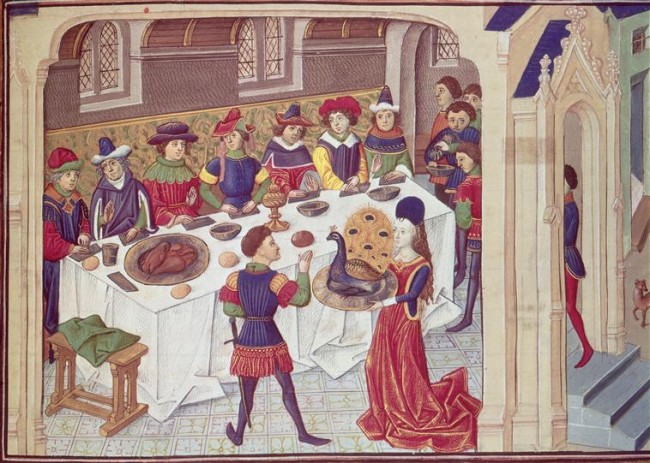
Entremet: Peacock with plumage
An entremet (or entremets, from Old French, literally meaning "between servings") is in modern French cuisine a small dish served between courses or simply a dessert. Originally it was an elaborate form of entertainment dish common among the nobility and upper middle class in Europe during the later part of the Middle Ages and the early modern period. An entremet marked the end of a serving of courses and could be anything from a simple frumenty (a type of wheat porridge) that was brightly colored and flavored with exotic and expensive spices to elaborate models of castles complete with wine fountains, musicians, and food modeled into allegorical scenes. By the end of the Middle Ages, it had evolved almost entirely into dinner entertainment in the form of inedible ornaments or acted performances, often packed with symbolism of power and regality. In English it was more commonly known as a subtlety (also sotelty or soteltie) and did not include acted entertainment. The meaning also varies depending on time and location; in Italy, it refers to the live entertainment between courses, in 15th C France, the term covers both culinary and theatrical entertainment.
Original Meaning - Colored or Decorated Foods
Dishes that were intended to be eaten as well as entertain can be traced back at least to the early Roman Empire. In his Satyricon, the Roman writer Petronius describes a dish consisting of a rabbit dressed to look like the mythical horse Pegasus. The function of the entremet was to mark the end of a course, met (a serving of several dishes), of which there could be several at a banquet. It punctuated each stage of a banquet, prepared the diners for the next serving and functioned as a conversation piece.
The earliest examples in the Middle Ages involve coloring foods. Gold is one of the most popular color choices, whether obtained by use of saffron or eggs, or by gilding with actual gold leaf. Various colors could be obtained from edible substances. Modern food colors are an acceptable substitute. Parti-colored dishes were very popular, often being created out of a white base such as almond or rice dishes.
Endoring
Can refer to gilding with gold leaf. Can also refer to brushing with a flour paste containing egg yolks and/or saffron. For example, Le Menagier's recipe for Boar's Head describes endoring one half of the head with the yolk, flour, saffron mixture and the other half with the whites, parsley, flour mixture making the finished product half green and half gold. It then says to have the painters apply gold leaf. Occasionally this referred to the paste itself, regardless of color.
The earliest recipes for an entremets can be found in an edition of Le Viandier, a medieval recipe collection from the early 14th century. The Viandier lists thirteen dishes that are entremets (recipes 61 - 74?); they consist generally of porridges, jellied meats and stuffings. They oftten appeal to the eye and imagination as well as the palate. A simple recipe for millet directs that it be cooked in milk, colored with saffrom, and placed in a bowl. An entremet recipe for lamprey directs that the meat be roasted, then covered in a thick sauce made by combining its blood with spices and vinegar. This sauce is referred to as "mud," suggesting both its probably appearance and the possibility that the dish visually simuulates the living lamprey's tendency to burrow into river bottoms. Another comparatively simple dish is boiled and fried chicken liver with chopped giblet, ground ginger, cinnamon, cloves, wine, verjuice, beef bouillon and egg yolks, served with cinnamon on top, and was supposed to be of a bright yellow color. All these recipes have one thing in common, however: they contain saffron to give the dishes a golden hue.
The most noticeable trait of these early entremets was the focus on vivid colors. More sophisticated than these monochrome dishes was the blanc manger that was no longer only a “white” dish, as the name suggests, but was served in two contrasting colors on a plate. Another type of entremet was fish in a spiced jelly. UJellies, too, soon became the subject of much experimentation by cooks. With jelly squares in different colors the desired checkerboard effect could be achieved. At the Medieval table, an entremet was originally a ligher food or dish which claimed the interest of guests because it was somehow prepared with art. In time, "with art" became "artificial" with the intent to amuse or amaze guests.
Examples: “A dish of Particular Colors” in Sabina Welser’s Cookbook involves roasting hens on a spit, but basting each one of them with a different colored flour paste. 15th Century “Tourtes Parmeriennes” (meat pies) were usually gilded or silver leafed as well as decorated with miniature banners of al the Lords present at the banquet (see recipe below). The decoration of foods could also take the form of miniature “models”. An Ordinance of Pottage contains a recipe for little hats of meat/marrow/dried fruit stuffing enclosed in a pastry shaped to look like little hats. Miniature hedgehogs could be made of molded meat studded with almonds (as described in 14th C. Forme of Curye and in much later cookbooks like The English Housewife 1615), or made with thickened almond milk, as illustrated in the Ambras Recipe Collection. Unlike illusion foods, these examples are not tricking the diner into believing they are something else, but entertaining them with their whimsy and ingenuity of decoration.
Illusion Foods or Warners
Later on, the entremets would take the shape of various types of illusion foods, such as peacocks or swans that were skinned, cooked, seasoned and then redressed in their original plumage (or filled with the meat of tastier fowl). Most directions instruct the cook to insert a wire in the neck and tail, so that these can be posed in a life-like way. They were also often made to “spit” fire by the use of cloth soaked in camphor placed in the mouth and lit just before the presentation. The image of a wild boar caught with an apple in its mouth was possibly among the first dishes to attempt an imitation of a live animal. We also find scenes depicting contemporary human activities, such as a knight in the form of a grilled capon equipped with a paper helmet and lance, sitting on the back of a roast piglet. Various period recipes involve suspending whole cooked fish in aspic, so that they appear to be swimming.
One food could be molded and tinted into the shape and color of another. For “eggs in lent,” eggshells could be emptied out and refilled with almond cream (the center tinted yellow to simulate an egg yolk), as outlined in The Harleian MS. Cheese could be duplicated with the milt and roe of tench, pike or carp. Substitutes for butter and ricotta were created from almonds according to the author of The Neopolitan Collection. Le Menagier contains a recipe to make beef taste like stag or venison (or bear). Ground meat and bean pastes were an immensely popular modeling material. De Fait de Cuisine instructs making hedgehogs, apples, Spanish pots, molded figures such as hares, brachets, deer, boars, the hunters with their horns, partridge, crayfish, dolphins, peas and beans, all made of molded meat and endored. Other period references to this practice include “Poume d’orange” (oranges) in Two Anglo-Norman Cullinary Collections, “Farsur to make pomme dorryse (golden apples) and othere thynges” in The Forme of Cury and “Pear Puddings” from The Closet of Sir Kenelm Digby Opened (these are pear shaped meatballs made of ground chicken).
Elaborate models of castles made from edible material was a popular theme. At a feast in 1343 dedicated to Pope Clement VI, one of the Avignon popes, one of the entremets was a castle with walls made from roast birds, populated with cooked and redressed deer, wild boar, goat, hare and rabbit.
The following are from Le Viandier de Taillevent (early 15th century version)
These are additional recipes added to the copy from the first half of the 15th century and are not inclued in the earlier 14th century copy:
196. Coqz Heaumez. Mettez cochons rostir, et poulalaille comme coqz et vielles poulles, et quant le cochon sera rosty d'une part et la poulaille d'autre convient farsir la poullaille - sans escorcher, qui veult; et la convient farsir de paste batue aux oeuf; et quant ell'est doree la convient mettre a chevauchons sur le cochon, et fault ung heaume de papier colle et une lance fichie a la poittrine de la dicte poullaille, et les fault couvrir de fueil d'or ou d'argent
pour les seigneurs, ou de feul d'estain blanc, vermeil ou vert.196. Coqz heaumez: Helmeted Cocks. Roast piglets and such poultry as cocks and old hens; when both the piglet and the poultry are roasted, the poultry should be stuffed - without skinning it, if you wish; it should be (glazed) with an egg batter. And when it is glazed it should be seated astride the piglet; and it needs a helmet of glued paper and a lance couched at the breast of the bird, and these should be covered with gold-or-silver-leaf for lords, or with white, red or green tin-leaf.
197. Tourtes parmeriennes: Parmesan Pies [Parma Pies]. Take mutton, veal or pork and chop it up sufficiently small; then boil poultry and quarter it -- and the other meat must be cooked before being chopped up: then get fine powder and sprinkle it on the meat very sensibly, and fry your meat in bacon grease. Then get large open pastry shells -- which should have higher sides than usual and should be the size of small plates -- and shape them with crenellations [the battlements of a castle or other building]; they should be of a strong dough in order to hold the meat. If you wish, you can mix pine-nut paste and currants among the meat, with granulated sugar on top; into each pastry put three or four chicken quarters in which to plant the banners of France and of the lords who will be present, and glaze them with moistened saffron to give them a better appearance. For anyone who does not want to go to such expense for poultry, all he has to do is make flat pieces of pork or of mutton, either roasted or boiled. When the pies are filled with their meat, the meat on top should be glazed with a little beaten egg, both yolks and whites, so that this meat will hold together solidly enough to set the banners in it. And you should have gold-leaf or tin-leaf to glaze the pies before setting the banners in them.
Scully, Terence. Le Viandier de Taillevent. An Edition of all Extant Manuscripts. Ottawa: University of Ottawa Press, 1988.
Entremets with an Element of Surprise
From the late 14th century on in England, entremets are referred to as subtleties. This English term was derived from an older meaning of "subtle" as "clever" or "surprising". The meaning of "subtlety" did not include entertainment involving actors; those were referred to as pageants. The "four and twenty blackbirds baked in a pie", in the nursery rhyme "Sing a Song of Sixpence", has its genesis in an entremet presented to amuse banquet guests in the 14th century. This extravaganza of hospitality was related by an Italian cook of the era. "Live birds were slipped into a baked pie shell through a hole cut in its bottom." The unwary guest would release the flapping birds once the upper crust was cut into, astounding all the guests.
Magia Naturalis and Cuoco Napoletano have recipes for “A Young Pigeon With His Bones Pulled Out” achieved by soaking the bird in a strong vinegar solution to dissolve the bones while leaving the flesh intact. A similar effect could be achieved by carefully removing the outer skin of a chicken and refilling it with a sausage stuffing mixture as in the recipe for “Farced Chicken” in Le Menagier. Battered and fried strung dried fruit creates an extremely accurate representation of entrails in the “Trayne Roast”recipe from the Harleian Manuscript.
Symbolic Forms of Inedible Entertainment
In the 14th century entremets began to involve not just eye-catching displays of amusing haute cuisine, but also more prominent and often highly symbolic forms of inedible entertainment. In 1306, the knighting of the son of Edward I included performances of chansons de geste in what has been assumed to be part of the entremets. During the course of the 14th century they would often take on the character of theatrical displays, complete with props, actors, singers, mummers and dancers. At a banquet held in 1378 by Charles V of France in honor of Emperor Charles IV, a huge wooden model of the city of Jerusalem was rolled in before the high table. Actors portraying the crusader Godfrey of Bouillon and his knights then sailed into the hall on a miniature ship and reenacted the capture of Jerusalem in 1099.
At the end of the Middle Ages, the level of refinement among the noble and royal courts of Europe had increased considerably, and the demands of powerful hosts and their rich dinner guests resulted in ever more complicated and elaborate creations. Chiquart, cook to Amadeus VIII, Duke of Savoy, described an entremet entitled Castle of Love in his 15th-century culinary treatise Du fait de cuisine ("On cookery"). It consisted of a giant castle model with four towers, carried in by four men. The castle contained, among other things, a roast piglet, a swan cooked and redressed in its own plumage, a roast boar's head and a pike cooked and sauced in three different ways without having been cut into pieces, all of them breathing fire. The battlements of the castle were adorned with the banners of the Duke and his guests, manned by miniature archers, and inside the castle there was a fountain that gushed rosewater and spiced wine.
Anne Boleyn’s coronation feast in 1533 featured subtleties and ships made of wax. An example from a dinner given by Gaston IV,Comte de Foix at Tours in 1477 in honor of an embassy from the King of Hungary: “A man attired in embroidered crimson satin appeared astride a similarly caparisoned horse. In his hands he carried a model garden made of wax which was filed with roses and a variety of other flowers, and set it before the ladies. A 1435 feast subtlety for King Rene of Anjou consisted of two large tables on each of which stood a hawthorn tree covered in gold and silver flowers, the greenery enriched with gold tinsel and adorned with the heraldic arms of France and of the other guests. Eighteen smaller trees bore the ducal arms. This décor framed the entry of an entremet involving a peacock surrounded by ten golden lions, each holding a banner bearing the arms of the ducal lands.
Noteworthy for its entertainment value to the assembled nobles of the time, the 17th century provided a memorable banquet event courtesy of the host, the Duke of Buckingham. In honor of his royal guests, Charles I and Queen Henrietta Maria, a pie was prepared concealing a human being—famous dwarf of the era, Jeffrey Hudson.
Entremets also made an effective tool for political displays. One of the most famous examples is the so-called Feast of the Pheasant, arranged by Philip the Good of Burgundy in 1454. The theme of the banquet was the fall of Constantinople to the Ottoman Turks in 1453, and included a vow by Philip and his guests to retake the city in a crusade, though this was never realized. There were several spectacular displays at the banquet referred to by contemporary witnesses as entremets. Guests were entertained by a wide range of extravagant displays of automatons in the form of fountains and pies containing musicians. At the end of the banquet, an actor representing the Holy Church rode in on an elephant and read a poem about the plight of Eastern Christianity under Ottoman rule.
Theatrical Presentations
Later period banquets could have exclusively theatrical breaks between courses. Sometimes the theatrics were employed in conjunction with the serving of the food, although at other times these productions functioned more like pageant plays than the extraordinarily creative culinary subtleties that preceded them. Large elaborate sets and multitudes of actors could be used in their execution.
The Coronation feast of the queen of Pedro of Aragon 1399 featured quite an array of entertainment: Each course was prefaced by a little drama – men-at-arms killing a dragon, musicians on a rock bearing a wounded lion, actors imprisoned in a fully fledged ship flanked by sirens singing advanced to the table and disgorged the fish course. At supper a horse disguised as an elephant with a castle on its back ambled in. Cupid, attired in peacock’s feathers emerged from the castle to shoot red and white roses at the diners. At another feast a huge pie was wheeled in and a man dressed as an eagle leapt out flapping his wings and releasing a flock of white doves.
