The Preparation of a Medieval Feast following the Four Homour System of food and diet
from "Messe it Forth," http://www.godecookery.com/feastpre/feastpre.htm, modified
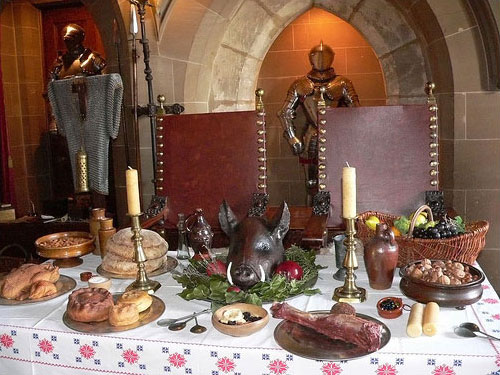
Medieval Feast set in the Great Hall at Warwick Castle
Introduction
Medieval feasts and dinners were remarkably similar to our own modern manner of eating; today's meals generally start out light, such as with a soup or salad, then move on to the heavier items of meats and vegetables, and end with something sweet - and the more formal or special the occasion, the more likely the dessert will be something extravagant or showy.
Medieval meals, too, followed such a pattern, but the reasons for the foods that were eaten, how they were prepared, and when they were eaten followed a train of thought much different than ours of today. In the Western world of the 21st c., the ideas of proper nutrition and the analyzing of food properties and qualities is a complex and efficient science that has changed the world in many positive ways. From ingredient lists on packages to the mass instruction of such concepts as the "food pyramid," modern society has a knowledge of food and its true nutritional value that far exceeds anything our medieval ancestors could have imagined. Still, medieval culture was well aware of the truth in the thought that we truly are what we eat, and had its own complex science that prescribed what should be eaten, and when. And the medieval version of the contemporary "food pyramid" was the Four Humour system.
Ancient Greeks
The Greeks understood that not all food would take the same time to digest, and it was thought to be unhealthy to eat a food that digested more slowly before eating food that digested quickly. Foods that were eaten at the wrong time would block the exit from the stomach of food that had already been digested. Therefore, the Greeks devised an order in which food was consumed, as determined by how easily it was digested. This played a major part in an individual’s health.
Health handbooks, therefore, were used in determining the manner of foods to be eaten and in which order based on the nature of the food and how it was prepared. For example, lettuces with oil and vinegar were believed to be more easily digestible then boiled meats or pureed vegetables which in turn, were believed to be more easily digestible then roasted meats. Many published medieval menus show a similar delineation in the dishes that were served in each course.
Although several menus that have been published contain two or more courses, the majority contain three courses. The first course contained foods that were thought to be easy to digest. Each successive course would contain increasingly more difficult to digest foods. Upon conclusion of the meal, the issue de table, spiced wines, candied fruits and nuts were served to "close" the stomach. It was believed that sugary foods dulled the appetite and would serve to close the stomach, just as foods that were considered hot and dry would open the stomach and prepare it for the process of digestion.
The Four Humours
In a nutshell, the Four Humour system was a philosophy, along with astrology, followed by most physicians, medics, and intellectuals of the Middle Ages that believed, like astrology, that all things - man, animals, the four seasons, planets, etc. - existed under the effects of certain influences and inner manifestations; in this case, four specific properties called the Four Humours. These four qualities, or conditions, were Melancholy, Choler, Phlegm, & Blood (with many other names and versions also in existence). Melancholy had the properties of cold and dry, and was associeted with the god Saturn. Choler was hot and dry and was linked to Mars, the god of war. Phlegm was governed by the Moon Goddess and was cold and moist. Blood was a hot and moist condition, ruled by Venus. Men & women were supposedly influenced by the bodily presence of these Humours, with the excess of any one of them affecting personality, feelings, and behavior. A person with increased Melancholy was said to "loveth and desyre dethe" and to be prone to delusions and depression, but to also be sensitive and perhaps dignified. Choler made one unkindly and "wrathful, hardy," and "unstable." Those affected by an excess of Choler were recommended to eat leeks, onions, or garlic only at their own peril. An excessive amount of Phlegm induced slothfulness, and its subjects were "fatte, greate and shorte and croked in extremyties," while Blood was a sign of heat, youth, and passion, and other healthier aspects. Too much Blood in an older man, however, could cause a heart attack.
The Four Humours Applied to Food
As these four influences played their part with man, they did so with food as well. Medieval cooks were advised by physicians to prepare foods that were properly balanced with these four Humours in mind, the same as today's cooks are trained to present meals that are balanced in nutrition. For example, fish, which are cold and moist, should be served with spices or sauces that are hot and dry, to counteract against an excess of Phlegm. Plump and moist young male chickens were castrated into capons to prevent them from maturing sexually, a process which would increase Blood and therefore make their meat dry. Foods which were naturally dry were boiled, never roasted, while moist foods were baked to dry them out. (Consider how dry a plainly roasted carrot is, and how horrible a boiled pie would be!) Eating foods that were properly in balance kept the eater in balance as well, and menus were arranged with the familar concept of light foods first, heavier foods later, all properly spiced and prepared in such a manner as to counteract whatever excess of humour was present.
Medieval physicists told their contemporaries that cooking added either warmth or moisture or warmth and dryness to the foodstuff that was cooked. The cook chose his cooking method according to the inherent nature of the foodstuff and any need he had to correct this nature. Not following this correctly could lead the person eating the dish to some form of illness or attack.
Roasting, the application of direct heat, was appropriate for a cold, moist meat such as pork, because an open fire would warm and dry. A grill was convenient for flat meats, a spit for larger cuts.
Boiling, on the other hand, offered a relatively constant heat, and boiling better suited beef because its cold dry nature needed to be both warmed and moistened. Cooks took this seriously and rarely roasted their beef as is evident in the large stocks of beef bouillon that recipes imply was always on hand.
The effects of the process of frying, whether sauteeing or deep-frying, fell theoretically between those of boiling and roasting. Frying added heat moderately, but it also added moisture moderately - in the form of oil or grease - to the foodstuff. Frying was declared appropriate for foods possessing a relatively moderate temperament, such as chicken.
The theorists tend not to have too much to say about baking, but did at least indicate that this cooking method did not present any serious dangers. Baking was valued as a means to retain the natural moisture in a food without adding to it, so this cooking procedure was suitable for meats that were themselves only moderately moist. Thus lamb, mutton and wildfowl were good candidates for the oven.
Order of Courses
Dinners & feasts usually started with foods that were considered easily digestible, such as light meats, warm & moist foods such as soups and broths, moist fruits (especially peaches, plums, melons, cherries, strawberries, grapes, cucumbers which were considered a moist fruit ), and greens such as lettuce, cabbage, and "herbs." Spices were thought to warm the stomach, and were therefore an excellent stomach opener. Cheese was eaten both before and during the meal, as an aid to digestion and to help a "weak stomach." Foods that were more difficult to digest, such as beef & fatty pork and heavy fruits, like pears & chestnuts, were consumed later in the meal. In large feasts, very rich and exotic foods were served in smaller portions only to highly distinguished guests after the more filling and common dishes had been served to the entire hall. This practice would continue as the feast progressed, ending with the finest of delicacies being served to just the table of the king or nobleman in charge of the affair.
When meat was eaten, it was normally followed with cheese, which physicians recommended for proper digestion. When fish was served, it was followed with nuts, for essentially the same reason. Wines and ales of all sorts were consumed during the entire meal. Sweets, like today, were saved for last, and spices were again used here as a digestive aid to end the meal. Wine, as a custom, was drunk just before retiring, and so the evening would usually end with refreshing comfits, ginger breads, cheese, wafers and candied fruits and seeds, served with a mulled wine. These sweetend treats were thought to aid the digestion of the meal; (it was the warming properties of sugar, which gave it such an important role in the ritualised ending of a meal).
Dinners were arranged in courses, each course containing several items, with several courses in each dinner. A feast may contain many courses with just a few dishes in each, or just a few courses with many dishes included. The idea of eating one main dish during every course, which is called service à la russe, didn't become popular in Europe until the 19th century. Before that, courses at grand meals consisted of many dishes being served simultaneously. At the coronation of Richard III in 1483, for example, there were three courses, each of which included at least 15 different dishes. After the final course came the concluding presentation of wine and sweets.
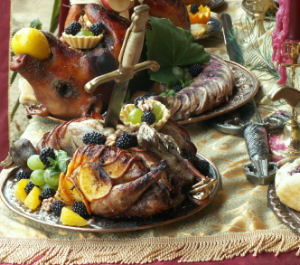
Solteties served during the Entremet course
At royal feasts, the courses were broken up with a mini-course called an entremet,* featuring lavish presentations and spectacles, and fantastic and fanciful foods called solteties. They were ornamental offerings, often made from dough or marzipan, and were made to represent saints, warriors, heroes, scenes from mythology, etc., but also were such dishes as the Cockentrice (made by combining a pig and a capon into one creature, thus creating a "new," or mythological, animal that would amuse and amaze the guests) and the Coqz Heaumez (Helmeted Cock, another fantastic combination of pig and fowl, which appears in the medieval French Cookbook of Guillaume Tirel, known today as Le Viandier de Taillevent.). Food-in-disguise was also a popular soltetie, and a cake could appear as a realistic looking fish and a meatloaf could be crafted to resemble a fancily painted pitcher. Beautiful and awe-inspiring, a well-presented soltetie was a masterpice of imagination and skill on the cook's part. Spectacles often included music, singing, and play-acting.
*An entremet (or entremets, from Old French, literally meaning "between servings") is in modern French cuisine a small dish served between courses or simply a dessert. Originally it was an elaborate form of entertainment dish common among the nobility and upper middle class in Western Europe during the later part of the Middle Ages and the early modern period. An entremet marked the end of a serving of courses and could be anything from a simple frumenty (a type of wheat porridge) that was brightly colored and flavored with exotic and expensive spices to elaborate models of castles complete with wine fountains, musicians, and food modeled into allegorical scenes. By end of the Middle Ages, it had evolved almost entirely into dinner entertainment in the form of inedible ornaments or acted performances, often packed with symbolism of power and regality. In English it was more commonly known as a subtlety (also sotelty or soteltie) and did not include acted entertainment. From http://en.wikipedia.org/wiki/Entremet
Planning your Own Feast
A modern medieval feast, whether done for friends and family as an amusement, or presented by schools and historical societies for the public, should follow the traditional standards of the Middle Ages. Begin dinner with soup or broth, bread, & cheese. Follow with green vegetables, a meat dish of lean pork or chicken, or perhaps fish, accompanied with sauces, then move on to the heavier and fancier items, in smaller portions. End with sweets and spiced desserts. Serve wine and ale throughout the entire meal, or if the event is non-alcoholic, use apple cider, grape juice, lemonade, water, etc. Just don't let your guests go thirsty! Divide the various dishes among two or three courses, serving each course in its entirety and leaving time for talk, music, & entertainment for guests between courses. For larger events, separate the two main courses with an amusing and entertaining presentation, such as a performance of some sort or an unusual or flashy food item - a roast pig always has a welcome audience at a time like this, or try a fancy food-in-disguise soltetie. A good medieval feast should last at least several hours, and your guests should leave not only full of delicious food, but emotionally satisfied and intellectually entertained. Give them one final drink and a sweet morsel to send them on their way home, but first make sure they offer a toast to the evening, the friends present, and the magnificent cook who made it all possible!
"Messe it Forth" was a common medieval expression meaning "Serve it."
Course Suggestions
Suggested dishes that are most appropriate for a "first course" that would be easy to digest would be meats or non-fatty fish, or shellfish cooked in broth, or almond milk such as sops, brewets, graves or cives. It could also contain dishes of vegetables that have been simmered, boiled or stewed, for example green leafy vegetables sometimes served with salted meat, peas or beans and turnips that have been cooked and then mashed into porres. Other dishes to consider would be pasties, or rissoles.
Following with the Greek system the next course (second) should contain those foods that were thought to be slower to digest, heavier meats which have been roasted, baked or in a pastry shell, served cold (froide sauge), jellied (jelly of fish) or sliced. The “grand char” would normally be found in this course. A roasted meat served with various sauces would be appropriate. Suggestions for this course include beef, game, pork, rabbit, poultry or fatty fish. It is also suggested that grain based dishes such as frumenty, isings, or bread based dishes such as guissell be placed in this course. Other items that could be included in this course are jellied and sliced dishes, nuts, aged cheeses, vegetables that have been roasted, baked or fried, pears and chestnuts. In this course it is not uncommon to find pancakes or other fried dishes such as fritters.
Suggestions for the last course include sweet dishes made with honey and sugar, glazed dishes, crepes, fruit rissoles, stewed fruits, puddings, custards, and light cakes. This course is often made up of "delicacy" meats, roasted wild fowl, peacock, wild boar, and of "bake metes," the pies, tarts, pasties and quiches. The "Issue de Table" would come next and would be composed of comfits, preserved ginger, and other sweets. At many modern feasts, the Issue de Table is not observed, but suggestions to invoke the spirit of the Issue include the addition of candied fruits, spices and nuts, along with candied ginger and other sweetmeats served with spiced fruit juice or wine.
Food In The Middle Ages - Medieval Habits
In the medieval period human digestion was thought of as extension to the cooking of food and therefore had to be conducted correctly in order for a person to remain healthy and digest well. In order for food nutrients to be absorbed correctly it was believed that easily digestible foods had to be eaten first and then heavier foods. This was the proper way to fill the stomach. If you did not follow this, heavier foods would sink to the bottom of the stomach and light foods, being on top would not be able to get through to digest quickly enough. This would cause bad gases in the body and putrefy it resulting in all sorts of ailments (actually many modern nutritionists believe the same). As well there was a philosophy on which food could be properly mixed inside and outside the body.
The technique for eating food in the middle ages went something like this. An aperitif was to be consumed before the meal in order to open up the stomach and prepare it for heavier food. It was recommended this be of a hot and dry nature. Sugar or honey coated confections made with ginger, anise, cumin, fennel and caraway were common, among those that could afford it. There was also wine and sweetened milk or almond milk. Then the meal could begin.
A meal might begin with fruit such as apples or peaches which were considered less taxing to the bowels. Next might come vegetables like cabbage, carrots and lettuce, some moist fruits and herbs. Potages were popular as meal starters and the poor many times only ever ate potages. Sometimes lighter roasted meats such as chicken or lamb were next. The heavier meats such as beef and pork came after this, along with nuts, and heavy sauces. Beef was actually rarely eaten as the raising of cattle took too much land. Most of the poor could not afford much meat and so lived on various potages alone. A potage is a thick soup with vegetables, meat and water boiled together, sometimes until very thick. But potages vary in their makeup. A Frumenty potage consisted of boiled wheat with possibly eggs, milk or broth. To this could be added currents, rum, sugar, orange flower water or saffron. A mawmenny potage was made of boiled fowl. Some potages were simply mashed pears or other fruit in water, thickened milk or almond milk, sometimes even with mashed flowers.
At the end of the meal the stomach was to be closed by a digestive aid called a dragee. This aid could be spiced wine, spiced lumps of sugar or more popularly, aged cheese.
What kind of food in the middle ages did the common peasant family consume? For the commoner, bread was the main staple as well as dishes made from wheat or cereal grains. Meat was rare and usually chicken or pork when it could be had. The main spices were sugar (expensive then) and honey. Expensive foreign spices were acquired by the wealthy. Wine or vinegar was popular in many dishes. Fish was eaten as well, in the northern areas especially. Almonds were used as a thickening agent or to make almond milk, when dairy milk was not to be consumed because of lent. A minor few of the poor had fruit trees as well. A bland diet for sure compared to today.
Distribution of Dishes
Those lower in rank not only got fewer courses but also were served smaller portions. Only the host and any exceptionally high-ranking guest got an individual serving; other high-ranking guests shared dishes (messes), usually two to a mess. If there were lower-ranking guests, as there would have been at a manor house, they were more apt to dine three or four to a mess. Sometimes those of higher rank were so served, to judge by a German banquet scene showing a number of crowned ladies at the side tables being served four to a mess.
This does not mean that those at high table ate all they were offered. The lord (or lady) of the house was expected to give some of the choice dishes to others. The thirteenth-century "household rules" for the Countess of Lincoln, attributed to Bishop Robert Grosseteste, advise that her "dish be so refilled and heaped up, especially with the delicacies, that you may courteously give from your dish to right and left to all at high table and to whom else it pleases you." The fifteenth-century Latin poem Modus Cenandi tells us empty plates are to be brought to the host so that he may distribute delicacies to others, and many recipes tell us to allow a whole chicken for a lord but only a quarter for commoners ("The Way of Dining," Furnivall, pp. 231–257).
If the Countess of Lincoln was to offer food from her dish to others at high table, clearly even those honored guests were not served everything on the menu. Just how many they had to choose from in each course probably varied according to the wealth and generosity of the host. The fourteenth-century poem Sir Gawain and the Green Knight describes lavishness that is highly unlikely in real life when it states that the members of King Arthur's court at a New Year's feast had so many dishes that it was hard to find room on the table for them: "Every two had twelve dishes / Good beer and bright wine both" (translation of lines 128–129).
Order of Service
Generally there was soup or other pottage to start with, followed by meats (on a meat day), with the more commonplace boiled or roasted meat and fowl first; on a fish day, there would be salt fish. More "delicate" items, such as roasted wild birds and fresh fish, came next, along with other dishes, then sweet or richer foods including tarts and fritters. This order is already apparent in that banquet described by Walter of Bibbesworth, although there the pottages follow rather than precede substantial meats. But some fifteenth-century menus for grand occasions were so expanded that each course might run the gamut from soup to fritters.
The basic order is spelled out in the Latin poem Modus Cenandi (The Way of Dining), which calls for pottage to be followed by meat of large animals and fowls, then smaller ones, and finally "better dishes" (fercula dant meliora). This "natural rule" is also claimed in the Liber Cure Cocorum—that for a feast featuring fowl, the larger ones come first, then "bakyn mete" (mainly pies), with more dainty foods at the end. A similar order is found in continental banquet menus, with a few differences.
French banquet menus varied in the number of courses, but the basic model seems to consist of four courses. The first course was much like an English first course, except that it excluded roasts. Roasts, with some accompaniments, came in the second course, and more elaborate dishes (entremets) in the third. Any or all of these courses might consist of only one or two dishes, as is the case with one of the Menagier's menus for wedding feasts. As in England, the French last course (dessert) usually included sweet dishes and/or fruit, although it might also contain meat or fish dishes we would not consider dessert today.
Italian banquets ran to more courses: eight, ten, and sometimes twenty or more courses, generally with two or more dishes in each. Sometimes they began with pasta dishes, but otherwise the order was much like the French: soups and meats in sauces preceded roasts. German banquets also ran to a good many courses, but most of them consisted of a single dish.
Setting and Protocol of the Banquet
The menu order, however, does not give the complete order of the banquet. The first thing given to all diners was water and a towel for washing hands, usually before they were seated at the table. They were seated strictly according to rank at tables which, for a large banquet, were arranged in a U-shape. The host and especially honored guests sat at the head (high) table, and the others at the side tables. The nearer a guest was placed to the host, the greater the honor. The principal salt cellar, often a very elaborate affair, was placed at the host's right hand: hence the saying that others sat "below the salt." Salt for general use was distributed in piles on pieces of bread that served as individual salt cellars.
On the table, guests would find bread, and often a knife, a spoon, and a napkin, but not a fork: fingers or pieces of bread were used to pick up food not eaten with a spoon. "Trenchers" of coarse bread were cut and placed in front of each diner to receive pieces of meat or fish. Wine and/or ale would soon be poured, but before the meal was served, grace was said. Food was brought from the (often distant) kitchen; the German banquet scene referred to above shows a servant bringing a pile of covered dishes, much like those used in restaurants today to keep food warm. Roasts were carved and served in the hall.
French banquets usually started with an aperitif, or assiette de table (as against the première assiette, first course). Grenache, a fairly sweet wine (compare modern French aperitifs), seems to have been usual, with such accompaniments as fresh fruits, butter, salad, or small meat or fish pastries. While English banquet menus do not mention aperitifs, John Russell's Boke of Nurture (Furnivall, The Babees Book, p. 122) advises serving soft fruits before dinner, and they would seem to be the same fruits recommended for the aperitif course in France.
It is thus possible that aperitifs may have sometimes preceded the first course in England. The English menus often omit mention of how the meal ended, although we know the custom was the same as in France: a sweetened, spiced wine was usually served with wafers, fruit and cheese being an alternative way to end the banquet. After grace and the final handwashing, the table was cleared (or removed) and more wine and candied spices followed, at least for the higher-ranking diners.
Entertainment
Anyone who has seen medieval pictures of banqueting scenes will have noticed musicians almost invariably present, blowing fanfares to herald the beginning of a course or playing to entertain the diners while they eat. Other entertainers might include minstrels, jugglers, mummers, or players putting on a pageant or interlude, a form of theatrical entertainment referred to in Sir Gawain and the Green Knight. This poem is also one of many sources of evidence that the guests themselves did a lot of singing and dancing. Since the banqueting in the poem takes place in the Christmas season, much of the singing and dancing consists of carols. But a major source of entertainment at a medieval banquet was apt to be culinary in nature, at least in part. This was what was known in England as a subtlety, usually a creation of sugar, marzipan, or pastry depicting one or more birds, beasts, or people, brought out at the end of every course. At the coronation feast of Henry V, the subtlety at the end of the first course was a (confectionery?) swan surrounded by cygnets, all of whom carried messages in their bills that were lines of verse. But that was not enough. Twenty-four more swans followed, each one carrying the last line of the poem. Some subtleties were considerably simpler, including foods decorated with a motto or appropriate symbol, such as a coat of arms.
In France, subtleties were known as entremets, indicating their placement between courses. But the situation is complicated by the fact that entremets were originally just interesting dishes brought out between courses: the Menagier considers any elaborate dish to be in this category, including jellies and frumenty. This explains why frumenty with venison, which invariably appears at or near the beginning of the first course in England, occurs in the third or fourth course in France.
Still, the French also prepared elaborate entremets that are certainly in the category of subtleties. One of the manuscripts of the Viandier de Taillevent contains a number of these, some of which are edible: for example, the "helmeted cocks" for which roasted chickens are mounted on roasted piglets, with paper helmets and lances, probably wooden but covered with foil. But the Viandier's "painted entremets" are strictly decorations, made of wood and other inedible materials, depicting such subjects as a knight in a swan boat, sailing on a cloth sea.
Medieval Foods
by Tim Nash, http://www.thefinertimes.com/
Many of the philosophies of how meals are taken and the types of foods that are suitable for a family meal that we hold today have their origins in medieval times. The image of a slovenly king eating a turkey leg with his hands makes for fun at a medieval faire but that image is not a good representation of how food was prepared and what kinds of things the people of the middle ages age most often.
There was a thought out approach to diet during the medieval years that, while not as scientific as present day, this system still showed a concern for health in what people ate and, moreover, the order in which they ate it. The dining experience and what went on inside the diner's digestion system was considered to be a continuation of the cooking process by medieval chefs. So there was a great deal of emphasis on starting any mealtime with very easy to digest foods to lay the groundwork for the more substantial main courses to come.
Medieval chefs believed strongly that is those who dined on their meals ate the heavy food too early in the process, that food would "sink" to the bottom of the eater's stomach and then get covered up with the lighter foods. The common medical belief of medieval thinkers was that this type of eating would cause that heavy food to create unhealthy gases and even spoil in the stomach which could result in serious illness or death. So much thought was put into how to carefully "mix" the foods after they had been consumed so that digestion proceeded in a healthy fashion.
If you every wondered where the custom of serving appetizers before the meal came from, it came from this medieval concept of laying down light foods before heavy ones during mealtime. Similarly, the custom in fine dining situations where the soup and salad is served before the main course is an evolution on the medieval approach to serving meals.
The actual beginning of a medieval meal would probably start with a fruit offering like peaches or apples because that was considered to be the easiest foods for the stomach and bowels to take and that it would prepare the digestive system for further entries. Following the fruit course, vegetable dishes were served which would often include lettuce, cabbage, herbs, carrots or other forms of soft fruit.
Another popular dish that was offered at this phase of the meal was a "potage". A potage generally resembled a soup or stew like mixture of meat and vegetables. Our modern stews or goulashes are descendents of the medieval recipes for potage offerings that were part of the progressive system of introducing heavier foods as lighter ones were put into the system to prepare the way.
After these preliminary dishes were offered, the heavier meats were put out for the family or guests to consume. Even then, there was an order that meats were consumed with lighter meats like poultry offered first to be followed by the heaviest of the dinner options which would be beef if it was available. Of course, many times beef was not part of the meal at all as it was expensive to produce. Generally only royalty or the very rich were able to afford the delicacy of beef as the main course of their meals.
The diversity of ingredients used for a potage varied tremendously depending on availability of certain foods and what the family could afford. For those who were not privileged, a potage of boiled wheat and eggs would often be filling but affordable to those on limited incomes. This potage base was a good place to start so that the cook of the family could add sugar, orange flower water, rum or other ingredients to give the potage more flavor and substance. If fish was readily available, that might be combined with boiled chicken or some other fowl for a mawwenny potage.
The theory of how meals should be presented that was held by medieval chefs prevailed even after the main courses were over. It was considered both polite and healthy to eat a light repast after the main courses were done. This was called a dragee. The dragee might include a spicy wine, aged cheese or spiced lumps of sugar similar to our modern candies.
It is easy to see how the modern custom of desert came down to use from medieval times. And while the ingredients of our foods has changed and we have much more medical knowledge about digestion, a great many of our modern dining customs are direct descendents from medieval society.
