Gaylede - Rice Porridge with Figs & Honey
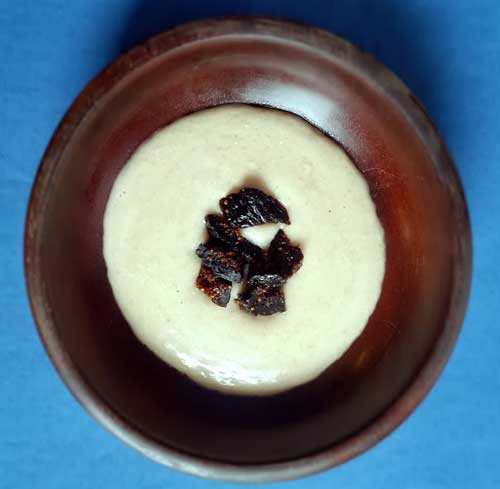
It would be easy to pass over this recipe if you were looking for one of the more exciting period dishes, but to do so, would be a disservice. Gaylede is one of a number of almond milk and rice flour based recipes that you can find in the pottage section of Harleian MS. 279. The completed dish is very pretty; the sandalwood adds a very pretty pink color to the recipe, while the ginger and galingale provide a warm spice. Ideally, the medieval cook would serve this at the beginning of a meal because it fit in with the ideology that foods which were easily digestible, along with sugar and warm spices would prepare the stomach for the important job of digestion.
This dish is interesting in that it calls for either sugar or honey to be used as a sweetener and it is the first time that I have seen this references in the Two fifteenth-century cookery-books : Harleian MS. 279 (ab 1430), & Harl. MS. 4016 (ab. 1450), with extracts from Ashmole MS. 1439, Laud MS. 553, & Douce MS. 55 by Thomas Austin--which does not mean that similar recommendations were not made in other period cookery books. We know that sugar arrives in Europe in the early 1100's, and that prior to that honey was the main sweetener that would have been used in dishes. We are also given multiple suggestions on how to serve this dish, either with figs, raisins, or hard bread that has been diced.
When sugar first arrived in Europe it was used as a medicine, and would have been restricted to those households that were able to afford it. By the 1600's it would have been more readily available. Prior to sugar, honey was the universal sweetener and its usage is as old as written history itself. One of the earliest mentions of honey is 2100 BC, where it is mentioned in Sumerian and Babylonian writings. However, there are cave paintings in Spain dating back to 7000 BC that may depict individuals gathering honey and engaging in possible bee keeping activities.
Two fifteenth-century cookery-books, 1430
.Ixxxv. Gaylede. — Take Alraaunde Mylke & Flowre of Rys, & do ])er-to Sugre or Hony, & Powder Gyngere & Galyngale ; |ieu take figys, 'an kerue hem a-to, or Eoysonys y-hole,' or hard Wastel y-dicyd^ and coloure it with Saunderys, & sethe it & dresse hem yn.
85. Gaylede - Take almond milk and rice flour and add sugar or honey, and powder ginger and galyngale; then take figs, and cut them in two, or raisins whole, or hard Wastel (bread), diced, and color it with saunders, and boil it and dress them in.
Interpreted Recipe Serve 1 as main, 2 as side
1 c. almond milk
2 tbsp. rice flour
1 tbsp. sugar or honey
1/4 tsp. ginger
1/8 tsp. galingale
1 figs, or 1 tbsp. raisins, or 1/8 c. diced bread
2 tsp. sandalwood
Bring the almond milk to a simmer and add the sandalwood. Let steep ten minutes or until desired color is reached. I used sandalwood bark that I purchased from Amazon, and you will want to strain the bark out from the almond milk--it's just not pleasant biting into a piece of bark. Trust me on this! Once the milk has been strained, add the sugar or honey, ginger, galingale and rice flour. Cook this until the rice flour has cooked thoroughly and almond milk has thickened. Top with figs, raisins or diced bread and enjoy!
The sandalwood turned the almond milk a very pretty rosy pink. The ginger and galingale was a perfect complement to the figs.
