Homemade Rose Water
The rose water of the Romans was made simply by soaking petals in water, but after the invention of distillation it meant the distillate which results when roses are boiled in water.
First, collect your roses. You can gather these in the process of normal deadheading. Use pesticide free roses if possible. If you use pesticides or you buy them from the florist, give them a good rinse before starting your rosewater project.
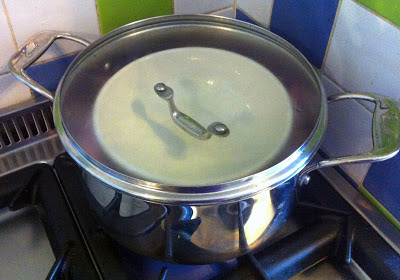
Select a large nonreactive pot with a curved lid. Place a clean brick or rock at the bottom of the pot, arranging the roses around it, and fill the pot with water, just enough to cover the petals and brick completely. Rest a nonreactive bowl on top of the brick, ensuring that it is not so high that the lid of the pot won't close, or that it is so low it is bobbing in the water.
Cover the pot with the inverted lid, and take it to the stove. Pretty much what you've done is to create your own homemade still! Now: bring the petals to a rolling boil then turn the heat down and simmer gently for about 40 minutes. The steam from the simmering roses will rise and collect on the inverted lid, and drip down into the bowl (I have seen a version of this project that calls for 2-3 trays of ice cubes to be placed on the pot lid to accelerate the distillation process).This distilled liquid is pure rosewater. Simmer for about until the rose petals in the pan lose all their color. Remove the bowl from the pot and allow to cool.
Transfer to a bottle with a tightly-fitting lid, and keep in the fridge for up to two weeks. Rose water can also be frozen.
Made about half a cup of rosewater
Recipe
Be sure you have a brick and heat-safe stainless steel or glass quart bowl ready before you begin.
2-3 quarts fresh roses or rose petals
Water
Ice cubes or crushed ice
1. In the center of a large pot (the speckled blue canning pots are ideal) with an inverted lid (a rounded lid), place a fireplace brick. On top of the brick place the bowl. Put the roses in the pot around the brick; add enough flowers to reach the top of the brick. Pour in just enough water to cover the roses. The water should be just above the top of the brick.
2. Place the lid upside down on the pot. Turn on the stove and bring the water to a rolling boil, then lower heat to a slow steady simmer. As soon as the water begins to boil, toss two or three trays of ice cubes (or a bag of ice) on top of the lid.
3. You've now created a home still. As the water boils the steam rises, hits the top of the cold lid, and condenses. As it condenses it flows to the center of the lid and drops into the bowl. Every 20 minutes, quickly lift the lid and take out some of the rose water if the dish is getting too full. It's time to stop when you have between a pint and a quart of water that smells and tastes strongly like roses.
Adapted from Rosemary Gladstar's Herbs for Natural Beauty, by Rosemary Gladstar.
