Jacobin Sops
from http://www.coquinaria.nl/
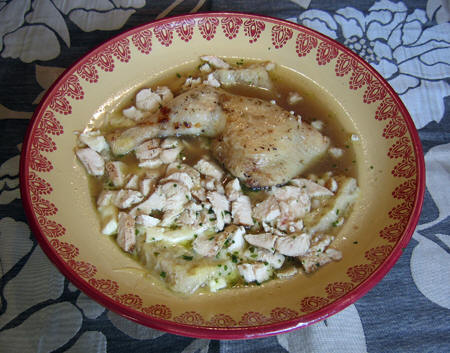
This is a recipe from the delightful cookbook Du fait de cuysine (1420) by Maître Chiquart. He was a cook in the service of Amadeus VIII (1383-1451, also known as the last Antipope Felix V from 1439 to 1449), count and first duke of Savoy. Amadeus was a regular guest at the courts of Burgundy and Berry (the Duc de Berry of the famous book of prayers was his great-uncle), and was well aware of the elevated status of his family and court. He commisioned a history of the duchy of Savoy, and ordered several of the craftsmen and scientists at his court to write books on their subject.
Not Soupe, but Sop
The recipe is for soupe Jacobine. This soupe is not a soup in the modern sense, but a sop (food soaked in a liquid before being eaten and served over toast). According to the menu at the end of the cookbook this was served during the main meal of the second day, the dynee that was served at noon. The sop must be served in gold, silver and pewter dishes. What metal you got depended on your status. Moreover, the lower you were on the social ladder, the smaller the portion you got. The dishes did not get smaller, but you had to share a dish with more people.
The soupe jacobine has a Middle Dutch variation. In ms UB Gent 476 (around 1500, edition) there is a recipe for soppijn Jacopijn, a slice of bread on which cheese and chickenmeat are heaped. But the recipes are not exactly the same. Chiquart uses broth with bone marrow and herbs, the Dutch version beef broth and sugar, and the cheeses are regional cheeses. The Dutch version is very good. Because of the sugar it tastes even more 'medieval' than the almost hundred year older recipe of Chiquart.
Jacobins
More medieval Jacobin recipes have survived. In the Ménagier de Paris there is a recipe for a delicious eel pie called Tarte Jacobine. (there is also a Middle Dutch version of Tarte Jacobine in the Nieuwen Coc-boeck of Carolus Battus 1593). Who or what were these Jacobins? They were monks from the Dominican order, their oldest cloister in Paris was dedicated to the apostle Jacob. The street where the Dominican cloister was situated, was named after the cloister Rue Saint-Jacques. During the French Revolution at the end of the eighteenth century there was a group of radical revolutionaries than named themselves after the street where they convened, but these Jacobins have nothing to do with our soupe Jacobine. On the picture a rendition of the 'termination' of the revolutionary Jacobins in 1794 with the cloister as backdrop.
The original recipe
The cookbook of Maistre Chiquart is called Du fait de Cuysine (About cooking). It survives in just one manuscript, S103, that is kept in the Kantonal-Bibliothek in Sion (in the Swiss province Wallis). Terence Scully, who has also delivered excellent editions and translations of the Viandier and the three books by La Varenne, has published the Oldfrench text in 1986, and seperately an English translation. Both are hard to find. Manuscript S103 is the actual manuscript written in the hand of Jehan de Dudens, in 1420. For the English translation I have used Scully's version (edition pp.44/45).
Et pour servir de la soupe jacobine fault que haiés voz beaulx chappons et, selon la quantité de la feste, cent ou .iic. chappons de haulte gresse, et d'aultre poulaille a grant foyson pour servir en deffault desdistz chappons ; et si soient roustitz bien et appoint. Et quant sera au despiecer les beuffs d'aute gresse si prenne on les os miolle et les lavés bien et adroit, puis les mectés boullir en chaudieres belles et nectes, et de beau mouston parmi ; et puis apprés faictes que vous ayés ung quintal de tresbon fromaige de Crampone et de Brye et du plus fin que faire se pourra et trouver, et lesditz fruictz faciés parer et nectoyer bien et appoint, et puis le tayllés bien minument. Et ledit queux qui est ordonné pour faire ladicte soupe jacopine si prenne deux ou .iiic. pains de bouche et ce pain taille par belles lesches et les roustissez tresbien nectement sans bruller, et qu'il soit rousselet, et puis le mectés en belles cornues belles et nectes - et que vous aiés .ii. belles postz blanches et nectes pour tailler vostre dit pain rousti pour les souppes jacobines ; et puis que vous ayés vostre platz d'or et d'argent et d'estaing a la suite, et par voz platz alloés vostre pain bien et doulcement et le fromaige par dessus. Et prennés voz chappons et les mectés par membres, c'est assavoir levés les ailles et les cuisses et levés la crouppe ; et puis prennés le blanc dudit chappon et le taillés bien menuz, et ce blanc de chappon semés par dessus vostre souppe jacobine ; et puis apprés prennés les membres desditz chappons, c'est assavoir les aylles, cuisses et crouppe, et mectés par dessus vostre souppe jacopine en ordonnance. Et vous prennés garde de vostre boullon des miolles de beufz et moustons qui sont bons et doulx, et coullés ce boullon en une olle grande, belle et necte ; et que vous hayés une bonne -bonnete- buguete d'erbes de salvy, percy, margellayne et ysope, et quélles soient bien nectoyés et lavees, et mectés dedans vostre boullon. Et faictes que vers le dreceur, ou vous serés pour servir des dictes souppes jacopines, vous hayés bon feu de charbon et dessoubz vostres oulles en quoy est vostre boullon affin qu'il boulle toujours ; et dudit boullon cuisés voz dictes souppes jacopines.
To serve Jacobin Sops you need your good capons, and, depending on the size of the feast, that will be one or two hundred fat capons, and a large number of other poultry to serve if those capons run out; and they should be properly roasted. When fat oxen are being cut up, their marrow bones should be taken and carefully washed, and then set to boil in good clean cauldrons with good mutton among them. After that, arrange to get a quintal [120 lbs] of very good Crampone cheese and Brie cheese, the finest that can be made and found, and have this cheese properly pared and cleaned, then cut it up very small. The cook who is ordered to make these Jacobin Sops should take two or three hundred loaves of table bread and cut this bread into good slices and toast them very neatly without burning them, so that they are brownish, and then put them into good clean two-handled pots; and you should have two immaculately clean work-tables to slice that toasted bread for the Jacobin Sops. Then you should set out your gold, silver and pewter dishes in a row, and place your bread delicately on them with the cheese on top. Take your capons and dismember them, that is, remove the wings and the legs, and remove the rump; then take the white meat of each capon and cut it up very small and scatter this white meat from the capons on your Jacobin Sops. After that take the members of the capons, that is, the wings, legs and rump, and place them in orderly fashion on top of your Jacobin Sop. Check on your broth of beef and mutton marrow, that they are good and soft, and filter this broth into a large good clean kettle; get a good bonnette - bouquet garni of sage, parsley, marjoram and hyssop which should be thoroughly cleaned and washed, and put this into your broth. Over by the dressing table where you will be serving up the Jacobin Sops, arrange to have a good coal fire under the kettles containing your broth so that it will keep on boiling, and cover your Jacobin Sops with this broth.
Modern adaptation of the recipe
I've reduced the amounts to a meal for four persons. My estimate is that the amounts in the original recipe were for four to eight hundred people, if you reckon a half to a quarter capon each. In the fifteenth century the Jacobin Sop was served in dishes for multiple eaters. The guest of honor and the host probably had a dish for themselves, from which they would present morsels as a token of favour. The larger the distance between the eater and the places of honour, the more persons he had to share his dish with. For the modern adaptation I use individual soup plates. We are all guests of honour! Although ... the plates I used were simple earthenware dishes ...
First course or main course soup for 4 persons; preparation in advance at least1 hour; preparation 15 minutes.
1 fat chicken, home-roasted (the ready roast chicken you can buy won't be spiced the medieval way!)
2 marrow bones of beef and 2 of sheep or lamb, or 4 marrow bones of beef
200 gram (1/2 pound) salers or cantal, or gruyère cheese if you can't find the other two
200 gram (1/2 pound) brie, not too ripe
coarse white bread, uncut, two days old
sprigs of sage, parsley, marjoram and hyssop
8 deciliter (3 cups/1 1/2 pints) medieval beef stock (or modern stock, preferably home made)
Preparation in advance
Cover the marrow bones with cold water, bring to the boil. Take the marrow bones out of the water, rinse them well and put them in a pan with the beef stock. Let simmer for an hour. Strain the stock while still hot (marrowfat coagulates at a high temperature). Push the remaing marrow fat out of the bones, let it cool slightly and slice it. You can also make the stock after deboning the chicken, because then the carcass can be used too.
Remove legs and wings of the chicken, and take off the white meat. Mince the breast meat. Before I forget: the chicken was filled with an onion spiked with cloves, and coated with a mixture of melted butter, pepper, ground cloves and cinnamon before roasting.
Grate the salers, cantal or gruyère, remove the crust of the brie and cut into small cubes.
Preparation
Bring the stock to the boil with the herbs.
Cut the bread into thick slices (2 centimter, 1 inch) and toast them in an oven until brown but not burnt. Place each slice in a deep soup plate and sprinkle the cheeses over them. Then cover with the minced chicken meat that you have reheated in a little hot broth. Place a leg or wing on each plate.
Pour the boiling hot broth over the covered bread and serve at once. If you are not averse to it, garnish the sop with some slices of marrow.
To serve: You can also, like Chiquart, pour the stock over the sop at the table, but take care that the stock is as hot as possible.
Ingredients
Craponne or Salers - The fromaige de crampone is a pressed cheese of cow milk originating from Craponne in the Auvergne. The modern name of this cheese is Salers, a variation of Cantal. Salers is still produced with raw milk from cows grazing on mountain pasture. But, while Cantal is made all year through, the production of Salers is limited from April 15 to November 15.
Hyssop - A small shrub with tiny purple flowers, Hyssopus officinalis. You can grow it easily in your own garden. The taste of the leaves resembles thyme. The plant originates from the Middle East and the Mediterranean, where it was a kitchen herb in classic times. The taste is rather dominant, use it sparingly. According to Alan Davidson (The Oxford Companion to Food) hyssop helps the digestion of fat, which makes it a very good herb in fatty meat dishes.
