Medieval Breads
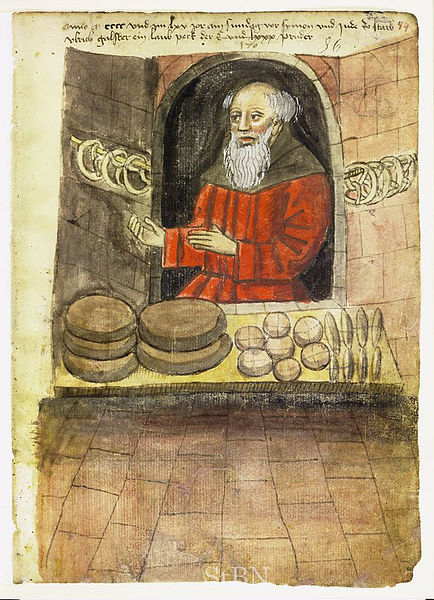
Manchet Breads were some of the best quality leaven breads eaten in Medieval and Tudor Britain. According to Elizabeth David, only the wealthy could have manchets for their breakfast or dinner and these became the 'ancestors' of eighteenth century french rolls or french bread. Yet bread like this, made of double boulted (sieved through a cloth) stoneground wheat was always the exception. For much of Britain’s history most bread baked was commonly made from a mixture of coarser flour, made from various grains like rye and barley. This mixed flour bread, called a Maslin Bread, fed the lowest classes in Medieval society, and also made the trencher’s, (bread plates) used in feasts to eat food off of.
Here is a description from the 17th century of different mixes of flour and their use:
"It is folly to send more corn [grain] to the mill than one has present use for. Wee sende (in winter time) a mette [2 bushels] of massledine for our own tempsed-bread [passed through a tempse, or coarse hair sieve] backinge; in the heat of summer wee sende but a bushell, because it will moulde and bee wasted with long standing. Wee sende for the browne bread baking (in winter time) a bushell of rye; a bushell of pease and a bushell of barley; and afore wee putte it in the poake, wee make the miller take a besome and sweepe a place, and pour it onto the grownd, and blende it alltogeather with his hand, and after that take a scuttle and putte it into the poake; in summer time wee send but a mette, because it will grow hard with long standings, viz, a bushell of pease, and a bushell of rye, into which wee putt a ryinge or two or three of barley. Wee send for our own pyes a bushell of the best wheat. We send for the folkes puddinges a bushell of barley, but never use any rye for puddinges, because it maketh them soe softe that they run about the platters; in harvest time they have wheate puddinges. The folkes pye crusts are made of massledine, as our bread is, because that paste that is made of barley meale cracketh and checketh [splits]. Poore folks putt usually a pecke of pease to a bushell of rye; and some again two pecks of pease to a frundell [2 pecks] of massledine, and say that these make hearty bread. In many places they grinde after-logginges of wheat for their servants pyes; and fewer there are that grinde any barley at all for their household use, because it is soe shorte, and will not abide workinge."
Henry Best, 'Farming Book', 1641 (in Yorkshire)
Manchet, manchette or michette (French), is a wheaten yeast bread of very good quality, or a small flat circular loaf of same. Manchets were made up as rather small loaves: in Elizabeth I's reign they were supposed to weigh 'eight ounces into the oven, and six ounces out', and forty were to be made out of the flour bolted from one bushel of corn [i.e., wheat]. The English word in early use denotes a certain quality of bread, and this may be based on its having been sifted through a narrow bag, or in French manche, lit. ‘sleeve’, also ‘strainer, boulter’ (17th cent.). The following quot., where maincherin (perhaps a variant of Middle French mancheronmancheron n.) is a kind of loaf, appears to support the view that the word meaning sleeve was used as a name for a kind of loaf.
However, for the privileged few, the very finest wheaten Manchet’s, or Pandemain (white bread of the highest quality. French “pain demaine”=bread of the lord’s estate) were baked. Yet it also needs to be remembered that Medieval milling and boulting methods were never wholly successful in removing all of the bran from the ground wheat grain, even the best flour produced was an ‘off-white’ flour, rather than the pure white flour produced today by modern industrial roller milling and boulting methods.
Manchets were often used as part of other dishes. For example, a recipe for a baked pudding that incorporates manchet is included in "Things Not Generally Known, Familiarly Explained," citing The Queene's Royal Cookbook of 1713. This is a rich pudding that includes double cream, the addition of beef suet and added aromatics such as nutmeg, cinnamon and rose water.
Period serving manuals indicate that tables were set with large amounts of bread completely apart from trenchers, and that bread was always on the table with cheese and fruit before the first course arrived. There are recipes for sops, but they are not all that common; and while it is highly probable that bread was dipped in other broths and sauces, we have no evidence that it was *only* used so, and considerable reason to doubt it. On the other hand, the same serving manuals make no mention of putting butter on the table (or olive oil); which suggests that neither was it spread with substances of that kind, at least much of the time.
Manchets generally ceased to appear in English cookery books after 1800. The closest similar yeast bread is probably a Bath bun or a Sally Lunn bun.
There are very few existent bread recipes from pre-1600. Among those are the bread recipe in Platina, the recipe for “Rastons” in one of the Harleian manuscripts, and the recipes for “Fine Manchet” and “Restons” in The Good Huswife’s Handmaide for the Kitchen.
Pliny mentions several ways of making bread, notably in an oven and under a bell (clibanis). The methods most likely used in Gaul were in ovens, under coals (hearth bread) or in bells. Certainly a great deal of bread – probably most – was made at home. While there is evidence that professional bakers existed in cities, no such evidence exists for the countryside and it would have been surprising – beyond private villas – for such establishments to have existed so early.
Bread from Platina, De Honesta Voluptate, 1475
This looks to be a standard sponge-starter method of bread making. A natural sour dough starter is used (presumably this is what the "leaven" is that Platina refers to), to which fine wheat flour water, and salt are added. The whole mix is combined and kneaded. Sponge starters using natural leaven such as the kind in Platina's recipe typically take a long time to reach the appropriate state, often an entire day. The rising time and the starter give the bread a more traditional texture and stronger flavor (not necessarily a sour one!) typical of today's European-style breads.
“Therefore I recommend to anyone who is a baker that he use flour from wheat meal, well ground and then passed through a fine seive to sift it; then put it in a bread pan with warm water, to which has been added salt, after the manner of the people of Ferrari in Italy. After adding the right amount of leaven, keep it in a damp place if you can and let it rise…. The bread should be well baked in an oven, and not on the same day; bread from fresh flour is most nourishing of all, and should be baked slowly.” (Platina, Milham, 1999)
Fennel Buns
"The same baker should mix as much flour with warm water as is enough to make a bun and then put into the mixture fennel seeds and chopped bits of lard,or butter, and mix again as long as necessary to bring it all into a single mass, Then he should press it into a round shape with his hands and put it in the oven with the bread, or he may bake it on a hearth under a lid covered with ashes and coals".
Recipes for Manchet, Cheat, and Course Breads from The Good Huswifes Handmaide in the Kitchen, 1594
This one of the earliest and most important English bread recipes. The Good Huswifes Handmaide for the Kitchen was published in England in 1594. It is one of the first English cookbooks. The anonymous author offers a wide range of recipes, mostly simple, and most reasonably accessible to modern readers. The book includes two recipes for a white bread called manchet. Manchet seems to have been the best of the white breads. It was made in private homes, not sold by bakers. The “fine manchet” is the first of the two white bread recipes in The Good Huswifes Handmaide for the Kitchen.
The making of fine Manchet.
TAke halfe a bushell of fine flower twise boulted, and a gallon of faire luke warm water, almost a handful of white salt, and almost a pinte of yest, then temper all these together, without any more liquor, as hard as ye can handle it: then let it lie halfe an Lent, Tansey hower, then take it vp, and make your Manchetts, and let them stande almost an hower in the ouen. Memorandum, that of euery bushell of meale may be made fiue and twentie caste of bread, and euerie loafe to way a pounde beyside the chesill,
The making of manchets after my Ladie Graies vse.
Take two peckes of fine flower, which must be twice boulted, if you will have your manchet verie faire: Then lay it in a place where ye doe use to lay your dowe for your bread, and make a litle hole in it, and put in that water as much leaven as a crab, or a pretie big apple, and as much white salt as will into an Egshell, and all to breake your leven in the water, and put into your flower halfe a pinte of good Ale yest, and so stir this liquor among a litle of your flower, so that ye must make it but thin at the first meeting, and then cover it with flower, and if it be in the winter, ye must keepe it verie warm, and in summer it shall not need so much heate, for in the Winter it will not rise without warmeth.
Thus let it lie two howers and a halfe: then at the second opening take more liquor as ye thinke will serve to wet al the flower. Then put in a pinte and a halfe of good yest, and so all to breake it in short peeces, after yee have well laboured it, and wrought it five or sixe tymes, so that yee bee sure it is throughlie mingled together, so continue labouring it, till it come to a smoothe paste, and be well ware at the second opening that yee put not in too much liquor sodenlie, for then it wil run, and if ye take a litle it will be stiffe, and after the second working it must lie a good quarter of an hower, and keep it warme: then take it up to the moulding board, and with as much speede as is possible to be made, mould it up, and set it into the Oven, of one pecke of flower ye may make ten caste of Manchets faire and good.
To make good Restons.
TAke a quart of fine flower, lay it on a faire boord, and make a hole in the middest of the flower with your hand, and put a sawcerfull of Ale Yest therein, and ten yolkes of Egges, and put therto two spoonefuls of Synamon, and one of Ginger, and a spoonfull of Cloues and Mace, and a quarterne of Sugar fine beaten, and a litle Safron, and halfe a spoonefull of Salt. Then take a dishfull of Butter, melt it and put into your flower, and therwithall make your paste as it were for Manchets, and mould it a good while and cut it in peeces the bignes of Ducks Egges, and so moulde euerye peece as a manchet, and make them after the fashion of an Ackorn broad aboue, and narrow beneath Then set them in an Ouen, and let them bake three quarters of an howre. Then take fiue dishes of Butter and claryfie it clean vpon a soft fire: then drawe foorth your Restons foorth of the Ouen, and scrape the bottoms of them faire and cut them overthwart in foure peeces, and put them in a faire charger, and put your clarified butter vpon them. Then haue powder of Synamon and Ginger readie by you, and Sugar verie fine. And mingle them altogether, and euer as you set your peeces thence, together cast some of your sugar, Synamon, & ginger vpon Reston them, and when you haue set them all vp, lay them in a faire platter, and put a litle butter vpon them, and cast a litle sugar vpon them and so serue them in.
To make leauened bread.
TAke sixe yolkes of Egs, and a litle peece of Butter as big as a Walnut, one handfull of verie fine flower, and make al these in paste, and all to beat it with a rolling pin, till it be as thin as a paper leafe, then take sweet Butter and melt it, and rub ouer all your paste therewith, with a feather: then roll vp your paste softly as ye would roll vp a scroll of paper, then cut them in peeces of three inches long, and make them flat with your hands and lay them vpon a sheet of cleane paper, and bake them in an Ouen or panne, but the Ouen may not be too hot, and they must bake halfe an howre, then take some sweete butter and melt it, and put that into your paste when it commeth out of the Ouen, and when they are verie wet, so that they be not drie, take them out of your butter, and lay them in a faire dish, and cast vpon them a litle Sugar, and if you please, Synamon and Ginger, and serue them foorth.
Gervase Markham provided recipes for Manchet and Cheat Bread, The English Huswife, 1615
For baking of bread of your simple meals [i.e. of meal of wheat unmixed with rye or barley] your best and principal bread is Manchet, which you shall bake in this manner:—First your meal being ground upon the black stones, if it be possible, which makes the whitest flour, and bolted through the finest bolting-cloth, you shall put it into a clean kimnel, and opening the flour hollow in the midst, put into it of the best ale barm the quantity three pints to a bushel of meal, with some salt to season it with ; then put in your liquor reasonable warm, and knead it very well together with both your hands and through the brake; or, for want thereof, fold it in a cloth, and with your feet tread it a good space together; then letting it lie an hour or thereabouts to swell, take it forth and mould it into manchets round and flat, scotch them about the waste to give it leave to rise, and prick it with your knife in the top, and so put it into the oven and bake it with a gentle heat.
To bake the best Cheat bread, which is also simply of wheat only, you shall, after your meal is dressed and bolted through a more coarse bolter than was used for your manchets, and put also into a clean tub, trough or kimnel, take a sour leaven, that is, a piece of such like leaven saved from a former batch, and well filled with salt, and so laid up to sour; and this sour leaven you shall break into small pieces into warm water, and then strain it ; which done, make a deep hollow hole in the midst of your flour, and therein pour your strained liquor, then with your hand mix some part of the flour therewith, till the liquor be as thick as a pancake batter, then cover it all over with meal, and so let it lie all that night. The next morning stir it and all the rest of the meal well together, and with a little more warm water, barm, and salt to season it with, bring it to a perfect leaven, stiff and firm ; then knead it, break it, and tread it (as before said in the manchets) and so mould it up into reasonable big loaves, and then bake it with an indifi'erent good heat.
The manchet here is leavened entirely with barm. The cheat is leavened with sour dough (“sour leaven”), even if the latter is (unusually) reduced to a liquid first. Rather strangely though, barm is still added, but, like salt, “to season it with”. In France, it would not later be unusual to use yeast and sourdough together, but not to use one much later than the other. Was the idea here to give the cheaper, sourdough leavened, bread some of the taste of the better bread? Or did this simply “top off” the bread's rising? Either way, this again shows how universal barm was in England.
Gervase Markham also gives instructions for an even less refined bread. “Coarse Bread”, which uses peas along with wheat or rye:
For your own bread, a bread for your hind-servants, which is the coarsest bread for man's use, take of barley two bushels, of pease two pecks, of wheat or rye a peck, a peek of malt; these you shall grind altogether, and dress it through a meal sieve; then putting it into a sour-trough, set liquor on the fire, and when it boils let one put in the water, and another with a mash-rudder stir some of the flour with it, after it hath been seasoned with salt, and so let it be till next day. Then putting to the rest of the flour, work it up into stiff leaven; then mould it, and bake it into great loaves with a very strong heat.
This appears to be barely leavened at all, though the approximate method used is closer to sourdough than yeast.
Lady Arundel's Manchet
Lady Arundel's Manchet is a traditional version of a manchet, a traditional English yeast bread from Sussex. The recipe for Lady Arundel's Manchet was first published in 1653 according to Elizabeth David. It was a luxurious bread eaten by the medieval aristocracy and remained popular into the Restoration period. A recipe appears in A True Gentlewoman's Delight (1653) printed for the Countess of Kent.
Take a bushel of fine wheat-flower, 20 eggs, three pound of fresh butter ; then take as much salt and barm as to the ordinary manchet; temper it together with new milk pretty hot, then let it lie the space of half an hour to rise, so you may wor it up into bread, and bake it: let not your even be too hot.
— True Gentlewoman’s Delight, 1676.
This too uses barm.
In Hannah Glasse's 1784 cookbook, she offered a recipe for “white bread” which also uses barm:
To make White-Bread, after the London Way
TAKE a bushel of the finest flour well dressed, put it in the kneading-trough at one end, take a gallon of water (which we call liquor), and some yeast; stir it into the liquor till it looks of a good brown colour and begins to curdle, strain and mix it with your flour till it is about the thickness of a seedcake; then cover it with the lid of the trough, and let it stand three hours, and as soon As you see it begin to fall, take a galIon more of liquor; weigh three quarters of a pound of salt, and with your hand mix it well with the water: strain it, and with this liquor make your dough of a moderate thickness, fit to make up into loaves; then cover it again with the lid, and let it stand three hours more. In the mean time, put the wood into the oven and heat it. It will take two hours heating. When your sponge has stood its proper time, clear the oven, and begin to make your bread. Set it in the oven, and close it up, and three hours will bake it. When once it is in, you must not open the oven till the bread is baked; and observe in summer that your water be milk-warm, and in winter as hot as you can bear your finger in it.
Note, As to the quantity of liquor your dough will take, experience will teach you in two or three times making, for all flour does not want the same quantity of liquor; and if you make any quantity, it will raise up the lid and run over.
This is followed by one for French bread, which too uses barm (though much bread in France at this point was in fact still made with sourdough). Later in the same chapter, she gives a recipe for “making Bread without Barm by the help of a Leaven”. This recipe however specifies that the original sourdough will have been ferrmented with barm. What is more, the recipe is credited to “the Dublin Society”, which means it may have come from Ireland, which is indeed said to have used sourdough.
Glasse also includes instructions “to preserve a large Stock of Yeast”, again showing how important this was in England. Though French bakers by now were using yeast for some breads, no similar domestic instructions exist in France.
What can one conclude from this fairly light evidence? Certainly, barm was widely available in England, available enough to be used beyond both brewing and baking. It was the favored leavening for the best bread. Was sour dough used for the others? From Elizabethan times on, at least, that seems to have been the case, even if some barm might be added even for these. For the medieval period, the best one can say is that it is possible, but that not the least evidence proves as much, whereas the close association of baking and brewing in the period makes it very likely that barm was used in at least some breads.
