Medieval Cookbooks - up to 1500
Texts to add below:
Ein Buch von guter spise c. 1350 (Translated by Alia Atlas)
Kitab al Tibakhah: A Fifteenth-Century Cookbook by Ibn al-Mabrad
An Ordinance of Pottage, 15th c, pub. by Constance B. Hieat 1988
Ancient Cookery from A Collection of the Ordinances and Regulations for the Government of the Royal Household made in Divers Reigns from King Edward III to King
William and Queen Mary also Receipts in Ancient Cookery 15th c., pub. by John Nichols 1740
Here is a selection of manuscripts and cookbooks of Medieval Europe, written or published between the 13th century and the Renaissance.
The most ancient texts, such as the Sion manuscript, have come down to us in the form of rolls or books of parchment. The parchment was usually made from the skins of stillborn animals (calves, kids, lambs), tanned and cut to the required size. This demanded an enormous amount of preparation, and for this reason, parchment was expensive and scarce. The copyist, who was often a monk, originally used an ink made from cabbage juice, copper sulfate (cupri rosa or couperose) and oak gall, all cooked in gum arabic with the addition of beer or wine.
Later, manuscripts were established on paper made from rags of linen, hemp and cotton. This technique was invented in China in the 2nd century. The Mongols later exported it to Damas and Bagdad from the 8th century onwards. In 1250, paper was manufactured for the first time in Europe in Fabriano, near Ancona (Italy) but it wasn't until the middle of the 14th century that paper mills began to spread throughout Europe.
In the 13th century, the copying of books became more widespread, leaving its monastic origins for the more profane world of the professional copyists. Although Gutenberg invented the printing press in 1450, the production of copied manuscripts and printed books continued in parallel for a certain time. The first printed cookery books seem to be the Kuchemaistrey printed in German in 1485 and the Viandier de Taillevent printed in French around 1486. De Honesta Voluptate et Valitudine, a book on dietetics with recipes, written in Latin by Platina, was printed back in 1480.
Over 70 collections of medieval recipes survive today, written in several major European languages.
For a Bibliography with links to cookbooks, see http://www.3owls.org/sca/cook/bib.htm.
In 1992 Constance Hieatt suggested that there were well over fifty medieval manuscripts containing culinary receipts still in existence. This figure did not take into account the many medical collections which might also include culinary items. The number of culinary receipts varied from one or two, where the main focus of the manuscript lay elsewhere, to anything from twenty to over two hundred in what were essentially cookery books. Hieatt’s preliminary catalogue of extant manuscripts listed seven ‘families’ of receipts, each represented by between two and six copies, plus partial versions in other texts. She contended that virtually any other manuscript with more than a few receipts was related to one or other of these basic families. Even among these, later manuscripts borrowed from their predecessors: The Forme of Cury from the earlier Diversa Servicia; the earliest printed cookery book, the Boke of Cokery produced by Pynson in 1500, from a version of the late fifteenth-century manuscript A Noble Boke off Cookry, itself a compilation based largely on the mid-fifteenth-century ms Beinecke 163 (printed by Hieatt as An Ordinance of Pottage, 1988) and A Boke of Kokery (BL Harleian 4016), a text also from the middle of the fifteenth century.*
* Hieatt, ‘Listing and Analysing the medieval English culinary recipe collections’ in Lambert (1992), pp. 15–21. While there are 6 complete or nearly complete versions of The Forme of Cury, receipts from it appear in 4 other mss, as is clear from the catalogue by Hieatt, Lambert, Laurioux and Prentki in the same volume, pp. 314–362
There are mss in which cookery is associated with medical matters, used by practising doctors (such as BL Sloane 374) and apothecaries (such as BL Royal 8.B.iv) or patients themselves (such as BL Arundel 334) and, at the other end of the spectrum of association, those in which cookery forms part of a vast range of domestic lore, used as a practical guide to estate management by householders (as, for instance, BL Add. ms 5467).
Overview of Cookbooks by Country
These are some of the cookbooks available from 1100 - 1500.
Northern Europe steps up to the plate first with Libellus de arte coquinaria. written not in the Latin of previous texts, but in the vernacular. This cookbook is the source of the famous Icelandic Chicken Recipe; a delicious dish of chicken with bacon and sage wrapped in pastry and baked. Plus it records directions for several basic preparations such as walnut and almond oil, almond butter and an early version of the cameline sauce (think medieval ketchup) that was served throughout the Middle Ages.
Also known as the Harpestreng Cookbook, this text exists in four extant manuscripts. The earliest is believed to date from 1300, and while written in Danish, is likely a translation of an earlier German text. Other versions date from the fourteenth century, the last quarter of the fifteenth century (this time in Icelandic) and the late fifteenth or early sixteenth century (this time in low German). While these editions are not exact copies, some include extra recipes or omit others and sometimes expand on the included recipes, all are closely related. For a detailed account of the linguistic ins and outs plus a translation to modern English of all the recipes, see Libellus de arte coquinaria: An Early Northern European Cookery Book by Rudolf Grewe and Constance B. Hieatt.
It might seem strange that this cookbook is being copied out over the course of two centuries or more, however, this was common for many texts, which often appeared decades and even centuries after they were first written and reappeared in other languages. The Renaissance, for example, saw many classical tests revived, not always with proper citations. Thus if you are having trouble finding primary resources specific to your place and time period, it is perfectly reasonable to look at later sources or neighboring cultures. And sometimes it's the only choice you have.
German Cookbooks: While the Libellus mentioned above could be argued to be the first German cookbook, around 1350 we have an indisputably genuine German cookbook in Ein Buch von guter spise, a book of good food. Das Kochbuch des Meisters Eberhard, which includes a large section of advice on the healthful qualities of various foods, arrives around 1450 and Kuchenmeisterei in 1490. Also in the 15th century we see in Kochbuch aus dem Archiv Des Deutschen Ordens from East Prussia.
French Cookbooks: We start out about 1300 with Enseignements, a text mostly of meat recipes, but Le Viandier de Taillevant is perhaps the most important text. Copies date from the early in the 1300's and continued to appear either under this title or repackaged (plagiarized in modern parlance) under other titles, both whole and in part. It was also translated in period into many languages and could reasonably be the basis for a fine meal for any persona in this period.
Le Menagier de Paris, 1393, draws most of its recipes from Tailevent. However, it adds a wealth of information about various topics from six ways to kill flies to buying horses, from planning a wedding feast to proper deportment in all sorts of situations, including choosing a second husband. This was written by a middle-aged man for a young (probably fifteen) bride at her request. It is an ideal source for the operation of a French household of the lower nobility in the mid-centuries of our period.
Du fait de cuisine follows at 1420, with Viander around 1485, finishing up with Le Cuisinier Taillevent at 1496. Terence Scully, editor and scholar, has published editions of many Medieval French texts and is an undisputed expert in the field.
English Cookbooks: While there are a few earlier texts, Forme of Cury, written by the chief cook for Richard II, arrives on the scene around 1390 and is often considered the first English cookbook. This is a hallmark text with recipes for many signature dishes of Medieval cuisine. A large assortment of fourteenth century manuscripts, (some as early as 1300), ranging from just a few recipes to editions of Forme of Cury have been collected and published together in Constance B. Hieatt's Cury on Inglysche. Hieatt, and Sharon Butler are the authors of an early classic in the field Pleyn Delit, Medieval Cookery for Modern Cooks, which brings a number of recipes from English sources into modern English and into modern kitchens.
Two Fifteenth Century Cookery Books (ca. 1439-1450) were published by Thomas Austin in 1888 and republished by Cindy Renfrow in Take a Thousand Eggs or More. This two volume set includes the original text, a modern English transcription and in Vol. 1, modern redactions. We also have Liber cure Cocorum in 1430 and A Noble Boke of Cookry in 1468. We are quite indebted to Victorian era antiquarians for the publication of many extant texts. However, while some Victorians were trying to preserve these manuscripts, others were more interested in using them to show how far they had come from such ignorant behavior. (To them we owe the demon of 'they used lots of spices to disguise bad meat' which refuses to die no matter how often we skewer it.)
Moving down to the Iberian Pennisula we start off with an Andalusian Cookbook: Andalusia was an area of Moorish Spain and An Anonymous Andalusian Cookbook of the 13th Century, translated my Charles Perry, is Arabic in nature and usually serves as a source for Middle Eastern period food. You could also view this as a Spanish Cookbook as Arabic influences are evident in later cookbooks from the area. There are also some earlier Arabic cookbooks from the Middle East and Arabic medicine continued to influence medieval medicine throughout period, as is evident in the lavishly illustrated Italian Tacuinum Sanitatas texts cataloguing information on the health effects of food and various activities.
Portugal: What we have of Portugal is a bit later but we do have A Treatise of Portuguese Cuisine From the Fifteen Century featuring a variety of recipes from meat to sweets.
Spain: Finishing up with the Iberian Peninsula we have Libre de totes maneres de confits in Catalan around 1400 and Arte Cisoria I tratado dell�arte de cortar del Culchillo in Spanish in 1423.
Italian Cookbooks: Early works remained in Latin but by the early 1400's we have Martino of Como's Libro de arte coquinaria. Tucany provides Libro della cocina, also known as Anonimo Toscano and Libro di cucina/Libro per cuoco, also known as Anonimo Veneziano from the area around Venice, both hail from the late fourteenth or early fifteenth century.
A number of recipes from these manuscripts would be familiar to modern Italians including pasta. (But still no tomato sauces as the tomato is a transplant from the New World.) Terence Scully brings us a translation of The Neapolitan recipe collection of the fifteenth century bringing us up to what is considered the first printed cookbook, De honesta voluptate by Platina. This was, like many cookery texts, packaged as a health manual and took much of its recipe collection from Martino of Como's earlier manuscript. It was also translated into many languages including English by 1600.
10th century
Kitab al-Ṭabīḫ by Abu Muhammad al-Muthaffar ibn Nasr ibn Sayyār al-Warrāq (9th and 10th century)
Abu Muhammad al-Muthaffar ibn Nasr ibn Sayyār al-Warrāq (Arabic: أبو محمد المظفر بن نصر ابن سيار الوراق) of Baghdad was the compiler of a tenth-century cookbook, Kitab al-Ṭabīḫ (Arabic: كتاب الطبيخ, The Book of Dishes). This is the earliest known Arabic cookbook. It contains over 600 recipes, divided into 132 chapters. al-Warraq's book includes chapters on handwashing, dinner conversation and etiquette, and health, along with the recipes and poems about food.
This is a late 10th century compendium of recipes from 'Abbasid cookbooks from the 9th and 10th centuries CE that are now lost to us.The compiler is sometimes referred to in food literature as "al-Warraq", and sometimes as "ibn Sayyar". The original included forty recipes from cookbooks by the great gastronome Abu Ishaq Ibrahim ibn al-Mahdi (779-839 CE), half-brother of the Caliph Harun al-Rashid, as well as by Abu Samin, a chef to the Caliph al-Wathiq who died in 847 CE.
Annals of the Caliphs' Kitchens: Ibn Sayyar al-Warraq's Tenth-Century Baghdadi Cookbook by Nawal Nasrallah
A complete translation of ibn Sayyar al-Warraq's 10th century CE compendium of recipes from the 9th and 10th century CE, Kitab al-Ṭabīḫ (Arabic: كتاب الطبيخ, The Book of Dishes).
The book was recently edited and translated into English, with excellent introductory matter and an expansive glossary of food ingredients, medicinal ingredients, and prepared dishes, by Nawal Nasrallah under the entertaining title Annals of the Caliphs' Kitchens: Ibn Sayyar al-Warraq's Tenth-century Baghdadi Cookbook (Brill, 2007). This publication introduces to the interested reader a thorough survey of the period and its food culture. An extensive glossary, in Arabic and English, of medieval ingredients and dishes, and an appendix of historical figures provide the necessary reference tools for this work. Making this key resource available in English for the first time to scholars and the general reader fills a gap in the cultural history of the Medieval Islam.
This edition is drawn from and cross-checked through the three surviving manuscripts which are located in England, Helsinki, and Istanbul.
12th Century
Alexander Neckam's 12th century travelogue of London & Paris
Durham Priory manuscript, 1160s-1180s
13th century - Andalusian
Kitab al-Tabikh (The Book of Dishes) (1226) by Muhammad bin Hasan al-Baghdadi bin Muḥammad bin al-Karīm al-Baghdadi, usually called al-Baghdadi
Muḥammad bin al-Ḥasan bin Muḥammad bin al-Karīm al-Baghdadi, usually called al-Baghdadi (d. 1239 AD) was the compiler of an early Arabic language cookbook of the Abbasid period, كتاب الطبيخ Kitab al-Ṭabīḫ (The Book of Dishes), written in 1226. The only original manuscript, formerly held in the library of the Aya Sofya Mosque, is still in Istanbul, Turkey; it is now MS Ayasofya 3710 in the Suleymaniye Library. At some point a Turkish sultan commissioned very a handsome copy, now MS Oriental 5099 in the British Library in London.
At a still later time, a total of about 260 recipes were added to Kitab al Tabikh's original 160 and the expanded edition was retitled Kitab Wasf al-Atima al-Mutada (Kitâbü’l-Vasfi’l-Et‘ime el-Mu‘tâde) (translation of it also appears in Medieval Arab Cookery); three currently known copies of K.Wasf survive, all in Turkey - two of them in the library of the Topkapi Palace, showing the Turks high regard for this book.
Finally, in the late fifteenth century, Muhammad ibn Mahmud al-Shirwani, the physician of Murad II prepared a Turkish translation of the book with also adding around 70 contemporary recipes, the first Turkish cookery book. This translation was published in modern Turkish in 2005, whereas a modern Turkish translation of the original book (co-edited by Charles Perry) was published in 2009.
A Baghdad Cookery Book: Tthe Book of Dishes (Kitaab Al-oTabaikh), by Muhammad Ibn Al-H Al-Baghdadi, English translation by Charles Perry
Al-Baghdadi's "Kitab al-Tabikh" was for long the only medieval Arabic cookery book known to the English-speaking world, thanks to A. J. Arberry's path-breaking 1939 translation as "A Baghdad Cookery Book", which was re-issued by Prospect Books in 2001 as "Medieval Arab Cookery". For centuries, it had been the favourite Arab cookery book of the Turks. The original manuscript is still in Istanbul, and at some point a Turkish sultan commissioned a very handsome copy, which can still be seen in The British Library in London. In the twentieth century the Iraqi scholar, Daoud Chelebi, produced a modern transcription which served as the basis for Arberry's translation. Charles Perry has re-visited the manuscript and discovered many possible errors and amendments that affect the interpretation of these essential recipes for the understanding of medieval Arab cookery. He has produced a new English translation incorporating these amendments and fully annotating his variations with the 'authorised' version.
The Anonymous Andalusian Cookbook (13th century)
Anonymous Andalusian, Kitâb al-Tabîkh fi'l-Maghrib wa'l-Andalus fi'asr al-Muwahhidin ("The Book of Cooking in Maghreb and Andalus in the era of Almohads, by an unknown author." It is commonly known in English today as "The Anonymous Andalusian Cookbook." This manuscript, about cookery in North Africa and in Andalusia (southern Spain) at the time of the Almohades, includes 543 recipes.
The book was complied by a scribe in the 1400s, whose name appeared on the first page of the text, but the first page has not survived the ages. His work contains recipes copied from a number of works from the 1200s, some surviving and some not surviving independently to today.
The major part of the English translation is by Charles Perry, a scholar, food historian, and writer of a food column for the L.A. Times.
Charles Perry's translation of An Anonymous Andalusian Cookbook of the 13th Century (.pdf)Like all ancient cookbooks, this one is made up of pieces of other cookbooks. Think of it as a recipe notebook from a busy estate kitchen. The reigning cook added to his recipe collection by:
- combing through other cookbooks,
- learning from kitchen help who had worked for other households,
- receiving recipes collected by members of the household while abroad,
- learning from cooks who visited the estate together with their employers,
- and by corresponding with cooks in other households.
Periodically, these cooks published their recipe collections for the honor of their patron, or for their own honor. Then scribes would copy the books for a client, or for the book’s owner to give to friends, or as a gift, or even just for posterity.
This cookbook borrows directly from several well-known cookbooks, all from roughly the same period.
- One of these is by Muḥammad bin al-Ḥasan bin Muḥammad bin al-Karīm al-Baghdadi, usually called al-Baghdadi [d. 1239 AD], who compiled a cookbook called Kitab al-Ṭabīḫ, or The Book of Dishes, written in 1226.
- Some recipes come from cookbooks by the gastronome Abu Ishaq Ibrahim ibn al-Mahdi [b.779-d.839 CE], half-brother of the Caliph Harun al-Rashid.
- Some recipes come from cookbooks by authors unknown to us today.
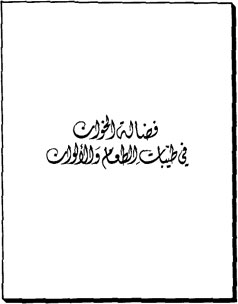
Fudalat al-Khiwan ("The delights of the table") Andalusian
This manuscript written by Ibn Razin Tujibi, an Andalusian nobleman, contains 450 recipes written between 1238 and 1266.
13th Century - Anglo-Norman manuscripts
B.L. Additional 32085 and Royal 12.C.xii
Two compilations written in Anglo-Norman, a language close to Norman French and Picard, containing about 20 recipes each, have been found in the British Library (London). B.L. Additional 32085, late 13th century - 1290, and Royal 12.C.xii, 1320 - 1340.
B. L. Additional 32085 consists of a small quarto vellum volume whose various contents date to no later than the early years of King Edward I's reign (1272-1307). The bound leaves are mainly statutes and treatises, but contain some recipes as well.
13th Century - French
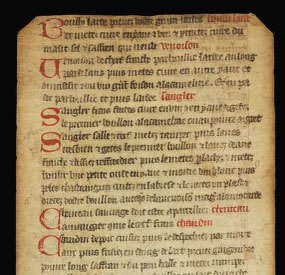
Manuscrit de Sion
Found in the cantonal library of Valais, this parchment was written before the birth of Taillevent (1310 - 1395) and includes 133 recipes. The text served as a source for and was revised in the late 1300s as the famous Viandier, attributed to the royal cook Guillaume Tirel, known as "Taillevent."
It was part of the library of Bishop Walter Supersaxo (ca. 1402-1482) and his son Georges (ca. 1450-1529). (tog)
Enseingnemenz ("Teaching")
The Enseingnemenz ("Teaching") was found in a manuscript of the National Library (Bnf, Paris), following 2 recipe compilations in Latin: the Liber de coquina ("Cookery book") and the Tractatus de modo preparandi and condiendi omnia cibaria ("Treaty of the way to prepare and season all food"). These 3 compilations of recipes were associated to a treaty of surgery.
The text consists of two independent parts cited mostly as Tractatus (part 1) and Liber de Coquina (part 2). The titles are taken from marginal notes by the medieval editor. The authors of either part are unknown. It is believed that the Tractatus has originally been written by a French author and the Liber de Coquina by an Italian author from the Naples area, someone familiar with the Neapolitan court then under the sphere of Charles II of Anjou (1248-1309)
Tractatus (part 1)
wine compositions
poultry and meat
fish
dishes for the rich
legumes, eggs, leeks and gravyLiber de Coquina (part 2)
vegetables
poultry
pastry
fish
compositions of many ingredientsIt survived in two codices from the beginning of the 14th century. Both are conserved at the Bibliothèque Nationale in Paris, France.
- manuscrits Latin # 7131, fol. 94r-99v, Bibliothèque nationale, Paris (ca. 1304-1314)
- manuscrits Latin # 9328, fol. 129r-139v, Bibliothèque nationale, Paris (14th century)
14th century
Catalan - Libre de Sent Sovi ("Book of Sent Sovi"): this is an anonymous text written in Catalan in 1324. This manuscript contains 222 recipes, which marks the infancy of Catalan cookery, with its specific techniques : the "sofregit" and the "picada".
Daz bûch von gûter spîse and Diz buch sagt von guter Spîse: "The book of good food" is the first known German cookbook, presumably written between 1345 and 1354. This manuscript includes 101 recipes. The other manuscript contains 69 recipes.
French - Le Viandier (often called Le Viandier de Taillevent) was the most widely published cookbook during the Middle Ages and is largely credited to Guillaume Tirel, alias Taillevent. However, the earliest version of the book has been dated to around 1300, about 10 years before the birth of Tirel. The original author is unknown, but it was not uncommon for medieval and early modern recipe collections to be plagiarized, complemented with additional material and presented as the work of later authors.
It is one of the earliest recipe collections of the Middle Ages. Among other things, it contains the first detailed description of an entremet. It is thought to be the first professional treatise written in France, and upon which all French cooking was founded until, in 1472, J.B. Platina's De Honesta Voluptate eclipsed it.
There are four extant manuscripts of Le Viandier.
- The oldest, found in the Archives cantonales du Valais (Sion, Switzerland), was written in the late 13th or very early 14th century, and was largely overlooked until the 1950s. It is this manuscript that calls into question the authorship of Tirel, but a portion of it is missing at the beginning, so the title and author given for this earlier work are unknown.
- A manuscript, formerly thought to be the oldest manuscript and published in 1395, resides at the Bibliothèque nationale de France. It includes 145 recipes.
- Somewhat later, early 15th century, and slightly expanded is the Vatican Manuscript, which is better known because it was reprinted in 1892 by Jérôme Pichon and Georges Vicaire.
- There is yet another altered manuscript in the Bibliothèque Mazarine in Paris. In 1485, an edition was printed, considerably altered from the original manuscripts.
The Viandier was reprinted in French around 1490, with 219 recipes and several complete menus.
These different versions of the Viandier are rewritten and enlarged versions of the Manuscrit de Sion, written around 1300 or before.
http://www.telusplanet.net/public/prescotj/data/viandier/viandier1.html
Great Britain -The Forme of Cury ("The Rules of Cookery") is an extensive recipe collection written around 1390 whose author is given as "the chief Master Cooks of King Richard II". The modern name was given to it by Samuel Pegge, who published an edition of it in 1791. This name has since come into usage for almost all versions of the original manuscript. Along with Le Viandier, it is the best-known medieval guide to cooking. The roll was written in late Middle English on vellum and details some 205 recipes (although the exact number of recipes varies slightly between different versions).
Some recipes in The Forme of Cury appear to be influenced by the Liber de Coquina, which had contributions from Arabic cuisine. For example, the recipe for mawmenee corresponds to the Arabic mamuniyya. The confectionery-like payn ragoun confirms the connection with Sicily (which had been Arab, Catalan and Norman), as it uses the Arab technique of cooking in soft ball syrup.
According to Constance B. Hieatt, the Forme of Cury can be classified into four different categories :
- Manuscript A, from the British Library, this text printed in 1780 contains 196 recipes. Constance B. Hieatt estimates that this version is unusable because the editors did not know the existence of other manuscripts. Thus, it does not act as a reference point, but the majority of the recipes presented in the Curye on Inglysch can be found there.
Complete Text in Medieval language : The Forme of Cury, A Roll Of Ancient English Cookery, Compiled, about A.D. 1390. - Manuscript B, from the Pierpont Morgan Library of New York, is very damaged and in the form of a scroll. It includes 180 recipes.
- Manuscript H, from the British Library Harley 1605, a manuscript comprised of 133 recipes.
- Manuscript M, from the John Rylands University of Manchester. This manuscript is missing the first few pages but contains 194 recipes.
The Forme of Cury in the version of the Curye on Inglysch (Edition Constance Hieatt and Sharon Butler in Oxford University Press London/ New York/ Toronto, 1985) includes 205 recipes.
The Forme of Cury contains :
An introduction announcing a compilation of recipes that were carried out with the agreement and the advice of the masters in medicine and philosophy who resided under King Richard II. This very young king (only 23 years old in 1390), ruled more or less in a despotic sort of way between 1377 and 1399. He died later from hunger in prison. We know his tragic fate thanks to Shakespeare’s piece on Richard II.
As related to southern cuisine, one can note the presence of about ten vegetable recipes, in which a very rare recipe for a vinaigrette salad, in the cookbooks for medieval cuisine. The medieval English cuisine seems to identify more with the medieval cuisine of the south than with the French cuisine where vegetables are seldom used. The relationship to southern cuisine is equally evident because of the presence of almonds and almond oil in 19% of the recipes, (compared to 12% from the recipes of the Viandier from the 14th century). This percentage rose to 45% in the books during the 15th century (Harleian). The Forme of Cury also uses large quantities of saffron just as the southern cuisine had, (40% compared to 29% in the Viandier).
Its Italian influence is confirmed by several pasta recipes: losyns, rauioles, makerouns, (macrows in Manuscript A), raphioles. The sawse sarzyne, with grenades which does not grow in England, seems to be very similar to the brouet sarrasinois of Anonimo Toscano. One may find many of the recipes to be bitter-sweet, as the Italians like them. One finds also sweetened mustard lombardes as seen in the Italian and Catalan recipes. In addition, 31% of the recipes from The Forme of Cury used sugar, (49% if one adds fruit), compared to 6% from the recipes of the Viandier from the 14th century, (8% if one adds fruit). Some recipes seem to be influenced by the Liber of Coquina, and through him, by the arabic cuisine, like mawmenne for example (mamuniyya Arab): Meat cooked in a sweetened and spiced sauce (stewed). The presence of a confectionary-like payn ragoun, mastered by the arabic technique of cooking in soft ball syrup, confirms the connection between Sicily, (which had been arab, norman and catalan) and England.
French - Le Menagier de Paris: The Ménagier was written around 1393 by a burger of Paris and was a guide book for his very young wife. In the last third of the work, the recipes are inspired from the recipes of the Viandier, but are more simple.
15th century
French - Du fait de Cuisine, Maistre Chiquart: this manuscript presents 78 recipes, as menus for meat days and days of abstinence. The functioning of the Royal Kitchen in the 1400's was laid down (equipement, staff, supply difficulties). There are simple recipes (the Emplumeus de pomes) and more sophisticated ones (Ung entremés eslevé de ung chastel).
Kochbuch Meister Eberhards ("Cookbook of Meister Eberhard", early 15th): This text of 113 categories only includes 24 detailed recipes, but mentions Hippocrate as well as Avicenne or Rhazès. We deal with a well-educated cook, expert at dietetics.
Italian - Registrum coquine: The "Cooking register" was written around 1430 by Jean de Bockenheim, a German cook of pope Martin V. This manuscript includes 74 recipes, written in Latin, in the brief style of the Manuscrit de Sion, contrary to the cookbooks of Maistre Chiquart or Maestro Martino, written with more details at the same time.
Italian - Libro de arte coquinaria: Maestro Martino is the most well known Medieval cook of Italy. His book, Libro de arte coquinaria (Culinary art book), was written in Rome around 1450, with 267 recipes arranged into 6 chapters: Chapter 1 gives 40 recipes of meats. Chapter 2 includes meats, doughs and soups in 60 recipes. Chapter 3 describes 22 sauces. Chapter 4 gives 37 recipes of tarts and pies. Chapter 5 deal with the fritters and eggs in 35 recipes. And chapter 6 presents 73 recipes of fish.
In 1462, in Rome, at the Papal Court, Maestro Martino served as cook to Cardinal Trevisan, nicknamed "Cardinal Lucullo ", who made a name for his lavish banquets. Martino acquired fame by entering the service of the Vatican kitchen, where he was considered a culinary expert, unequalled in his field, for his creativity and for the fact that, unlike most of his colleagues, he didn't like to serve already known dishes, but preferred to improvise new ones or to re-elaborate traditional recipes with a modern taste and inspiration.
This Italian cook is a good example of how ideas circulated in Medieval Europe: The Catalan manuscript Sent Sovi exercised an influence on Maestro Martino and several recipes of the Catalan cook Roberto de Nola have been based upon the cookbook of Maestro Martino. Later on, many Martino's recipes were quoted by Platine.
Great Britain - The Two fifteenth century cookery books or Harleian (The Two cookery books of the 15th century), British Museum.
Italian - Some reissues of the De re coquinaria of Apicius: a compilation of recipes in Latin distributed through the Middle Ages. Actually, it is about one book of recipes of ancient Roman cookery.
Italian - Four books named "Cookbook of the 14th century": Anonimo Toscano (Zambrini) / Anonimo Veneziano (Frati) / Anonimo Meridionale / Frammento (Guerrini).
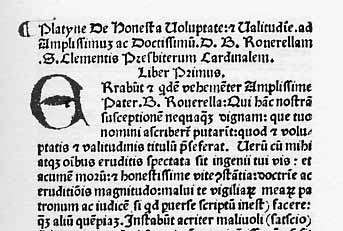
Italian - De honesta voluptate (~ 1470), Bartolomeo Sacchi, named Battista Platina, and considered the greatest cook of the Italian Renaissance. In the manner of Pliny the old and its Natural History, "About the honest delight" proposes consistent information and thoughts about food, diet and dietetics as well as some recipes of Maestro Martino.
Probably in the summer of 1465 Platina composed De honesta voluptate et valetudine ("On honourable pleasure and health") This first printed cookbook, a monument of medieval cuisine in Renaissance intellectual trappings, left the press in 1474 and ran into thirty editions, disseminating Roman ideas about fine dining throughout Western Europe - the book was translated into German and French. In a high moralizing display of humanist learning Platina embedded recipes cribbed from a professional chef, Maestro Martino de' Rossi of Como, whom he had encountered in the summer of 1463 at Albano, where Platina was the guest of Martino's employer, a cardinal.
Bartolomeo Sacchi's debt towards Maestro Martino is anything but derisory, if we consider that from volume VI to X of Platina's cookbook - volumes entirely dedicated to recipes - 240 dishes out of the 250 mentioned inside, were created by Maestro Martino who had already written Libro de Arte Coquinaria (1450- 1467).
English - A Noble Boke off Cookry For a Prynce Houssolde c. 1470, ed. 1882
Catalan - Libre del coch (~ 1477), Roberto de Nola: The "Cook's book" is the first printed cookbook in Catalan, in Barcelona in 1520 : The book to know how to serve well, to cut and the cook's art : that is to say all ways to make soups and sauces.
The cook Roberto de Nola is a symbol of the intercultural exchanges during the end of the Middle Ages: living in the south of Italy, under Aragon domination, he was obviously influenced by the Catalan cookery of the Sent Sovi and by the Italian recipes of Maestro Martino. The Libre del coch (the Book of the cook) was written in Catalan around 1477 by Mestre Roberto, chef at the court of Naples. Was he a Catalan or an Italian speaking Catalan?
German - Kuchemaistrey: the first printed cookbook in German, in 1485, was published many times until 1674.
16th century - Renaissance
French - Platine en françoys: Book of the Bibliothèque Municipale of Lyons, the "Platine in French" was printed in Lyons in 1505.
NL - Een notabel boecxken van cokeryen : A "remarkable small cookbook" was published in Brussels, around 1514, by Thomas VanderNoot. One doesn't know if he was only the publisher of the book or its author. When the rest of Europe still used bacon and olive oil, one notes specificities of Dutch cookery through 70 recipes with butter and numerous recipes with cream, milk, cheese.
Italian - Banchetti..., Messisbugo (1549): Compilation of 316 recipes, with the whole commissary of a banquet of court and examples of menus achieved by Cristoforo da Messisbugo between 1524 and 1548.
D - Das Kochbuch der Sabina Welserin: "The Cookbook of Sabina Welserin" was written in 1553 and includes 205 recipes.
French - The livre des confitures of Nostradamus ("Book of jams" printed in Lyons, 1555): Nostradamus is especially known as an astrologer. He was also a doctor. Jams, sugared almonds, candies, syrup and sugar were considered medicine in the Middle Ages. These are also sweets which are good to eat.
Italian - Opera, Bartolomeo Scappi : published in Venice in 1570, "Work" includes more than 1000 recipes, many menus and some boards illustrating the kitchen, the cooks working, the kitchen ustensils, how meals were served. Scappi is not only a practitioner but also a theorist of cooking, who knew how to present a complete panorama of cookery in his time.
Ein new Kochbuch (1581), Marx Rumpolt and Ein Köstlich new Kochbuch (1598), Anna Wecker : With "A new cookbook", including more than 2000 recipes, Marx Rumpolt wanted to pass down his know-how to young cooks.
Belgian - Ouverture de cuisine was written in French, in 1585, by the famous Belgian cook Lancelot de Casteau. This Medieval cookbook, published in 1604, is divided into three sections and includes 181 recipes and the menu of 2 banquets. One notes a moderate use of spices and the use of butter and cream.
Eenen seer schoonen ende excellenten Cocboeck ("A charming and excellent cookbook", 1593) : This cocboeck or cookbook includes 298 recipes derived from European Medieval cuisine : recipes of French, Italian, Spanish and Walloon inspiration, with specificities characteristic of the food customs in northern Netherlands (present Holland).
