The Medieval Feast
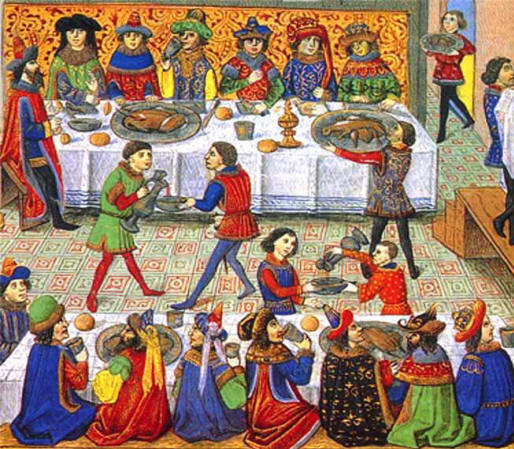
"Banquets during the European Middle Ages were often given on such important ecclesiastical feast days as New Year and Pentecost. But the greatest ones for which we have records were given for weddings and the coronation of kings or installation of bishops. There were also banquets for funerals, the coming of age (or knighting) of a son, or such lesser occasions as a harvest, the feast day of the patron saint of the local parish guild, various civic occasions, or even a tournament. Who was invited depended on the circumstances; wedding guests were apt to be family and close friends, as today, but many people of quite humble status would be included in festivities at a manor house.
This is not to say that banquets were frequent: they were very special occasions. Of the twenty-seven menus given in the fourteenth-century Menagier de Paris, a work compiled by an elderly Parisian for his young wife, only three are banquet menus: two for weddings and one for a civic event (Brereton and Ferrier, Le Menagier de Paris, pp. 175–190). The fifteenth-century English manor house of Dame Alice de Bryene, for which we have complete records of meals served over a period of a year (28 September 1412–28 September 1413), had only one major banquet that year, serving dinner to 160 people on New Year's Day. But it also provided fairly lavish meals to many of those involved in gathering the harvest in August, with several dinners for from forty to sixty guests, about twice the number usually present at Dame Alice's table."
- from Encyclopedia of Food and Culture, by the Gale Group, Inc.
Manor Hall
The hall of the manor was the place of choice for a Medieval Feast. It was the place where the household gathered together, and the lords and his dependants sat down in social conviviality. It was there that the harp of the minstrel, and the songs of the troubadours exerted their influence in awakening the better feelings of the baron. And it was there that the mimics with grotesque attitudes and grimaces of the lord’s fool excited the laughter and boisterous mirth so characteristic of the festivities of the Middle Ages.
The Medieval Feast was sometimes kept up for many successive days, during which time the minstrels were often handsomely rewarded. The presence of minstrels was almost an universal custom at this period. Every lord retained them in his household, and even the itinerant minstrels were never refused admittance into the hall. The name of minstrel was synonymous with that of musician. It was the duty of the musicians to strike up merrily as the attendants carried the dishes into the hall.
The magnificence of the Medieval Feast is a subject upon which even the chroniclers loved to dilate. It was a pageant, and the description of it reads in the pages of history like passages from fairy tales. We may form some idea of the vast scale upon which a Medieval Feast was conducted, from the fact that at the marriage feast of Lionel, duke of Clarence, son of Edward III, thirty courses were included in the bill of fare.
Food was served on long trestle tables which were folded away out of mealtimes and which were normally covered with white linen cloths, although on special occasions they could be spread with rich tapestries or embroidered fabrics. The Hall where the meals took place would also normally have been the formal reception room in the household, and so it would serve as the showcase for the owners' display of plate (i.e. plates and dishes made from precious metals; these represented the fiscal wealth of the household, as they would be melted down and minted into the owner's coins when necessary), rich tapestries and fine chairs.
Chairs in fact were few and far between in medieval times and before – from where the significance of the throne, often the only backed chair in a household. Meals were eaten on long benches without backs; one can only feel for our poor ancestors' aching lower lumbar regions. Most other furniture was also sparse. Closets and cupboards were virtually unknown. Large chests that doubled as seats were the main form of storage, but those would not have been kept in the main Hall. Between meals, the halls of medieval castles and keeps would have been rather barren affairs with rush-strewn floors and not much else.
For festive occasions or in honour of special guests, though, the Hall would be decked out with garlands of flowers or greenery, lit with many torches, oil lamps or candles and hung with a full complement of tapestries. New rushes would be strewn on the floor and mixed with aromatic herbs such as rosemary and lavender to fragrance the air. Precious goblets, platters and wine containers would be set out for the use of the feasters and the atmosphere in general would have been warm, colourful and almost overwhelming for the person used only to the drab stone walls and russet clothing of medieval times.
The domestics prepared the festive board early in the morning, as the time of dining was usually ten or eleven. The table was covered with a white cloth and adorned with candlesticks of artistic design. . The tablecloths were sometimes made of silk. In the houses of nobles the candlesticks were sometimes of silver. Candles were insufficient to illuminate the spacious hall, and it was therefore lit up with splinters and flambeaux, which were carried about by the attendants.
The serving platters were usually of pewter, although in houses of a second class, of wood. The display of plate was often extensive, and indicated the increase of national wealth. Silver dishes, cups, and saltcellars glistened upon the board. The taste displayed in the manufacture of these articles of plate was sometimes both chaste and elegant, proving that the ingenuity and skill of the medieval artisans were far from being exhausted. The nobles prided themselves upon their gold and silver vessels, and made many sacrifices to obtain them.
The saltcellar was the chief ornament of the table. It was placed before or on the right hand of the master of the house. It had various shapes: a covered cup, a castellated form, or, at the caprice of the owner, it frequently took the form of a dog, a stag, or another favorite animal. In 14th Century England, there are mentions of vessels of glass. Drinking cups were usually made of wood and horn, those of glass were of extreme rarity.
One of the most interesting appendages of the dining table of the 14th Century was the ship, or "nef", which was used to contain spices and sweetmeats. Its form was borrowed from the "navette", an ecclesiastical vessel in the form of a ship in which frankincense was kept upon the altar. The French appear to have introduced the nef as an ornament to the dinning table. It was not much in use in England prior to this century.
The mazer bowl (drinking cup) was in use among all classes during the 14th Century. This favorite vessel was sometimes adorned with the most costly workmanship, and enameled with the arms of its owner. Roasted meat, when served up in joints was usually taken to table on the spit. Spits were sometimes made of silver.
Service
In our times, it is considered polite to have the table fully set when the guests are seated - wine, bread and all plates and cutlery in place. In medieval times it was pretty much the reverse: guests were shown in to sit at tables that were covered with white linen cloths, with a salt cellar at the top of the table and perhaps napkins and cups at each place setting, but that was it.
Table settings included a silver salt cellar, a nef (a gourd for holding pepper), and cups. The cups would be made of silver, pewter, wood, or horn, although it was considered fashionable to have the castle's platware made of coconut shells, ostrich eggs, agate, or gourds. Interestingly enough spoons were provided ,but guests were expeceted to dish out their own knifes and forks
One was always expected to use one's own eating knife, and in some households, especially during the earlier medieval period, one's own cup, spoon and napkin too. So one would be sitting down to a basically empty table. The only other thing that was sometimes present (although, again, in some cases this would be done right after the guests sat down) are strewing herbs, aromatic herbs such as rosemary or mint scattered on the table to create a pleasant smell.
The first service performed for the guests after they were seated was that entered the hall with basins, ewers, and napkins, and carried them round to the company, who washed their hands before they sat down to dinner. The water was sometimes perfumed with aromatics, and on grand occasions the basin was filled with rose water. The ewers were often made of gold and silver, and also enameled with the owner’s arms. From passages in old romances it appears to have been usual to wash after as well as before meals. This, as everything else in a medieval hall, was done according to a strict order of precedence. As people ate with their hands until well into the Renaissance in England (the fork was not unknown, but considered vulgar), and especially since they often shared dishes with other guests, this was not just a formal flourish but a vital part of a healthy and pleasant meal. On some occasions, the guests were summoned to wash in the lavatory before meals by the sound of trumpets.
Next came the bread waiter, a specially trained man who presented the trencher bread, cut it up in a special way and then, no doubt helped by an army of waiters, distributed them to the diners (again, by order of precedence).
They did have plates, but they were more like serving plates. To understand the importance of the trencher, however, it is necessary to understand how food was served to people in the middle ages. People were seated in rows along straight trestle tables (although make no mistake - for private and small family meals they often sat at round, oval or square tables, as well), with dishes on plates or bowls placed in front of them. These dishes were shared between two, sometimes three or four people, and they were really what people ate from - the trenchers of bread were there to soak up any gravy or sauce dripping from the morsels taken from the communl plate and to serve as temporary resting surfaces for the same. Trencher bread was especially baked, and was much browner and coarser that normal eating bread (which was also served with the meal). It was sometimes eaten on the next day as a breakfast dish, soaked in milk or ale, and sometimes given as alms to the poor. It was not part of the menu.
From what I have read, the use of trenchers may be a tradition preserved from earlier times. Peasants did not have many possessions and they would use a piece of bread in place of a plate, using it to put their food on from a communal pot.
Much like in good restaurants today, the wine waiter was an important functionary in the medieval hall. He was called the Butler, and the modern important post of butler as manager of the household in stately homes derives from this ancient profession. The butler decanted the wine, which was an important and skilled task as the bottling of wine was not invented until much later. Drawing it out of the barrel without residue or murkiness was therefore a tricky task.
Only the high-ranking guests at a medieval table were served wine, but everybody was served pitchers of ale and sometimes cider or mead as well. Water was never drunk at table in medieval times. Although doubtless some people could not afford anything else, it was a mark of extreme poverty not to have at least the cheapest – and weakest - ale. This was in part a health measure: streams and wells were almost always polluted and only the clearest spring water was safe to drink (alcohol being of course the antiseptic that got rid of the parasites that survived the ale-cooking process).
It's true that clean drinking water was not easily available and that people drank and cooked in ale, cider, wine and mead. However, they did not consume nearly as many alcohol units as people do today! The ale brewed for everyday consumption was considerably weaker than modern beer, and wine was almost always mulled and warmed - which will reduce its alcohol content. There was, of course, recreational drinking of stronger ale and cider, but that was distinct from the former variety and served in ale houses or at major meal times. Hard liquor (brandy etc.) was almost non existent in medieval times.
All the above ceremonies having been gone through, the food was now served by a multitude of waiters. However, even here there was added a note of formality by the carver (who, doubtless, in some smaller households was the same as the trencher man and the butler) having the larger dishes like whole roast animals in the centre of the table and proceeding to expertly carve the meat off the carcass with a very sharp knife. The pieces were then served to the diners.
Banqueting tables at grand feasts were decked with spectacular dishes - providing the perfect opportunity for the nobleman to show off his wealth. Everyday jellies, pies, fritters and stews were accompanied by magnificent animals such as peacocks, seals, porpoises, and even whales. Jellies and custards were dyed with vivid natural colourings - sandalwood for red, saffron for a fiery yellow, and boiled blood for black. But the most visually alluring pieces at the table were special sugar sculptures known as sotiltees (or subtleties). These sculptures came in all sorts of curious forms - castles, ships, famous philosophers, or scenes from fables. Sotiltees were also known as 'warners,' as they were served at the beginning of a banquet to 'warn' (or notify) the guests of the approaching dinner. Unlike today, meals were not separated into savoury main courses and sweet desserts. Instead, many dishes were laid out together in luxurious chaos.
The strictness with which our ancestors observed the Lent and fast-days led to a prodigious consumption of fish. Red herrings, white herrings, sturgeon, stock-fish are accounted as being bought for domestic use. Herring pies were regarded as delicacies even by royalty. But lampreys was the favorite choice for the Medieval Feast, as it was considered a great delicacy, and much preferred by the medieval epicures. The festive boards of the most refined were also graced by delicious morsels of the whale, the porpoise, the grampus, and the sea-wolf. Beef, mutton, and pork were used in abundance. Geese, capons, fowls, ducks garnished the feast tables. The soups and messes were highly seasoned with spice, and during the reign of Edward III, all who made any pretensions to skilful cookery, highly flavored and deeply colored their dishes with saffron.
A blessing was usually asked before and after the meals. In the halls of royalty and nobles, the chaplain fulfilled this duty. It was an ancient custom among churchmen whilst at meals, to listen to the reading of the Holy Scripture, and several ecclesiastical canons enforce attention to this point. Reading at meals soon became common among laity. But the harpers, the mimics, and the fools were more acceptable to the popular taste. They took a prominent part in ancient festivities, and, on state occasions, they crowded the hall.
Seating and Who Ate What
As mentioned above, all the proceedings in the medieval hall were governed by strict order of precedence. In conjunction with their love of clear physical demonstrations of social principles, this led to a special geometry in the hall during meal times. The owner of the house - from the king right down to you middle class country squire - and his guests sat at a long table which stood at the top of the oblong hall, often on a raised dais.
Perpendicular to that there was another, even longer table (sometimes two if there were very many people), at ground level, which sat everyone else. Your position in the household hierarchy was clearly visible by how far from the high table you sat. If you'll remember, Ivanhoe, on coming home in disguise, has to take a seat at the very bottom of the table, with the beggars and vagabonds. This really would have been an unthinkable and unforgivable humiliation. The expression "to sit below the salt" also comes from medieval times, and the custom of having the large, elaborate and often precious salt cellar placed on the high table. All those who sat down the table from it - below it – were of secondary social status.
Who you were, and where you sat, also determined to a large degree what you ate. The people at the lower table were never served the same food as the people at the high table. Although some dishes were doubtless shared, the distinction of rank was always marked by the higher parts of the table receiving some dishes that the hoi polloi will never taste. This could be a very exotic roast fowl like peacock or swan, but can also be something as simple as white bread, made from wheat which was expensive both to grow and to mill.
One of the gallant inventions of a chivalrous age was the custom of two dining of the same plate. It was also usual for the lady and her partner at table to drink out of the same vessel.
For the knights-to-be, the Medieval Feast was the opportunity to render what was called "personal service", which was one of the most important components of the future knights' education. The squire attended upon the knight, and the sons of nobles carved, and did service in the hall as a part of their chivalric education.
Wedding Festivities for the Marriage of Charles to Margaret of York
Work began months in advance on the wedding festivities of Charles and Margaret.
Margaret left Margate for Sluys on 23 June 1468. Lord Scales escorted her to meet her future bridegroom. Despite Louis XI having ordered his ships to seize her on her journey, her convoy crossed without incident, reaching Sluys on the evening of the 25th. The following day, she met with her bridegroom's mother, Isabel, and daughter, Mary; the meeting was a success, and the three of them would remain close friends for the rest of their mutual lives. On 27 June, she met Charles for the first time, and the pair were privately married between 5am and 6am on 3 July, in the house of a wealthy merchant of Damme. Charles then left for Bruges, allowing the new Duchess the honour of entering separately a few hours later.
The celebrations that followed were extravagant even by the standards of the Burgundians, who were already noted for their opulence and generous festivities. The bride made her Joyous Entry in a golden litter drawn by white horses, wearing upon her head a coronet. During this procession, she charmed the burghers of Bruges when she chose to wave to them rather than shut herself away from the wind and rain. In the city itself, wine spurted freely from sculpted archers and artificial pelicans in artificial trees; the canals were decorated with torches, and the bridges decked with flowers; the arms of the happy couple were displayed everywhere, accompanied by the mottoes of the pair: Charles' Je l'ay emprins ("I have undertaken it") and Margaret's Bien en aviengne ("May good come of it"). The celebrations also included the "Tournament of the Golden Tree" that was arranged around an elaborately detailed allegory, designed to honor the bride.
When the Duke and Duchess appeared there, both wore magnificent crowns: Margaret's crown (made in about 1461) was adorned with pearls, and with enamelled white roses for the House of York set between red, green and white enamelled letters of her name, with gold C's and M's, entwined with lovers' knots (it can still be seen in the treasury at Aachen Cathedral). The removal of the crown to Aachen was significant, since it allowed its survival from the ravages of the later English Civil War which involved the destruction of all the main English Crown Jewels. It thus remains the only medieval royal British crown still surviving.
Charles wore an equally splendid crown, accompanied by a golden gown encrusted with diamonds, pearls and great jewels. The parades, the streets lined with tapestry hung from houses, the feasting, the masques and allegorical entertainments, the jewels, impressed all observers as "the marriage of the century".
