The Medieval Kitchen
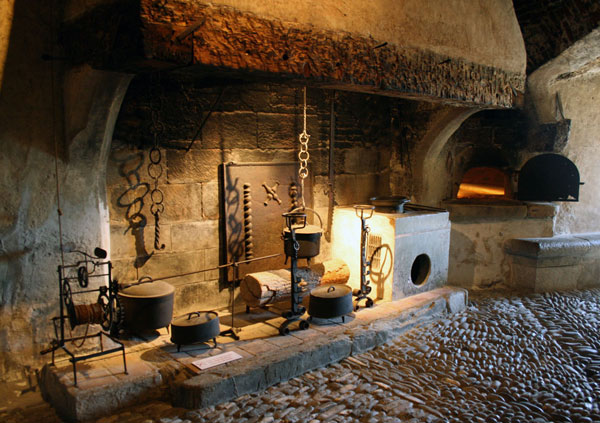
In most households, including early castles, cooking was done on an open hearth in the middle of the main living area, to make efficient use of the heat. This was the most common arrangement for most of the Middle Ages, so the kitchen was combined with the dining hall. Towards the Late Middle Ages a separate kitchen area began to evolve. The first step was to move the fireplaces towards the walls of the main hall, and later to build a separate building or wing that contained a dedicated kitchen area, often separated from the main building by a covered arcade. This way, the smoke, odours and bustle of the kitchen could be kept out of sight of guests, and the fire risk to the main building reduced.
Many basic variations of cooking utensils available today, such as frying pans, pots, kettles, and waffle irons, already existed in great households. Other tools more specific to cooking over an open fire were spits of various sizes, and material for skewering anything from delicate quails to whole oxen. There were also cranes with adjustable hooks so that pots and cauldrons could easily be swung away from the fire to keep them from burning or boiling over. Utensils were often held directly over the fire or placed into embers on tripods.
There were also assorted knives, stirring spoons, ladles and graters. In wealthy households one of the most common tools was the mortar and sieve cloth, since many medieval recipes called for food to be finely chopped, mashed, strained and seasoned either before or after cooking. This was based on a belief among physicians that the finer the consistency of food, the more effectively the body would absorb the nourishment. It also gave skilled cooks the opportunity to elaborately shape the results. Fine-textured food was also associated with wealth; for example, finely milled flour was expensive, while the bread of commoners was typically brown and coarse. A typical procedure was farcing (from the Latin farcio, "to cram"), to skin and dress an animal, grind up the meat and mix it with spices and other ingredients and then return it into its own skin, or mold it into the shape of a completely different animal.
Large tables provided space for all the necessary cutting and mixing of ingredients; stone sinks draining into a common cesspool provided facilities for washing ingredients and utensils alike. Mortars were crucial for crushing spices and blending ingredients, and an assortment of ladles, skillets, knives, spoons and basting-brushes were at hand for the treatment of food in various stages of preparation. Water might be piped in, or carried by hand. Fuel was all-import to maintain a steady fire, and where special stability of temperature was required, coals could be substituted for wood. Rather than tending to everything personally, the cook's job was to supervise and direct the work of assorted scullions, apprentices and hired help.
The kitchen staff of huge noble or royal courts occasionally numbered in the hundreds, including: pantlers, bakers, waferers, sauciers, larderers, butchers, carvers, page boys, milkmaids, butlers and scullions. Major kitchens of households had to cope with the logistics of daily providing at least two meals for several hundred people. Guidelines on how to prepare for a two-day banquet include a recommendation that the chief cook should have at hand at least 1,000 cartloads of "good, dry firewood" and a large barnful of coal.
In addition to the kitchen itself, a household of any size had several other food processing centres - or at the very least a pantry for storage. A bakery was important for more than just bread; every nobleman worth his salt employed a pastry chef, responsible for pies, pasties, tarts and other dough-based delicacies. Fillings for these treats were produced in the kitchen under the cook's supervision, then sent to the bakery to be encased in pastry and baked; the result was then returned to the cook for any necessary finishing touches and rushed off to waiting guests. Butcheries, wine cellars and dairies might also feature among a larger household's gastronomically oriented areas; ultimately, however, all authority in matters of cookery belonged to the cook. (Scully 86-89)
Pantry
A pantry is a room where food, provisions or dishes are stored and served in an ancillary capacity to the kitchen. The derivation of the word is from the same source as the Old French term paneterie; that is from pain, the French form of the Latin pan for bread.
In a late medieval hall, there were separate rooms for the various service functions and food storage. A pantry was where bread was kept and food preparation associated with it done. The head of the office responsible for this room was referred to as a pantler. .
Larder
A larder is a cool area for storing food prior to use. Larders were commonplace in houses before the widespread use of the refrigerator. Essential qualities of a larder are that it should be:as cool as possible, close to food preparation areas, constructed so as to exclude flies and vermin, easy to keep clean, and equipped with shelves and cupboards appropriate to the food being stored.
In the northern hemisphere, most houses would arrange to have their larder and kitchen on the north or east side of the house where it received least sun.
Many larders have small unglazed windows with the window opening covered in fine mesh. This allows free circulation of air without allowing flies to enter. Many larders have tiled or painted walls to simplify cleaning. Older larders and especially those in larger houses have hooks in the ceiling to hang joints of meat or game. Others have insulated containers for ice.
A pantry may contain a a stone slab or shelf used to keep food cool in the days before refrigeration was domestically available. In the late medieval hall, a thrawl would have been appropriate to a larder. In a large or moderately large nineteenth century house, all these rooms would have been placed as low in the building as possible, or as convenient, in order to use the mass of the ground to retain a low summer temperature. For this reason, a buttery was usually called the cellar by this stage.
In medieval households the larderer was an officer responsible for meat and fish, as well as the room where these commodities were kept. . The Scots term for larder was the spence, and so in Scotland larderers (also pantlers and cellarers) were known as spencers. This is one of the derivations of the modern surname.
The office only existed as a separate office in larger households. It was closely connected with other offices of the kitchen, such as the saucery and the scullery.
Buttery
A buttery was a domestic room in a castle or large medieval house. It was one of the offices pertaining to the kitchen. It was generally a room close to the Great Hall and was traditionally the place from which the yeoman of the buttery served beer and candles to those lower members of the household not entitled to drink wine.
The room takes its name from the beer butts (barrels) stored there.
The buttery generally had a staircase to the beer cellar below. The wine cellars, however, belonged to a different department, that of the yeoman of the cellar and in keeping with the higher value of their contents were often more richly decorated to reflect the higher status of their contents.
From the mid-17th century, as it became the custom for servants and their offices to be less conspicuous and sited far from the principal reception rooms, the Great Hall and its neighbouring buttery and pantry lost their original uses. While the Great Hall often became a grand staircase hall or large reception hall, the smaller buttery and pantry were often amalgamated to form a further reception or dining room.
Kitchen Staff
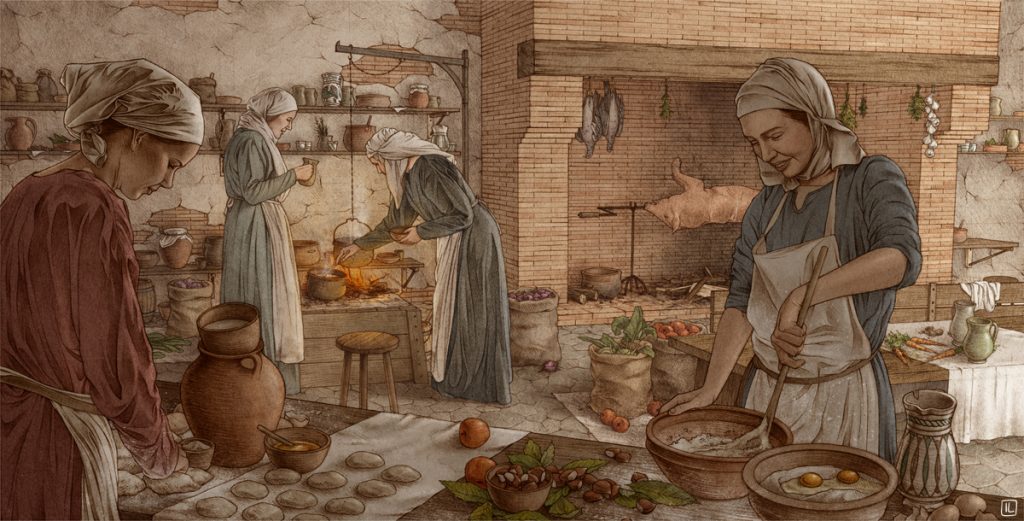
To feed a large noble household or the even larger retinue of a royal court could involve hundreds of kitchen staff. Many of these individuals had specific tasks. You had the hateur, in charge of roasting, the potier (manager of pots and dishes), a person to simmer the sauces, and a potagier to maintain the pots of potage. Manning the mortar was the broyeaur while the souffleaur tended the fires. And there were yet more kitchen workers. Unskilled labor chopped and hauled wood, and drew water to wash dishes. You had others shaping pasta, kneading bread, forming the pie crusts and even sharpening knives.
o Pantlers who oversaw the storage and preparation of bread in the pantry;
o Bakers making pastry and the many and varied loafs of bread;
o Waferers who specialised in making crisp, often sweet, very thin, flat, and dry biscuits;
o Sauciers specialising in producing all manner of sauces;
o Larderers responsible for the storage of meat and fish;
o Butchers who slaughtered the animals, dressed the flesh and prepared the standard cuts of meat, poultry, fish, and shellfish;
o Carvers skilled at disjointing the meat and slicing it uniformly to obtain a maximum or satisfactory number of portions;
o Page boys, young male servants;
o Milkmaids employed to milk dairy cows and prepare dairy products such as cream, butter, and cheese;
o Butlers, a middle-ranking member of the servants of a great house, in charge of the buttery (originally a storeroom for "butts“, that is casks, of wine and ale);
o and countless scullions who performed the most physical and demanding tasks in the kitchen, such as cleaning and scouring the floor, pots and dishes and assisting in the cleaning of vegetables, plucking fowl, and scaling fish.
