Medieval Pastry
from http://oakden.co.uk/
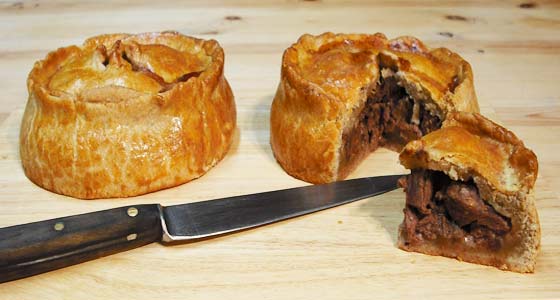
Tarts, Pies and Pastries
No clear distinction was made between sweet and savoury in the medieval era. Sugar was treated as a spice. Tarts, pies and pastries were the common speciality of the cook (for meats) and the pastry-cook (for the pastry, as it was he, and not always the cook, who had the oven). Cakes were the speciality of the oubloyer. Flaky pastry was still unknown at this period.
Pastries allowed the medieval cook to develop his architectural creativity and medieval cookery lent itself to theatricality. Of course, the pastry crust allowed the meat juices and aromas to be enveloped and conserved. It was, however, also often used as a "surprise parcel" to hide from the guests' view whole animals and sometimes several types of bird. Pastry came in shapes capable of solliciting the guests' admiration.
What was Medieval Pastry Like?
Medieval Pastry is perhaps the most misunderstood kitchen and food staple of this period. Should Medieval pastry be eaten? How should it be cooked? What is an authentic pastry recipe? All good questions, but with the almost total absence of fully explained pastry recipes from medieval sources it makes it difficult to resolve these questions one way or another – pastry was so commonly made that it was taken for granted as one of the things all cooks should know, and therefore not important enough to be written down in the earliest manuscripts.
Equally obvious during this time was the fact that different types of pastry was used for different types of dishes and design effects, and it was left to the cook to fall back on their knowledge in this area to decide on what was needed. Yet this also helps us, as a result of this common shared history, the most basic pastry recipes have varied very little in time, and in knowing the main building blocks we need to concern ourselves with just three types of ‘pastry’: a ‘plain pie crust’ a ‘hot-water crust pastry’, and perhaps a more controversial ‘basic shortcrust pastry’. Examples and recipes for these three pastries are given later; but essentially a basic ‘pie crust’ is made with just flour and hot water, while a ‘pastry’ is made with the inclusion of fats, i.e. milk, lard, butter, suet or eggs etc. and it is made either hot or cold: as always the grade of the ingredients used in the pastry depends upon the economic status of the cook or the household.
A lot of false assumptions about medieval pastry is written on the Internet, assumptions coming from poor research and writing, which has unfortunately been propagated from just a few modern sources. From what little information there is in the medieval period (1066-1485 AD) about pastry, there is only one conclusion to draw, namely there is no ‘one’ pastry recipe or pie making ‘technique’ right for all occasions. If anyone says anything different, just ask them to show you the original recipe … the very earliest recipes for British pastry were written down in the later Tudor period, as in Thomas Dawson’s book, The Good Houswife’s Jewel, first published in 1596.
The Pastry-Cook
It is thought that in the early medieval period the work of the commercial baker and pastrycook overlapped, until they became more specialised and separate; in France this clarity between the guilds was shaped in law in 1440 AD. Therefore the pastrycook, as a separate identity, would go on during this period to develop many different recipes for pastry, as seen two hundred years later in the 14 different types of pastry recorded in Robert May’s, The Accomplisht Cook, first published in 1685.
The Pie Maker
To understand making the most impressive and largest of the medieval ‘great pies’, (bakemeats and coffyn or coffins) we need to look at later pie designs published by Robert May, Henry Howard, Edward Kidder and John Thacker. These give us a very good idea of what these very impressive, larger, hand-raised pies must have looked like – although these examples are from long after the medieval period ended, they are still hundreds of years before the mass introduction of the pie tin, and so they can still show us the original historical skills of a British pie maker – skills kept alive by being handed down over generations, master to apprentice.
A note about the flour in medieval pastry
In the Medieval Period, if the finest wheaten flour is called for, or expected, in our pastry, then we should be using a stoneground flour with an 80% extraction rate. Essentially, Medieval and Tudor milling and boulting methods were never wholly successful in removing all of the bran from the grain, even the best flour produced in this period was an ‘off-white’ flour, rather than the pure white flour produced today by industrial roller milling. The best ‘extraction’ rates that could be achieved was around 80%. Yet this whiter flour, described as the ‘finest’, was desired by Medieval and Tudor bakers and cooks because it made a lighter bread loaf, (or pastry) of a finer texture, and was sold at a premium. To approximate this we should use an 80% stoneground plain flour and 20% wholemeal stonground flour mix.
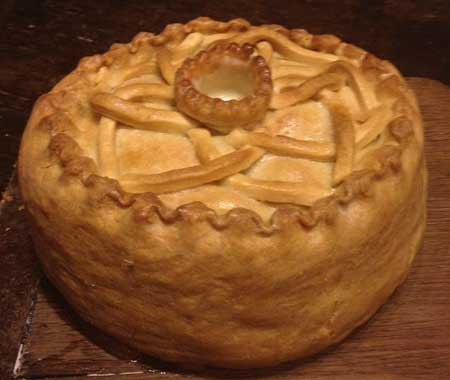
Raised pie with steam vent, called a haystack
Should The Pastry Be Edible?
In upper class Medieval society, where food centrepieces were made on an impressive size, it is thought that the pastry was not normally eaten, but rather eaten out of. The pie was used as a container (a coffyn or coffin), a good looking, but functional and ‘disposable’ tableware item, something the delicate ingredients were cooked in and then scooped out to be eaten on breads. Most times this type of pastry was either dried out in the oven first, in order to keep the shape of the container (like a castle or other sculptural subtylte), or the pastry came out only half-cooked so the ingredients, which were the important part of the dish, were not over-done.
This is the main argument for the use of only the most basic pastry recipes in Medieval pies etc. If the pastry was not to be eaten, and used only as a container or baking vessel for the pie filling, it therefore stands to reason that only flour and hot water should be used to make the plain pie crust, or in richer house-holds a thickened hot-water crust pastry could also be used to make the biggest pies, the ‘Pies of Paris’ and ‘Great Pies’ etc.; and yes, both these methods make a pretty inedible pastry if made to ‘just’ contain the pie fillings, with very thick pastry walls baked hard. It must also be noted that without the use of a pie-tin this is the most successful type of pastry to use in making the largest, free standing feast day pies.
It should be noted that these pies had fillings that were generally dry. When the pie came out of the oven, some sort of sauce was added to the pie through the steam vent in the top crust. Also, these pies were often stored for weeks. Butter or other fat was added through the steam vent to keep the air away from the food.
However, there is a natural counter argument to this: the ingredients used in making pastry were too expensive, and food too scarce, for the pastry to be thrown away or given to the dogs after consuming the pie filling. Food was never wasted, if the rich did not eat the pie crust, then the almoner, whose Christian duty and job it was to collect the uneaten food from the richer households and distribute to the poor, would have made sure it was not wasted. In other words, someone would probably have eaten the pastry or pie crust on most occasions.
When you consider in times of the worst famine, e.g. the potato blight in Ireland in the 1840's, which claimed hundreds of thousands of lives over the decade, where people resorted to boiling their leather shoes and eating grass to fill their stomachs, a medieval pastry crust, by comparison, soaked in the juices from the filling etc. would be far more appetising on a regular basis than the alternative, no food. And by soaking even the hardest pastry crust and pounding it, (like salt cod) it would become more edible.
So if eating the pie or tart crust was common, then why not develop it into a more edible form? A small pie for example is the perfect ‘food’ in terms of cooking, storing and eating, if you could eat all of its parts. And this is exactly what happened, certainly by the Tudor period: Dawson in in 1596 gives directions, ‘to make fine paste’ (pastry) for small pies using butter and eggs in the pastry ingredients, for use with small, sweet and savory pie recipes we would recognise even today. The only question is ‘when’ did it start. Perhaps over a hundred and fifty years earlier … In ‘Two-Fifteenth-Century Cookery-Books’, the two unnamed medieval manuscripts, Harleian MSS. 279 and 4016, kept in the British Museum, dated 1430 and 1450 AD. we have instructions in the recipes for Bake Metis (Pies) to “take faire paast” … “an make fayre lytel cofyns” … “& endore with yolks of Eyron, & Safroun”. Why would the pastry on these small pies, glazed with expensive ingredients, not be eaten?
We also only ever focus on the recipes of the medieval upper-classes, which is understandable, having most evidence about what they ate, with very little in the way of written evidence about the diet of the poor and their cooking methods; but we still need to ask the question, did the poorer classes (not the very poorest) make and eat pies, tarts, custards and flans, made with pastry, or even buy them commercially in the growing urban centers when they could afford it? And if they did, would they throw the pastry shell away?
Many probably did not possess an oven, but exactly like bread, a simple pie (with thinner pastry walls) or an open-faced tart can be baked by placing it over the embers of a fire in a shallow pan, covered with a ‘lid’ (or another upturned pan) and surrounded by more live embers, (making a basic oven) where the baking progress is then monitored closely – this type of baking was common practice.
We also have to understand that there were also better cooking techniques and ingredients available to the Medieval pastrycook to make a pastry far more light and edible than just a very basic plain hot water and flour recipe. So why should food historians focus only on a pie crust or pastry made with just flour and water, which are only really useful when making the biggest feast day pies, or the quickest, blind-baked tart or flan cases?
From an Oxford Companion to Food, by Alan Davidson, published by Oxford University Press 1999.
“In Medieval Northern Europe the usual cooking fats were lard and butter, which–especially lard–were conducive to making stiff pastry and permitted development of the solid, upright case of the raised pie…No medieval cookery books give detailed instructions on how to make pastry; they assume the necessary knowledge…Not all Medieval pastry was coarse. Small tarts would be made with a rich pastry of fine white flour, butter, sugar, saffron, and other good things, certainly meant to be eaten”.
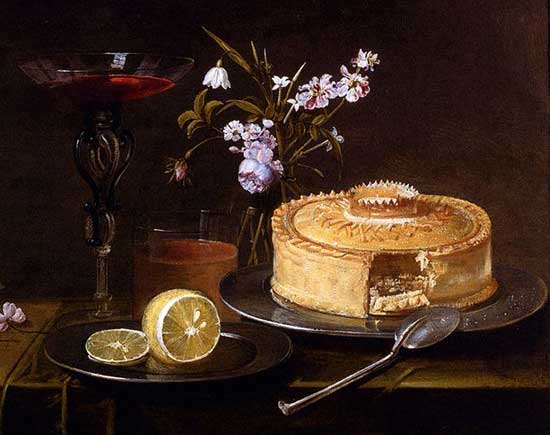
Pie with sliced lemon - Frans Yken 17th century
Notice the crust has been pulled away and a spoon is handy for serving
What should we be asking ourselves?
The modern cook needs to think like a medieval cook and not a historian. This question over which pastry recipe to use would have been resolved in the medieval age by the cook thinking about the size of the pastry dish or pie, (how many it was to feed) what it contained, (fish, meat, fruit, stew etc) and the occasion the dish was to be presented, (a family’s humble daily food course, or the large centrepiece of a banquet).
The reason is simple, the large ‘pie-tin’ we take for granted in our modern kitchen did not really exist. In fact it was with the introduction and the spread of these ‘new’ sprung-form metal pie dishes in the 1800s that most pie pastry in Britain became lighter and therefore edible on a consistent basis even with the largest pies. But without a pie dish a Medieval cook could not maintain the shape and integrity of the pastry in the largest pies during cooking, if it was made lighter and thinner (i.e. made so that it was edible).
A far more durable, self-supporting pastry was needed (hot water pastry).
Food Historian Ivan Day on pie making.
“As a result of the invention of the sprung metal pie form these ‘French’ raised pies became very popular in the nineteenth century These useful moulds were sold by braziers and kitchen equipment retailers, who marketed a great variety of designs.support the metal form afforded the pie during baking, it was possible to use a finer pastry than the old fashioned hot water crust which had been used since medieval times … [when] pie makers had to raise their pies entirely by hand.”
This is not to say that all pastry was made in this way in Medieval Britain, some pastry was specifically made to be lighter and edible (shortcrust). And some pies and pastries were supported while being cooked, examples of unglazed medieval ceramic ‘traps’ have been found, these flat, shallow dishes had ‘pinched’ rims indicating they were used not as dishes to eat from but to cook pie and tart cases in (which strongly indicates that pastry cases could be made thinner and more edible). So in choosing how to cook your authentic medieval pastry it is a question of scale, contents and of occasion.
From Peter Brears, Food Historian.
“Following the standard medieval practice, the pastry dough would have been mixed, kneaded and shaped as empty crusts [large and small] on the work-table, and then briefly dried off or hardened in the ovens … for custards and the like, the fillings would be poured into the empty shells while still inside the oven, but for most other recipes they were returned to the work-table, filled, any lids set in place, then put back in the oven for perhaps only 20 to 40 minutes … crusts and fillings could all be prepared in advance, then quickly baked immediately before they were required.” This is just like the ‘blind baking’ technique we use today.
So what pastry would we use? If I was going to do one of the larger, ‘great pies’, for an authentic medieval feast I would probably use the tougher, ‘plain pie crust’ recipe of just flour and water and not expect it to be eaten. If I intended building the large Christmas Feast type of pie, and I wanted the pastry to be eaten, I would use the hot-water pastry recipe, hand-raising both of them using the techniques discussed below – hand raising pies made with this type of pastry is an art form in itself and needs practice.
For the medium sized pies I would still use a hot-water crust pastry, only making the pastry walls much thinner and more edible, expecting the pastry to be eaten, making the pastry, “as tender as ye maye”. For smaller tarts or pies (chewitts and custardes) I would make a basic shortcrust pastry, hand raising them with individual shapes that tend to alter and settle when cooking. I would also consider using a small ceramic pie dish as a modern equivalent of a medieval trap, to blind-bake the cases in, for some of the most delicate, thinner pastries for pies, tarts and flans.
Making The Great Pies
The ‘great pies’, made with minced beef or forcemeat as a lining inside the pastry, contained parboiled poultry, game and fruit, and are a real must at Christmas. Hand raising these pies and making sure the integrity of them stayed in tact while cooking (losing no juice from the expensive fillings) is the most important skill of the pie maker.
You would need to make a pie case by rolling out a hot-water crust pastry to the size of around 30cm in diameter, 2cm thick, with walls of around 12cm in height. To maintain the height of the walls you should go around the pie case walls twice with a roll of baking parchment (trim down the height of the parchment to size, to make filling the pie easier) and tie around it with string to afford it additional strength. Let it dry out slightly in an oven for 20 minutes on a very low heat. Then you can start to fill it, before making a lid and sealing the pie by moistening the edges together.
The lids should be decorated with pastry shapes of medieval flora and fauna designs etc. After cooking you cut the pie lid off and scoop out the delicious insides on to a plate as a sort of side dish stuffing or in greater quantities as a main course meat (the pies can be eaten hot or cold).
Plain Pie Crust
The first ‘type’ of pastry to consider is the most basic, ‘plain pie crust’ of just flour and hot water, with no added fats or eggs. Made using boiling water this pastry would have certainly been used as just a ‘container’ of ingredients, without being eaten by the rich, and would have been particularly seen in the making of cases for tarts and flans (custarde or crustade) or the very largest pies. This is where the pie, tart or flan filling is by far the most important element of the dish; with the discarded pastry case probably being collected for the poor by the almoner, although there is also a strong argument to be made for this particular type of simple pastry case to be thrown away without it being eaten.
A Plain Pie Crust Recipe:
- 350g of plain Stoneground Flour
- 100g of Wholemeal Stoneground Flour
- 270ml of boiling water
Recipe Method:
A firm dough would have been made by mixing the flour with the hot water in a large mixing bowl, and brought together using the back of a blunt knife. The pastry would be left for a few minutes to cool, but while still warm it would have been kneaded for about 10 minutes to make it silky and pliable, and then the pastry would have been patted out flat to around 1cm thick, (forming a round disc of about 10 cm in diameter). The rim or wall of the pastry case would have been pinched up to stand 3cm vertical, (making sure the intersection of floor and wall of the case is flat and even). And a decorated design along the pastry rim top would have been made with a ‘pinched’ or ‘rope’ design etc. and then the case would have been left for 10 minutes before being baked in an oven at around 180C for 20 minutes.
These dried out cases would now ready for their fillings – the advantage of this method is that both case and filling can be made in advance, and lids could be added to the tart as well before cooking if needed to make a ‘pie’. The delicate flan and tart filling would be eaten from the case, without eating the pastry.
Hot-water Crust Pastry
A hot-water crust pastry is still used today to make the savory pies, such as veal and ham pie and game pie. It is mixed with boiling water, which makes it pliable enough to mould into a raised pie that will hold its shape as it cools and during the baking. It is a ‘strong’ pastry, fit to withstand the extra handling that it must receive during the shaping and also the weight of the pie filling it must hold. Keep the part of the pastry not being worked on covered to prevent it cooling and hardening before use. Note: Care must be taken during the shaping so that cracks do not appear in the pastry through which the liquid from the pie filling can escape.
A Hot Water Crust Pastry Recipe: (heavier, thicker)
- 350g Plain White Stoneground Flour
- 100g Wholemeal Stoneground Flour
- 150g Lard
- 250ml Water
- 1 tsp Sea Salt
Sift the flour and salt into a bowl, making a well in the centre. Place the water and lard into a saucepan, when the lard has melted bring just to the boil. Pour the mixture into the centre of the flour. Working very quickly, mix with a wooden spoon. Then knead with hands to produce a smooth dough. This pastry must be used whilst still warm, otherwise it will become brittle and hard to mould. Start to shape and raise the pastry into the pie shape you want, the bigger the shape, the thicker the pastry sides need to be.
Basic Shortcrust Pastry
A basic shortcrust pastry should be crisp, light yet firm in texture. The amount of liquid is very important, as too much produces a tough pastry and too little produces a dry, crumbly pastry, which is difficult to handle. This pastry would have used the very finest flour, with probably sugar or saffron added in, to make the small tarts and delicate pies etc.
A Basic Shortcrust Pastry Recipe: (lighter, thinner)
- 350g Plain White Stoneground Flour
- 100g Wholemeal Stoneground Flour
- 150g Lard, diced
- 100g Butter, diced
- 25ml Cold Water
- 1/2 tsp sea salt
Into a large mixing bowl sift the flour and sea salt together first and then add in the diced lard and diced butter, rubbing the flour, butter and lard together with your finger tips to resemble fine breadcrumbs, then add the cold water – bring together using a fat bladed knife, (decide if a little more cold water is needed at this stage) then bring together, gently kneading with your fingers, until a smooth pastry is made – do not over-work the pastry, it is not like a bread or pasta dough. Keep everything cool while you are bringing it together, and once in a ball leave covered in cling film in the fridge for 25 minutes.
