Medieval Spices
Medieval Spices
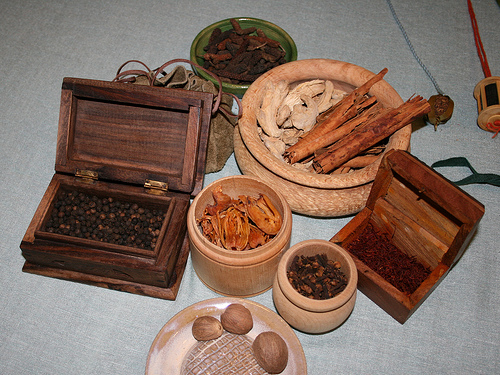
From the times of the Greeks and Romans, Europeans have imported from the East various spices to flavor their food, treat their ailments, and scent their worlds. The original spice routes started in India and travelled west through Asia Minor (later Arabia) or wound north through Africa to Egypt, finally transported across the Mediterranian to Greece and later, Rome. The fall of Rome virtually closed the water routes for about 400 years; during that time (before AD 1000), an alternative spice route developed through Russia. The first Crusade opened up the trade routes again, and it did not take long before the Italian city-states (especially Venice) were dominating the European end of the traffic. However, it was never impossible, just difficult, to get spices: a 10th-century abbot left his spice chest to his community with small hoards of cinnamon and other spices.
Spices were so precious that they were kept under lock and key-- in castles they were usually kept in the royal treasury, and they traveled in locked chests. The Spice Companion gives some comparative prices for some spices: "At one time a horse was valued at the same price as a pound of saffron, while a sheep could be bartered for a pound of ginger or a cow for two pounds of mace. Pepper was so highly valued that its price was measured in individual peppercorns, and they were used as currency to pay taxes and rent." It is now suspected that peppercorns were not that precious. On the other hand, the beginning spice speculator was advised to start with pepper, as there was always a demand for it and one seldom lost money!
Medieval food was not unlike Indian food of today: sweet and acidic flavors combined, spices used by the handful. If anything, the concentrated, bold flavors would overwhelm the modern palate. Food coloring was used liberally: red (sandalwood), yellow (saffron), green (mint or parsley juice), black (burnt bread crumbs). Some of the spices used in Europe are already familiar to us, some are more exotic.
Also see Middle Ages Food and the Importance of Spices and The Medieval Taste
Here is a sampling of some of the spices used in Medieval cuisine. Pepper, saffron, ginger, cinnamon and clove were the most bought spices, in decreasing order, and there was also (dried) coriander, as a matter of interest. In the spice mixes for pimen (the ancestor of hippocras) there was also grains of Paradise (called not ycherca), spic nard, nutmeg and mace, cubeb, long pepper, galangal and zedoary (curcuma zedoaria). These spices were bought either as medicine (with a prescription), or for cooking or making pimen. The spices for cooking or making pimen were bought mostly for feasts: Christmas, marriages or engagement parties. The hosting of renowned visitors would also favour purchases of candied ginger (gingibrat). Buyers of spices, apart from the poorest, came from all social categories: Notables, lords, bourgeois, but also craftsmen: butchers, cobblers, tailors, bakers, carpenters, blacksmiths and even herdsmen and ploughmen.
With the discovery of the New World came new spices, including allspice, bell and chili peppers, vanilla, and chocolate.
Peppers:
Peppercorns
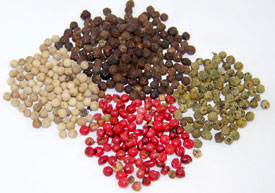
Peppercorns: While standard peppercorns were known and widely used in cooking in period (the average household might use more than a pound a year), other kinds of 'peppers' were known and used. In addition to black pepper, white pepper, which is merely black peppercorns with the outer covering removed before curing, was known in period. Legend said that black pepper was blackened by fire in the harvesting process. (Green peppercorns are unripe black peppercorns and rose pepper comes from a different plant; neither was known in Europe in period.)
Pepper was the principal spice in Ancient Roman cookery. It is found, along with garum, in most Roman recipes. It is of much lesser use in Medieval cooking. Though Italians and Catalans used it foremost, cooks like Taillevent or Maître Chiquart would prefer grains of Paradise or long pepper, as they considered black pepper much too common and too hot for the delicate stomachs of the elites.
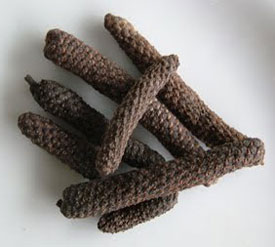
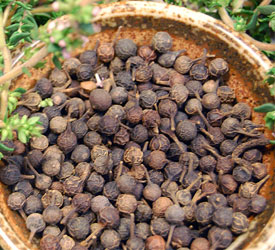
Peppercorn Substitutes: Long peppers, tiny corn-cob-like fruit of a plant cousin to the pepper vine, and cubebs or tailed peppers (shaped like tiny blueberries with attached stems) imported from Indonesia to England in the thirteenth century, as well as melegueta pepper or grains of paradise, seeds of an African tree (a species of cardamom) imported from Mali, went through periodic vogues as pepper substitutes or alternatives. Cubeb and long pepper were used much like pepper (in both savory and sweet dishes), grains of paradise were also used in certain types of mulled wine and hypocras.
The discovery of chile in the New World killed the market for long pepper in 16th c. Europe. Before chiles came on the scene, it was the hottest spice in the medieval arsenal and folks wanted it for spiced wine, food, etc.; considered an antidote to hemlock.
Grains of Paradise were more appreciated in the medieval gastronomy of 14th and 15th century France than in that of the other European countries. It appears that the reference to Paradise in its name was part of this spice’s success. But its use declined, starting in the 16th century. It is starting to be rediscovered now.
Long Peppers
Cubebs
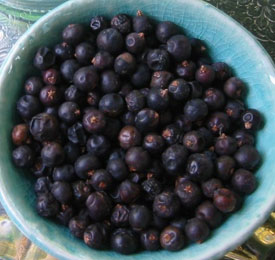
Grains of Paradise
Cinnamon and Cassia:
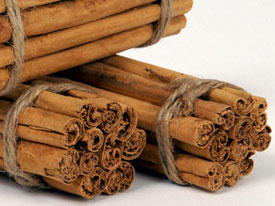
Most people think they know cinnamon but are unfamiliar with cassia. Oddly enough, they are exactly backwards. What is sold as cinnamon in the US is the bark of the cassia tree, from China. True cinnamon tree bark (Cinnamomum zeylanicum) is lighter in color, thinner, and has a smoother taste than cinnamon. Both cassia (or cassie) and cinnamon were used for its scent in fragrances, incenses, and pomanders, as well as in cooking. Herodotus and Pliny relate tall tales about where cinnamon comes from: cinnamon-bird nests and cinnamon-growing areas guarded by bats. Cinnamon was used to flavor fruit and grain dishes, as well as hashmeat, soup and other main dishes.
While the mixing of cinnamon and ginger was a favourite of French medieval cooking, present in most recipes, cinnamon was found in less than 10% of the English recipes.
Roots and Rhizomes:
Rhizomes are fat tubers off of which the roots grow in certain tropical plants.
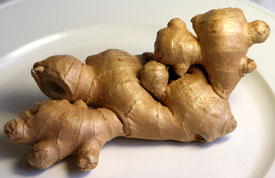
The rhizomes we know as ginger traveled as either whole roots or dried slices (to be powdered for use) or (possibly) preserved in sugar, packed in ginger jars. It was suspected of provoking lust, but widely used in saucing meats anyway. Seldom found during the Roman period, its use in Europe developed during the Middle Ages. According to Bruno Laurioux, ginger was found in one quarter of all medieval French and English recipes. Ginger was of less use in Italy and Spain, during that same period. At least three different kinds of ginger were used then: common ginger, white ginger (from around Madras) and Meccan ginger (having passed in transit through Mecca). Proof, if need be, of the gustatory sensitivity to spices of the medieval gourmets!
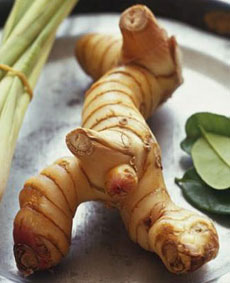
Galingale, the rhizome of a gingerlike Indonesian plant, was imported usually as dried strips. There are two kinds, the greater [Alpina Galanga] and the lesser [Alpina Officinarum]. The editors of the Forme of Cury said that it was the chief ingredient in galentine, and identified it with powder-douce and powder-fort; it is similar to ginger but more spicey, peppery and complex. The consumption of garangal develops starting in the 14th century in Europe, but it is already found in the spices bought by the Corbie monastery, in the 9th century: 10 lbs garingal, clove and costus root (sassurea lappa clarke, native to India and of wide use in Roman cooking).
Brightly yellow colored turmeric, another rhizome, was occasionally used as a dyestuff. Spikenard, the root of an Indian plant in the same family as valerian (Nardostachys Jatamansi), is the biblical Nard. (American Spikenard -- Aralia racemosa -- is not true spikenard.) Spikenard is present in several recipes of Apicius, and found again in a recipe for hippocras, of the Ménagier de Paris and of the Thresor de santé (health treasure). Spikenard is also cited in Forme of Cury.
Ginger
Galingale
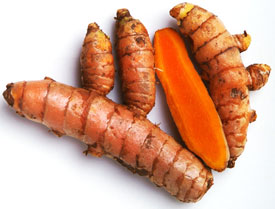
Turmeric Roots
Resins:
Most people have heard of frankincense, which is the resin of the olibanum tree, and is still used as incense. It was imported as 'beads' of resin from India. Medically, frankincense was used to treat sinus problems and uterine disorders (a poultice of frankincense tea applied to the abdomen, or the user burnt or boiled frankincense and sat over the smoke or steam). Myrrh is the resin tapped from splits in the bark of an Arabian tree. Used extensively in wound treatments due to its antiseptic and painkilling properties, its analgesic properties have recently been proven. Frankincense and myrrh were ingredients in pomanders, cosmetics and other scented preparations, partly for their sweet smell and partly to combat illness (thought of as noxious odors). Labdanum-- not to be confused with laudanum-- is the resin of the rock-rose shrub. (Traditionally it was gathered by scraping the beards of the goats that ate rock-rose.) Labdanum was extensively in perfumery, especially pomanders. Gum arabic, gum tragacanth (gumdragon), benzoin (benjamin), and storax (styrax) are other preservative resins that were used in making fragrances and medicines.
Mastic, a resin obtained from the mastic tree, was used in Arabo-Persian cookery and figures on the well-known list of spices of the Viandier.
Nutmeg and Mace:
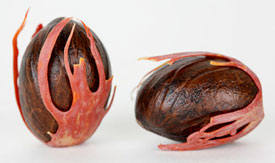
Most people know nutmeg, the seed pit of an Indian tree fruit. Fewer know mace, which was the outer covering around the nutmeg within the fruit of the nutmeg tree. Nutmeg was shipped as whole nuts and ground for use on a grater, eaten whole as a tonic, or set in silver as pomanders. (Fresh-grated nutmeg is amazingly sharper and stronger than the pre-powdered stuff.)
Mace was shipped as slivers of the dried skin. Both nutmeg and mace were used extensively in food; mace seems to have been slightly more popular, but both were signs of conspicuous consumption. Mace was also used as a strewing herb by the very rich, like German Emperor Henry VI whose coronation route in 1191 was strewn with it. Not part of the Roman spices, nutmeg and mace were widely used in the Middle Ages though. The English preferred mace and the French preferred nutmeg.
Saffron (Crocus sativus)
In period, turmeric would have been more expensive than saffron so they wouldn’t have used turmeric as a yellow/saffron substitute. In French medieval cooking the word “frangié” or fringed, was a term for the sprinkling of saffron on certain dishes to produce a speckled effect. Saffron was a prized spice in the Medieval cookery of Italy, of Catalonia and of England. Many Medieval recipes give an indication of colour for the dishes. Since the Medieval cooks didn't have all those coloured vegetables, such as tomatos or sweet peppers, at their disposal, they would easily use saffron to give a yellow coloration to the dishes, and parsley and other herbs for a colour green. Maître Chiquart and Taillevent even used orchil, a lichen that gives a colour blue, and alkanet or dyer’s bugloss, a plant of the same family as borage, that gives a colour red. Maître Chiquart also used gold leaves to give a golden aspect to certain dishes such as rissoles.
Saffron is an exception to the definition of spice as imported aromatic products, since it grew locally but was nevertheless viewed as exotic and was breathtakenly expensive. The dried stigmata of a variety of crocus (crocus stativus), saffron probably originated in the Middle East (Iran and Kashmir are the leading growers of saffton now). In the Middle Ages saffron grew throughout the the Mediteranean world and was particularly associated with Tuscany, where there were major markets in Pisa and San Gimignano. At the end of the period, the eastern part of Spain started to gain the reputation it continues to hold as the source of the best-quality saffron. Unlike almost all Medieval spices, the saffron crocus was easily adapted to different soils and climates. Even nothern Europe could produce a crop. The difficulty with saffron and the reason for its expense is in the tedious labor of harvesting just the stamen and the astronomical number of tiny threads necessary to make up a standard unit of measurement. Saffron was used as it is now in flavoring vaious dishes, but also as an incense, as a coloring agent, and probably most importantly, for its medicinal applications.
Salt – The salt available would have been local mined salt (England and Ibiza both produced mined salt, probably in blocks which would be shaved for serving), the other desired salt was French sea salt. Medieval processing did not contain additives like iodine (human added additives) but might contain naturally occurring impurities; an affluent household would buy bay salt (a large grain salt with impurities) dissolve it back into brine and boil the brine over a fire until it crystallized to make a finer salt for serving (from Kurlansky), the recipe for this is found in Menagier de Paris; Salt was also used to cure meat & fish, tan leather, glaze pottery, make butter, and as a medicine on its own.
Mustard [Brassica nigra and Sinapis alba] – ground in mills called mustard querns; served with vinegar over beef; period mustard sauce would not have been as yellow as our plain mustard as turmeric is added modernly to enhance the color. Used since antiquity, mustard was highly valued in the Middle Ages. The commercial production of mustard began in the mid-14thth century in Dijon, France.
Clove -
Cardamom -
Sugar - Sugar was obtained from sugar cane, which was cultivated in the Middle East, in Spain and in Sicily. Sugar was therefore, like spices, an uncommon and expensive product. It was considered both a spice and a medicine in the Middle Ages. It is found in many recipes "for the sick", and also, in the composition of sweet and sour sauces (rather than honey, because honey was considered too common maybe).
(Saccharum officinarum): cane sugar (beet sugar was unknown) originally imported from the Indies by way of Venice. According to Dalby, "by the year 1000, [the growing of sugar] had reached the Middle East and the coast of East Africa." Medieval sugar was dark brown, unless it had been refined and generally came molded into cones or blocks. Medieval and Renaissance writers give directions for refining/whitening sugar. Dishes described as 'Cypriot' usually included sugar.
Sumac - Sumac consists of the dried berries of a Mediterranean shrub (Rhus coriaria or Tanner’s sumac, family terebinthaceae), which is cultivated in Sicily, the south of Italy and throughout the Middle East. Sumac is supposed to have been used in Ancient Roman cookery (it is not found in Apicius). It is a spice commonly used today in Middle Eastern cooking (Lebanon, Syria, Turkey, Armenia, Iran) to give an acidic flavour to salads, fish or meat dishes. People can easily find them in Armenian grocery stores in France, for instance. Concerning the Middle Ages, there is often sumac in recipes of the Baghdad cookery book and we have found sumac again in the Liber de coquina: II.10 De sumachia (sumac), II.11 Recipe pullos (chicken) and V.11 De composito lumbardico (Lombard mix).
