Medlars
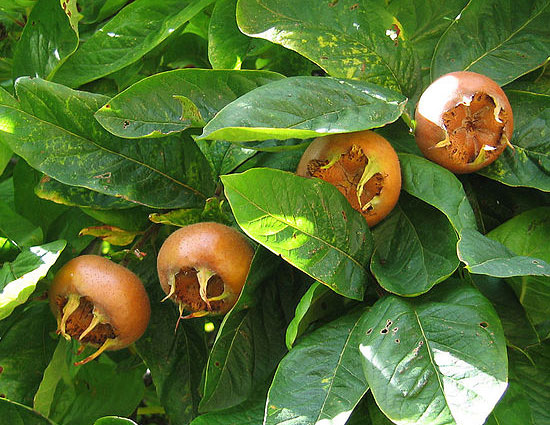
Medlars are the fruit of a small tree (the Mespilus germanica) that is related to apples. The fruit resembles an apple, but what is at the core of the apple, is visible at the underside of the medlar. The medlar was already being cultivated about three thousand years ago in the Caspian Sea region of northern Iran and Azerbaijan. It was introduced to Greece around 700 BC, and to Rome about 200 BC. It was an important fruit plant during Roman and medieval times. By the 17th and 18th centuries, however, it had been superseded by other fruits, and is little cultivated today. M. germanica pomes are one of the few fruits that become edible in winter, making it an important tree for gardeners who wish to have fruit available all year round.
The fruits are hard, acidic, and high in bitter tannins. They become edible after being softened, 'bletted', by frost, or naturally in storage given sufficient time. Once softening begins, the skin rapidly takes on a wrinkled texture and turns dark brown, and the inside reduces to the consistency and flavour reminiscent of apple sauce. This process can confuse those new to medlars, as a softened fruit looks as if it has spoiled.
Once bletted, the fruit can be eaten raw and is often eaten as a dessert, for example with cheese or tarts, or used to make medlar jelly and wine. Another dish is "medlar cheese", which is similar to lemon curd, being made with the fruit pulp, eggs, and butter.
