Mince Pies
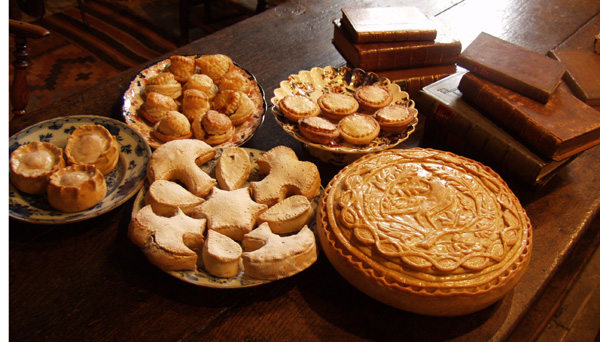
Three centuries of mince pies. Front row (left to right): Sir Kenelm Digby's Mince Pies iced with Ambergris Sugar (1670) ),
Edward Kidder's Shaped Mince Pies (c.1720), Lady Barbara Fleming's Mutton Mince Pie (1673).
Back row (left to right): Urbain Dubois's Puff Paste MincePies (1871) and Mrs Isabella Beeton's Shortcrust Mince Pies (1861)
Picture from http://www.historicfood.com/
The early mince pie was known by several names, including mutton pie, shrid pie and Christmas pie. Typically its ingredients were a mixture of minced meat, suet, a range of fruits, and spices such as cinnamon, cloves and nutmeg. Served around Christmas, the savoury Christmas pie (as it became known) was associated with supposed Catholic "idolatry" and during the English Civil War was frowned on by the Puritan authorities. Nevertheless, the tradition of eating Christmas pie in December continued through to the Victorian era, although by then its recipe had become sweeter and its size reduced markedly from the large oblong shape once observed. Today the mince pie remains a popular seasonal treat enjoyed by many across the United Kingdom.
Mince pie started being eaten in Britain as a fad food, brought home by returning Crusaders who'd picked up a taste for the spices and food styles they'd spent some years ingesting in the Middle East. The cuisines of the Islamic empires of the 1000's to 1200's included many dishes in which meat and fruit occurred together, and normally included what we now think of as "sweet" spices like cinnamon, nutmeg, mace, and various others now almost exclusively used in Western cooking for desserts.
11th Century – The Christmas pie came about at the time when the Crusaders were returning from the Holy Land. They brought home a variety of oriental spices. It was important to add three spices (cinnamon, cloves and nutmeg) for the three gifts given to the Christ child by the Magi. In honor of the birth of the Savior, the mince pie was originally made in an oblong casings (coffin or cradle shaped), with a place for the Christ Child to be placed on top. The baby was removed by the children and the manger (pie) was eaten in celebration. These pies were not very large, and it was thought lucky to eat one mince pie on each of the twelve days of Christmas (ending with Epiphany, the 6th of January).
In the centuries that followed, the British wholeheartedly embraced this new style of cooking, especially those who could afford the spices on which it depended and could therefore use such dishes as a way to show off to neighbors and friends. And the heavy and sometimes near-encyclopedic spicing was never (contrary to some assertions by confused food writers) a way to attempt to hide "bad meat": the spices involved were way too expensive to waste on something like that. Dishes of this kind were a delicacy, one that kings weren't ashamed to eat, and the popular passion for them lasted for hundreds of years.
The fourteenth century ‘Forme of Cury’ gives a recipe for Tart of Flesh which contains figs, raisins, wine, pine kernels, lard, cheese, minced pork, honey and spices.
Original (as transcribed by Hieatt and Butler, see sources):
161. Crustardes of flessh. Take peiouns, chykens, and smale briddes; smyte hem in gobettes. & sethe hem all ifere in god broþ & in gres wiþ veriows. Do þerto safroun & powdur fort. Make a crust in a trap, and pynche it, & cowche þe flessh þerinne; & cast þerinne raisouns coraunce, powdour douce and salt. Breke ayren and wryng hem thurgh a cloth & swyng þe sewe of þe stewe þerwith, and helde it vppon the flessh. Couere it & bake it wel, and serue hit forth.
Translation into modern English:
Crustardes of flesh. Take pigeons, chickens, and small birds; smite them in gobbets. And seeth them all fair in good broth and in grease with verjus. Do thereto saffron and powder fort. Make a crust in a trap, and pinch it, and couch the flesh therein; and cast therein currants, powder douce, and salt. Break eggs and wring them through a cloth and swing the juice of the stew therewith, and hold it upon the flesh. Cover it and bake it well, and serve it forth.
1413 – King Henry V of England served a mincemeat pie at his coronation in 1413. King Henry VIII liked his Christmas pie to be a main-dish pie filled with mincemeat.
Indeed both King Henry V (1413 - 1422) and King Henry VIII (1509 - 1547) were fond of mincemeat, especially when presented as a pie. It even turned up at Henry V's coronation. One recipe dating from a hundred or so years further on looks like this:
A Propre new booke of Cokery, 1545
To make Pyes. Pyes of mutton or beif must be fyne mynced & seasoned with pepper and salte and a lytel saffron to colour it / suet or marrow a good quantitie / a lytell vynegre / pruynes / great reasons / and dates / take the fattest of the broath of powdred beefe. And if you will have paest royall / take butter and yolkes of egges & so to temper the floure to make the paest.
Translation
To make Pies. Pies of mutton of beef must be finely minced & seasoned with pepper and salt and a little saffron to colour it / suet or marrow a good quantity / a little vinegar / prunes / great raisins / and dates / take the fattest of the broth of powdered beef. And if you will have paste royal / take butter and yolks of eggs & so to temper the flour to make the paste.
"Paste royal" was a high-quality short pastry possibly referred to here as royal perhaps due to its golden color. A side note: "powdred beef" meant spiced beef -- still eaten in Ireland at the Christmas and New Year's holidays today: the broth would have been the water it was cooked in, not the brine it was originally cured in.
The modern mince pie's precursor was known by several names. The antiquary John Brand claimed that in Elizabethan and Jacobean-era England they were known as minched pies, but other names include mutton pie, and starting in the following century, Christmas pie. Gervase Markham's 1615 recipe recommends taking "a leg of mutton", and cutting "the best of the flesh from the bone", before adding mutton suet, pepper, salt, cloves, mace, currants, raisins, prunes, dates and orange peel. He also suggested that beef or veal might be used in place of mutton. In the north of England, goose was used in the pie's filling, but more generally neat's tongue was also used; a North American filling recipe published in 1854 includes chopped neat's tongue, beef suet, blood raisins, currants, mace, cloves, nutmeg, brown sugar, apples, lemons, brandy and orange peel.
1588 – In the1588 Good Hous-Wiues Treasurie by Edward Allde, meats were still cut up to be eaten with a spoon and combined with fruits and heavy spices. Typical was his recipe for Minst Pye which used practically the same ingredientsthat go into a modern mince pie.
Gervase Markham The English Housewife, (London: 1615),
Minc't Pie
Take a Legge of Mutton, and cut the best of the flesh from the bone, and parboyl it well then put to it three pound of the best Mutton suet & shred it very small; then spread it abroad, and fashion it with Salt Cloves and Mace: then put in good store of Currants, great Raisins and Prunes clean washed and picked a few Dates sliced, and some Orenge-pils sliced ; then being all well mixt together, put it into a coffin, or into divers coffins, and so bake them and when they are served up, open the lids and strow store of Sugar on the top of the meat and upon the lid. And in this sort you may also bake Beef or Veal, onely the Beef would not be parboyld, and the Veal will ask a double quantity of Suet.
Edward Kidder's Pastry and Cookery. (c. 1720 )
At this period, the favourite meat used in mince pies was tongue, or sometimes tripe. In the nineteenth century, minced roast beef became the norm, as in the second recipe, made every Christmas for Queen Victoria by her master cook Charles Elme Francatelli.
19. Mincd Pyes Shred a pd of neats tongue perboyld wth 2 pd of beef suet 2 pippins a green lemon piele season it wth an ounce of sweet spice a pd of sugar 2 pd of currants ½ a pt of currants; sack a little orange flower water ye juice of 3 lemons a quarter of a pd of sliced citron & lemon piele mix these together & fill yor pyes. Sweet spice is Cloves, Mace, Nutmeg, Cinnamon, Sugar & Salt.
By the end of the Georgian era, mince pies were beginning to be made in a smaller, family size, sometimes with a base of short crust and a top of puff paste. Thomas Webster, in his 1815 Encyclopedia of Domestic Economy lays out a recipe for mince meat:
Mince Meat.
Take two pounds of beef suet finely chopped and picked free from strings, two pounds of apples peeled and chopped small, two pounds of raisins stoned and chopped, two pounds of currants washed and thoroughly cleansed, one pound of good moist sugar ; boil three lemons, and, after pounding the rinds small, add them and the juice to the other ingredients ; chop small half a pound of candied citron and lemon peel, and work all these ingredients together with two wine-glasses of French brandy, and a little salt. Put tbem into a covered jar, which place in a cool spot, and the mince meat will keep for several weeks. Keep at the top of the jar some unchopped candied peel, and add a slice to each mince pie, when any are being made. Some prefer puff paste, others a short crust, for sheeting the pans. (Webster, 1815)
Both from Charles Elme Francatelli The Modern Cook (London: 1846).
Mincemeat à la Royale
To equal proportions of roast-beef:, raisins, currants, suet, candied citron, orange, lemon, spices and sugar, add a proportionate weight of stewed pears and preserved ginger, the grated rind of three dozen oranges and lemons, and also their juice, one bottle of old rum, one bottle of brandy, and two of old port.Lemon Mincemeat
Boil four lemons till quite tender, then pound them in a mortar or chop them up while warm, adding to them two pounds of pounded loaf sugar; let tfhis stand till next day, then add two pounds of suet, two pounds of currants, one pound of raisins chopped, a little brandy, one ounce of mixed spice, and port wine, to taste, say half a pint of brandy and wine together.
