Raising Pies
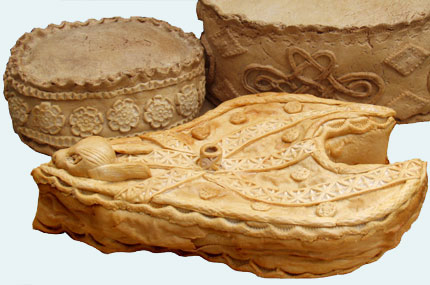
A re-creation of John Thacker's Rabbit or Hare Pie. This is a savoury pie, but some
early modern period meat pies were sweet. Even fish pies were seasoned with
sugar, such as the two unusual pies behind the rabbit. These are from Gervase
Markham's The English Housewife (London: 1615). They are a herring pie (left) and a
ling pie (right). Though they were slightly sweetened, pies of this kind usually contained
dried or fresh fruit and verjuice or Seville orange juice, so in reality the effect was
sweet and sour. In England, the sweet meat pie has survived into modern times
in the mince pies we eat at Christmas, though the only meat they now contain is suet.
From Ivan Day
Before there were such conveniences as baking tins, refrigerators, and lunch-boxes, a 'coffin' of thick dough performed the functions of all three perfectly well. In the Middle Ages meat pasties were made with a hard durable crust formed from rye flour. This was so tough and resilient it did not crack easily and was highly suited for pasties which were to be sent long distances as gifts - venison pasties for instance were popular wedding gifts and were even sent abroad. These pies fulfilled these funcitons so well that the contents were said to be able to be kept for many months (even a year). A pie with a thick crust, unless it got damp or cracked, would keep meat for a long time before refrigeration.
A stag or venison pasty (sometimes also called a 'leasing'), was a great favourite at feasts and celebration meals especially during the sixteenth and seventeenth centuries. Because the crust was hard and did not crack, this ensured that a wonderful gravy was produced by the venison, and that it did not leak out as the pasty slowly baked in the wood-fired oven. The pasty would have been cut into from the top to reveal its filling of meat and the filling scooped out with a spoon. They were not cut into slices as we do today.
A hot water dough was used to create the coffins or pie shells that meats could be cook in.
Here, from the marvellous English classic, Cassell's Dictionary of Cookery (1870's) are detailed instructions on the method. For earlier and other recipes, see below.
Paste for Raised Pies.
In making raised pies the first consideration is whether the pastry is intended to be eaten or not. If it is intended merely to form a mould in which to hold the meat, it may be made firm and compact without very much diffculty, and may be beaten with the rolling-pin or kneaded with the knuckles to make it stiff and hard. If it is intended to be eaten, greater care will be necessary. It must be remembered that small pies are much easier to make than large ones, and the very easiest and best way for inexperienced persons to make them is to use one of the tin moulds manufactured for the purpose, which opens at the sides. The French pastry named Pâte Brisée, the recipe for which is given (see Crust, Pâte Brisée), makes a good crust for small raised pies. When the pastry is not to be eaten, dissolve three or four ounces of lard in half a pint of boiling water, and stir in as much flour as will make a stiff smooth paste. A little more than a pound of flour will be required. Knead it thoroughly with the fingers, and when it is sufficiently firm to keep its form when moulded, put it into a bowl, and cover with a cloth until it is nearly cold. Dredge a little flour on the pastry-board, put the pastry upon it, and roll it with the hands into the shape of a sugar-loaf or cone, with the diameter of the lower part rather less than the size required for the pie. Place the cone upright, and flatten the top until it is half the height. Press it down with the knuckles of the right hand, at the same time forming the walls of the pie with the left. When the sides are smooth, and of equal thickness, fill the pie, roll out the cover, lay it on, and make a hole in the centre. Fasten the edges securely with a little egg, ornament the pie according to fancy, glaze it by brushing it over with the beaten yolk of an egg, and bake in a quick oven. An easier way of shaping a raised pie is to roll out the pastry to the required thickness, and then cut out a piece for the top and bottom, and a long strip for the sides. These pieces must be fastened with egg, and the edges pressed over one another, so as to be securely fastened. The pie may then be finished according to the directions given above.
When the crust is intended to be eaten, the pastry may be made according to the directions given for "Pâte Brisée" (see Crust, Pâte Brisée) or as follows: Rub a quarter of a pound of butter into a pound of flour. Sprinkle over it a small tea-spoonful of salt. Put another quarter of a pound of butter into a saucepan, with the third of a pint of milk. Stir it over a gentle fire until the butter is dissolved, then pour the liquid over the flour, and stir it to a smooth stiff paste. Dredge some flour over it; give it two or three turns, and mould it into the proper shape before it has had time to cool. Time to bake raised pies, from two to five hours, according to size.
Cassell's Dictionary of Cookery
Other recipes
1553 - From the English translation by Valoise Armstrong of the 1553 German cookbook Kochbunch der Sabina Welserine, includes a recipe for pastry dough:
Das Kuchbuch der Sabina Welserin, V. Armstrong (trans.), 1553
"61 - To make a pastry dough for all shaped pies - Take flour, the best that you can get, about two handfuls, depending on how large or small you would have the pie. Put it on the table and with a knife stir in two eggs and a little salt. Put water in a small pan and a piece of fat the size of two good eggs, let it all dissolve together and boil. Afterwards pour it on the flour on the table and make a strong dough and work it well, however you feel is right. If it is summer, one must take meat broth instead of water and in the place of the fat the skimmings from the broth. When the dough is kneaded, then make of it a round ball and draw it out well on the sides with the fingers or with a rolling pin, so that in the middle a raised area remains, then let it chill in the cold. Afterwards shape the dough as I have pointed out to you. Also reserve dough for the cover and roll it out into a cover and take water and spread it over the top of the cover and the top of the formed pastry shell and join it together well with the fingers. Leave a small hole. And see that it is pressed together well, so that it does not come open. Blow in the small hole which you have left, then the cover will lift itself up. Then quickly press the hole closed. Afterwards put it in the oven. Sprinkle flour in the dish beforehand. Take care that the oven is properly heated, then it will be a pretty pastry. The dough for all shaped pastries is made in this manner."
Das Kuchbuch der Sabina Welserin, V. Armstrong (trans.), 1553
65 The dough for the pastry. Take rye flour, according to how large the fish is, take it, and put water, about three pints, in a pan and a good quarter pound of fat into it, and let it cook together, put the flour on the table and put the solids from the melted fat-water on top, until it makes a good firm dough. You must knead it well so that it becomes good and sticky. Afterwards make two parts out of it. First the bottom, roll it out as large as the fish is. After that lay the fish on the bottom crust and roll out the top crust just as wide and put it over the fish and shape it like the fish. Make fins on it and take a small knife and make dough scales, also eyes and everything which a fish has. And put it in the oven and spread it with an egg. Then you have a fish pastry. (Germany, c. 1553)
The Good Huswifes Handmaid for Cookerie in her kitchen (1588) includes this recipe for pie crust:
"To make paste and to raise coffins. Take fine flour and lay it on a board and take a certaine of yolkes of egges as your quantitie of flower is, then take a certain of Butter and water and boile them together but you muist take heed ye put not too many yolkes of egges, for if you doe it will make it dry and not pleasant in eating, and ye must take heed ye put not in too much Butter, for if you doe, it will make it so find and so short that you cannot raise: and this paste is good to raise all manner of coffins: likewise if ye bake veneson, bake it in the paste above named."
Gervase Markham, in The English Huswife, 1615, provides a similar crust recipe:
"... your fine wheat curst must be kneaded with as much butter as water, and the paste made reasonable lithe and gentle, into which you must put three or four eggs or more according to the quantity you blend together, for they will give it a sufficient stiffening."
These are both very similar to modern deep-dish pie and meat pie recipes. Here's the result:
For a 9" pie:
2 1/2 cup flour
1/2 cup butter
6 Tbsp water
3 egg yolks
Mix flour and egg yolks. Put butter and water in a small saucepan over low heat until the butter is melted. Add butter and water to flour and egg mixture. Knead until all flour is part of the dough ball. If extra water is needed, add 1 tsp water. Divide in half and roll. No chilling required!
The taste is similar to a shortening and cold-water crust, but the texture is stiffer and more solid.
