Service à la Française
Today the method of service in restaurants and at formal dinners in France is not service à la française — service in the French-style. It was called service à la française 150 years ago, but in the middle of the 19th century the style of service changed to the Russian-style — service à la russe. Going out to dinner was quite different 150 years ago.
Method of Service in the Middle Ages
Service à la française evolved over time from the method of service used in the Middle Ages by royalty and the nobility. During that period, the only cutlery supplied the diner was a spoon. All the guests, at least each male guest, would bring his own knife. Female guests would be served by men sitting nearby. The edge of the blade was used to cut pieces of meat off a joint and the pointed end of the knife was used to spear the pieces. Forks hadn't arrived yet from Italy and fingers were the preferred method of transporting food from a bowl to the mouth. Bowls and platters would be used for serving, but each dinner had a hollowed-out piece of hard, brown bread, a trencheoir, as his or her individual plate [as opposed to having a ceramic or porcelain plate]. The various courses were brought to the diners in large bowls or platters which served two or more guests. Everybody was not served the same food. What each diner was served, as well as where each guest sat, was a function of his or her relative station in life. The choicer morsels, the rarer ingredients, and the better quality serving bowls went to those diners higher up the pecking order.
Later Development of Service à la Française
As culinary habit and etiquette in France changed from the Middle Ages to the 19th century, multiple pieces of silverware replaced fingers and multiple pieces of fine porcelain replaced hard bread. But one aspect remained the same, the diner's position in life was still reflected at the table both in placement and in food.
The typical formal dinner in the 19th century, whether enjoyed by the rich or the growing middle class, and whether served in a home or eaten in a restaurant, consisted of three courses, sometimes described as premier service, second service, and troisième service. Up until the 18th century it was still common, as in the Middle Ages, for sweets to be served as part of all three courses, but by the 19th century, the third course was closer to the modern concept of dessert.
The first course would commence with one or more soups. When these were removed, a couple of large plates of roasted or stewed meats, poultry, or fish, called relevés, were presented. These were accompanied by a series of entrées — smaller dishes of meat, poultry, or seafood — plus some entremets, small sweet or savory preparations. (In the Middle Ages, an entremet was entertainment presented between the mets, French for items "placed" before the diner. By the 18th century, these sweet and/or lighter dishes were now intended to provide a break between the larger heavier dishes of the course.) For larger meals, hors d'œuvres were place around the main dishes. Hors d'œuvres, literally "outside (the) work," were not served before the meal as they are today, but around the main body of the meal.
The second course had the largest dishes of the meal, accompanied by vegetables, salads, and more sweet and savory entremets. By the 19th century, this course would contain the pièce de résistance, the center of the meal. The term apparently comes from the concept that diners had to resist eating too much of the first course in order to save room for this main dish. Also, this was not just a simple roast placed on a platter but an entire architectural construction of a combination of meats or seafood with a multitude of garnishes.
The third and final course was closest to the modern concept of dessert consisting of cheeses, pastries, and fruit. It could also include meat pâtés and other savory preparations. In the 18th century, this course bore more similarity to the earlier courses in that it would be centered on savory dishes with some sweet ones interspersed. The French word dessert evolved from desservir, meaning to "to remove what has been served, to clear (the table)." Also, much like today, the third service was prepared not in the kitchen but in the office, or pastry kitchen.
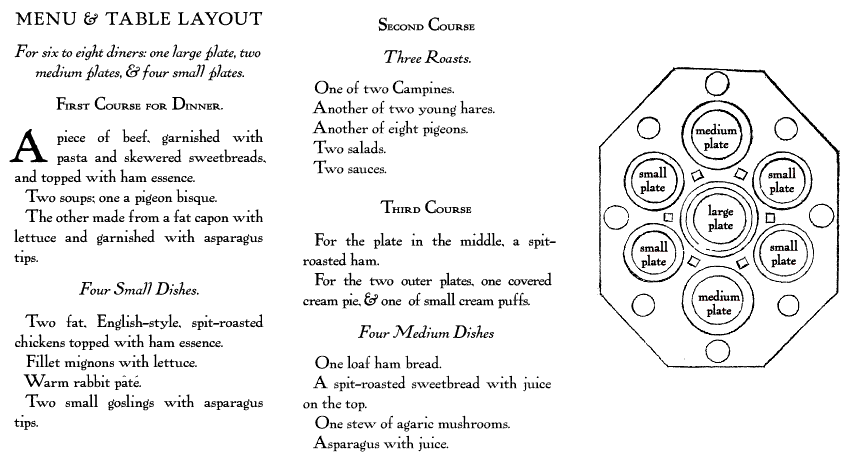
For all three courses, the individual dishes are placed in the center of the table in a symmetrical pattern with the principal dishes in the center and lesser dishes arranged around the center. Thus the dishes were arranged by size and symmetry. The arrangement was the responsibility of the maître d'hôtel. As the number of guests increases, the amount of each dish is not increased, but the number of dishes is. That is, the variety of dishes in the service increases with the number of guests. The 1748 edition of François Massialot's Le nouveau cuisinier royal et bourgeois ou cuisine moderne presents sample menus for a variety of possible dinner parties. In his examples, it is not until the party reaches a size of 30 to 35 guests before he begins to double up some of the dishes.
The following is Massialot's example of a simple dinner for six to eight diners along with the layout of the service plates on the table.