Sweet Frumenty
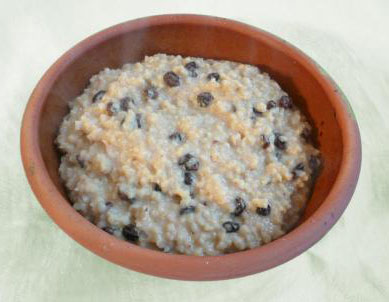 This is a standard dish appearing in many variations over the centuries. It makes a lovely side dish, especially with strongly flavoured meats. It appears on menus alongside game, especially venison. The author of Le Menagier de Paris tells us that "salted wild boar is eaten with frumenty."
A sweet, luxurious porridge like this one was treated as a prestige dish for dinner feasts. It was most famously served hot alongside roasted meats, particularly venison, wild boar, or porpoise during royal banquets. The sweetness of the fruit and honey was meant to complement the savory, gamey flavors of the meat.
It was a symbolic dish in winter, a sign that spring would come. It later came to be served as a festival dish on Twelfth Night (5th of January).
Because it used almond milk instead of dairy, it was a popular dessert or side dish during Lent and other church fast days when eating meat and animal byproducts was strictly forbidden.
Today we eat similar porridges for breakfast. But in medieval Europe, eating breakfast (disjejunare) was generally frowned upon, and this recipe was served at dinner feasts. Medieval theology viewed eating early in the day as a sin of gluttony, suggesting a lack of self-control. Only hard physical laborers (who needed fuel before heading to the fields), the very young, the elderly, or the sick ate in the morning. Even then, their meal was usually just a piece of stale rye bread dipped in ale or wine, or a leftover bowl of savory vegetable pottage.
Similar Modern Recipe
Yield: 2 servings
1 cup oats (steel-cut or rolled) or cracked wheat
2.5 cups almond milk (unsweetened)
2 tablespoons honey (adjust to taste)
1/4 cup dried fruits (currants, raisins, or chopped figs)
A pinch of saffron threads (steeped in 1 tablespoon of warm water)
1/4 teaspoon cinnamon
A pinch of salt
Steep the saffron: Place the saffron threads in a small bowl with one tablespoon of warm water. Let it sit for 5 minutes until the water turns deep yellow.
Combine ingredients: In a medium saucepan, combine the almond milk, oats, honey, dried fruits, cinnamon, and a pinch of salt.
Simmer: Bring the mixture to a gentle boil over medium heat, then immediately reduce the heat to low.
Color and thicken: Stir in the saffron and its soaking water. Simmer uncovered for 10 to 15 minutes, stirring frequently, until the oats are thick, creamy, and beautifully golden.
Serve: Pour into bowls. If you want to eat like royalty, top it with an extra drizzle of honey or a few toasted almonds.
Original recipe from Curye on Inglysch:
'To make frumente. Tak clene whete & braye yt wel in a morter tyl the holes gon of; seethe it til it breste in water. Nym it up & lat it cole. Tak good broth & swete mylk of kyn [cow] or of almand* & tempere it therwith. Nym yelkes of eyren [eggs] rawe & saffroun & cast therto; salt it: lat it naught boyle after the etren ben cast therinne. Messe it forth.' (Curye on Inglysch CI.IV.i.)
*Note: mylk of alamand: almond milk, used during Lent
From The Art and Mystery of Food
. . . the dish has been made in England since at least the Medival period, until the mid-20th century. . . Basically, the recipe is wheat pounded and seperated from its hulls, then boiled in cow or almond milk until it forms a gel, this mixture was then sweetened, spiced or coloured as appropriate to the the period. During the Medieval period it most often served without sugar with boiled venison as a type of pottage or in non-meat days with porpoise or beaver tail. Despite being mammals the entire of the former and the tail of the latter were counted as "fish".
By the modern period frumenty had become associated with Christmas eve, as the following 19th century description indicates:
"Christmas-eve is celebrated in almost every family by a supper of frumenty, made of steeped wheat boiled with milk, apple-pie, cheese, and yule-cake. It is accounted very unlucky to cut into the cheese before supper. At the commencement of supper a large fire is made, on which is placed the yule-log, and a tall mould-candle, called the yule-candle, which is not to be snuffed, is lighted and placed on the table; a piece of the log is preserved until the following Christmas by each prudent housewife, to secure the house from fire during the year."
The popularity of frumenty in 19th rural England is rather interesting as for the most part wheat was a recent addition to the diet, especially in the North. It is possible that this was viewed as a high status dish and was eaten only on festivals where rarities like wheat were more freely available. So popular was frumenty at this period that it was possible to buy the wheat pre-boiled and set into a jelly from vendors.
This jelly was called "Creed Wheat" ( to cree grain is to soften it by soaking or boiling) and it is the creed wheat I had a problem with . Buying whole wheat is not a great problem and instructions for preparing the grain where essentially the same since the Medieval period: Beat grain to loosen the hull, then gently boil. Remove the hulls and you will get a wheat gel that will set solid like well made oat porridge. Try as a might I could not get this process to work with the wheat I used.
Back to the drawing board. I managed to find another source of wheat, this time with partial removal of the hull ("pearled wheat"). Problem solved, gel formed in roughly 40 minutes of gently boiling. Clearly the important part of all the recipes I looked at was the removal of the hull, however I failed to note this initially. This illustrates part of the difficulty with historical recipes; if I can get this simple process wrong, what hope would I have with a more complicated dish? And in addition, in this instance I had a very good idea what the dish should be like at several stages, often this is not the case with historical recipes.
The creed wheat was mixed with milk, egg yolk, spice and sugar and gently heated to give an indulgent but comforting porridge type dish. I can see why it was popular.
If you are interested in making this dish you could look for pearl wheat (very hard to find) or substitute pearl barley. Least you think this inauthentic, here is a recipe from the end of the 17th century."
From The Queen-like Closet or Rich Cabinet — Stored with all manner of rare receipts for preserving, candying and cookery. Very pleasant and beneficial to all ingenious persons of the female sex. Author: Hannah Wolley. Note: The first cookbook written by a woman was Hannah Wooley's The Queen-like Closet; or Rich Cabinet, published in 1670.
"54. To make Furmity.
Take some new Milk or Cream, and boil it with whole Spice, then put in your Wheat or Pearl Barley boiled very tender in several Waters, when it hath boiled a while, thicken it with the yolks of Eggs well beaten, and sweeten it with Sugar, then serve it in with fine Sugar on the Brims of the Dish.
57. To make Furmity with Meat—Broth.
Boil a Leg of Beef in water and salt, and put in a little whole Spice; when it is boiled tender; take it up, and put into the Broth some Wheat ready boiled, such as they sell in the Market, and when that hath boiled a while, put in some Milk, and let that boil a while, then thicken it with a little Flower, or the yolks of Eggs, then sweeten it with Sugar, and eat it.
58. To make Furmity with Almonds.
Take three Quarts of Cream, and boil it with whole Spice, then put in some pearled Barley first boiled in several waters, and when they have boiled together a while, then put in so many blanched Almonds beaten fine with Rosewater, as you think may be enough, about four Ounces of Barly to this quantity of Cream will be enough, and four Ounces of Almonds, boil them well together, and sweeten it with Sugar, and so serve it in, or eat it by the way, you may put in Saffron if you please."
