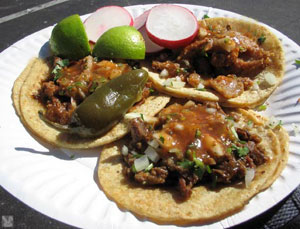
 Authentic Mexican Tacos
Tacos are probably Mexico's most commonly consumed prepared food. They are found everywhere in Mexico, with some regional variations, and are usually purchased from mobile street vendors (that only specialize in tacos...usually just on specific cuts of meat or types of vegetables)...who assemble them straight from the griddle, grill, roaster etc. They are always piping hot...and need to be eaten immediately.
From The Tortilla Book, Diana Kennedy [Harper & Row:New York] 1975 (p. 53-4)
"To most people in the United States, a taco is a tortilla bent in half to form a deep U shape, then fried crisp and stuffed to overflowing with ground beef, shredded iceberg lettuce, sliced tomato, and grated cheese.Throughout Mexico, however the simple taco consumed by millions of people daily is a fresh, hot tortilla rolled around some shredded meat or mashed beans and liberally doused with any one of the endless variety of sauces for which Mexico is justly famed, but which are sadly misrepresented this side of the border...Tacos are usually eaten as a snack between meals, in the evening with a bowl of soup for supper, or as an appetizer before the main meal of the day."
The Serious Eats Guide to Taco Styles
by
J. KENJI LÓPEZ-ALT, http://www.seriouseats.com/
Tacos come in all shapes, sizes, colors, makes, and models, and you'd be hard pressed to find anyone who doesn't like at least some form of meat-shoved-in-thin-flatbread. Here's a quick guide to the most common types of tacos around. I'm sure we've missed a few, so feel free to chime in with anything you think should be included!
SOFT TACOS
There are many regional variations, but the oldest, most widely consumed forms are made with soft white corn tortillas griddled on a comal until lightly charred or steamed until soft. They're small (usually no more than three or four inches across), and are eaten as a street snack.
Fillings can be anything from the battered and deep-fried fish of Baja to grasshopper-stuffed tacos de chapulines of Oaxaca, but they generally fall into one of three categories: griddled/spit-roasted meats, fried meats, or braised meats. Most restaurants or carts specialize in one category. The meaty fillings are finely chopped into tiny pieces on a block of wood known as a tronco with a sharp cleaver before serving. Traditionally, Mexican tacos come very simply adorned with diced onions and chopped cilantro, with lime wedges, pickled or grilled jalapeños, radishes, and a choice of salsas for the customer to add themselves. Of course, nowadays, fillings and condiments run a wide gamut. We'll get into that.
Tacos de Asador (Griddled Fillings)
Griddled fillings include meats cooked using dry heat methods like frying on a flat comal or roasting on a spit. The most common ones you'll find are carne asada (grilled steak), chorizo (a sour fresh Mexican sausage), pollo (chicken), or tripita (grilled tripe). Often served on a double stack of tortillas, guacamole is a common addition, particularly to strong-flavored grilled meats like tripe or stomach.
Tacos de Cazo (Fried Fillings)
Fried fillings are generally slow-cooked in a simmering pot of lard before being crisped up on a hot comal. In that way, it's analogous to French-style confit. The most popular of this style of cooking is carnitas, made by slow-cooking pork shoulder in lard until meltingly tender. Other common cuts are tripa (pork tripe), buche (pig's throat), and suadero (beef cuts, usually from the brisket).
Recipe for Carnitas
Tacos de Cazuela (Braised or Simmered Fillings)
These tacos include head meats like cabeza (mixed face meat), sesos (braised brains), tromp (braised lips), and cachet (cheeks). Whole sheep or goat wrapped in maguey leaves are cooked in large steamers into barbacoa, then the meat is shredded and mixed with the juices that drip out while it cooks before being piled back into a double stack of tortillas.
SALSAS
There's no doubt that the quality of the tortilla and the filing are what define a good or bad taco, but the best taco in the world can be either brought down or elevated by the quality of its salsa (which, by the way, is Spanish for "sauce"). There are four common types of salsa typical to taquerias or carts (though obviously, there are many more variations on these depending on where you go):
Salsa Roja
A deep red salsa made with cooked dried chili peppers and aromatics. It's generally smoky, complex, and hot. It may or may not contain tomatoes.Avocado-based salsa
A loose puree of avocado, lime, and aromatics, it's similar in flavor to guacamole, but far thinner, with a pourable consistency.Salsa Casera (pico de gallo)
Fresh salsa made from raw chopped tomatoes, onion, chili peppers, and cilantro, though other vegetables and fruits can sometimes be used. It's often called pico de gallo (the beak of the rooster), and represents the three colors of the Mexican flag (red, white, and green).
Salsa Verde
Green salsa made from tomatillos, chilis, and cilantro. Bright, tart, and fresh tasting, it can range from mildly hot to downright fiery.
Diana Kennedy's Salsa Verde (tomatillos, no tomatoes)
Flame Charred Salsa Verde (green salsa - tomatillos)Jarred Salsas
Made from cooked tomatoes and tomato purée, this is the stuff you'll find in the jars sold next to the tortilla chips. While they aren't the best choice for real tacos, they can make a great addition to kit-style tacos. Check out our taste test.
Diana Kennedy's Salsa Ranchera (tomato salsa)
Smoky Two Chili Salsa (dried chilis, no tomatoes)
Pantry Chipotle Salsa (good in winter - this is not cooked but uses canned tomatoes)
SPECIALTY SOFT TACOS
These are some of the most popular regional variations on the soft taco theme that you'll find in Mexico and beyond.
Fish Tacos
Originally from Baja, the long peninsula off the Northwest coast of Mexico, fish tacos have been popular in Southern California for a long time and are finding greater popularity on these days on both coasts and everywhere in between (even the Cheesecake Factory has'em on the menu). Made with fresh fish either grilled or battered and deep fried, it comes served on a soft corn tortilla with a shredded cabbage slaw and a cream, mayonnaise, or sour cream-based dressing, often flavored with chipotle (smoked jalapeños), lime, or cilantro.
Shrimp Tacos
Remove the fried fish from a fish taco and replace it with grilled or fried shrimp and you've got shrimp tacos, also from Baja.
Tacos al Pastor or Tacos de Adobada
Meats cooked on vertical rotisseries. Very similar to Greek gyros or Middle Eastern shawarma, thin slices of marinated meats (like pork seasoned with adobo, for instance) are layered on top of each other on a long skewer, cooked via radiation in a vertical broiler, and sliced off in thin shreds as needed. You'll often find a pineapple, tomato, or onion stuck on the top of the stack to help flavor the meat as its juices drip down over the layers.
Tacos al Carbón
A specialty of Sonora, these tacos generally feature fast-cooking meats, most commonly thinly sliced beef steak, though stands specializing in tacos al carbón will often also serve chorizo, chicken, and/or organ meats like tripe and intestine. The meat is grilled on grates set over live coals, which impart a distinct smokiness and char them more deeply than those seared on a griddle. They're often accompanied by grilled green onions, sliced cucumbers, and radish.
Tacos de Canasta
Rarely found outside of Mexico, these tacos are made by stuffing corn tortillas with fillings like chorizo, potatoes, pork skin, or beans, then placed immediately inside a container lined with a cloth. The cloth is folded over the trap steam, and the tacos are then carried around until sold or eaten. In this manner, they get steamed as they sit, turning the tortilla extremely soft and fragile. So elusive are they that we couldn't even track down a photo of them in the wild.
Bug-Stuffed Tacos
Ok, so they may not be for everyone, and they're tough to find in the U.S., but tacos stuffed with fried chapulines (grasshoppers) can be quite tasty. They're crunchy and nutty and really quite delicious—as long as you close your eyes.
Vegetarian Tacos
Tacos are generally a meaty snack, but there are a number of traditional vegetarian options. Tacos de Papa are filled with creamy potatoes, while squash blossoms, rajas (roasted pepper strips) or even nopales (cooked cactus paddle) are not uncommon. Perhaps the most famous (and one of the rarest) is stuffed with huitlacoche: kernels of corn that have been infected by corn smut, a fungus that turns them black. Often referred to as "Mexican Truffles," huitlacoche has an almost cheesy, earthy aroma that's truly fantastic inside a hot corn tortilla.
Mission-Style Tacos
The style of taco served in San Francisco's Mission district, where burritos are really king. Along with meat, they come adorned with more burrito-friendly fillings, like cooked beans, refried beans, cheese, lettuce, and a variety of salsas. The archetypical mission-style taco comes from La Taqueria, on Mission Street.
Breakfast Tacos
With the popularization of Tex-Mex restaurants came a need for something other than Huevos Rancheros for breakfast. Breakfast tacos are a quick and easy option in the morning, consisting of a tortilla (often flour) filled with meat, eggs, and cheese. They're particularly popular in Texas, where you'll find everything from eggs and cheese to potatoes, bacon, and chorizo, like in the Suicide Taco at Rosie's Tamale House in Bee Cave.
Food Truck Fusion Tacos
With their simple mode of production and eminent snackability, tacos and food trucks naturally go hand in hand. While many rolling restaurants stick to the basics, serving either griddled or braised fillings, modern trucks veer from the creative to the just plain weird. The Kogi Barbecue Truck from L.A. can be attributed with popularizing this style, with their tasty, kimchi-stuffed concoctions. Note: These tacos don't actually have to come from a truck.
Fancy-Pants Tacos
This is what happens when renowned chefs get their hands on tacos. Like most foods, they range from excellent—try the chicken and green chorizo version from Alex Stupak's hot new Empellón or the awesome smoked and confited beef tongue in the Benny Lengua Taco at Ken Oringer's La Verdad in Boston—to the downright silly (like the raw Spicy Tuna Tartar Tacos at Todd English's Bonfire). What they all share in common is a particular chef's attempt to add a twist and upgrade to the classic.
Fancy-pants tacos can occasionally end up in the dreaded realm of Tacos Gringos.
Tacos Gringos (a.k.a. Yuppie Tacos)
Imagine an alien flying over the earth observing us through a telescope and taking notes so they can recreate an earth exhibit back on their home planet. Now, they may well get a bunch of things right, and at first glance, their replica of the earth might fool some people. But get down to the details, and the façade falls short. That's what gringo tacos are. Tacos that bear a resemblance to the Mexican original soft corn taco, but lose something (or several things) vital in preparation.
This often manifests itself in the following ways:
Badly heated or stale tortillas that either get saturated with juice and fail, or crumble when you try and fold them.
A vain attempt to up-scale-ify the meat. This can mean, for instance, using higher quality beef cooked medium rare and sliced into strips (thus making them impossible to consume without sliding out of the tortilla). Marked by high quality but low flavor.
Odd fillings and salsas that compete rather than complement the main filling. The biggest offenders include corn and black bean relishes, or the dreaded mango salsa. Horrors!
Soy-based vegan fillings. That's all there is to say about that.
For an example of tacos that offend on nearly all of these fronts, head to Papalote Mexican Grill in San Francisco's Mission District. Or better yet, don't.Chinese Soft Tacos
I can't verify the following story, but it seems to make sense to me. Starting about ten years ago, Chinese immigrants to New York who planned on opening Chinese restaurants found the takeout Chinese restaurant market to be saturated. Rather than throwing in the towel, they instead opted to open cheap, fast, taco shops around the concept of tortillas cooked fresh to order. Hand over a couple bucks and the cook deposits a small ball of flour-based dough into a machine that rolls and grills the tortilla, which is then stuffed with toppings, usually limited to steak, chicken, or black beans. They often serve other NY Chinese Takeout staples like fried chicken with duck sauce and french fries.
Depending on the quality of the fillings, these can range from excellent to stomach-churning. Look for restaurants that look suspiciously like Chinese takeout joints with names like "Taco Mex" or "Fresh Mex" or "Tortilla Max." The combination of "taco" or "tortilla" in the name along with a Chinese cashier is a dead giveaway.
Indian/Navajo Tacos
Indian tacos, sometimes called Navajo tacos, are a regional specialty, found in the American West and Midwest. They swap the tortilla for frybread, yeast-leavened disks of dough fried in lard or oil until puffy. Though you can find them at restaurants like Tim's Drive Inn in Oklahoma City, they are more commonly served at pow-wows and Native American festivals.
HARD TACOS
Here are some of the more common hard-shell taco varieties you'll see.
Tacos Fritos
Probably the closest thing you'll find to a "traditional" hard taco. The fillings tend to be similar to a soft tacos, but the shells (usually made of corn flour) are fried until crisp before serving, folded in half to cup the filling. If fried flat, what you've got instead is a tostada (also delicious).
Tacos Dorados (aka Flautas or Taquitos)
Tacos stuffed with a simple filling of shredded chicken or beef, rolled up into cigar-shaped cylinders, and deep fried until crisp. They can be served to be eaten out of hand as-is, or served a few at a time on a plate drizzled with salsa and crema.
Puffy Tacos
The cracklier, greasier, puffier cousin to hard shell tacos, puffy tacos are always made with a fresh corn flour dough. The dough gets pressed into disks of a specific thickness (it takes practice to get this right), then tossed into a deep frier where they gently puff up. They come served with typical hard taco-style fillings, including beef or chicken garnished with cheese, lettuce, and chopped tomatoes. A specialty of San Antonio, we like the ones from Los Barrios.
