Aztecs, Mayans, and Incas
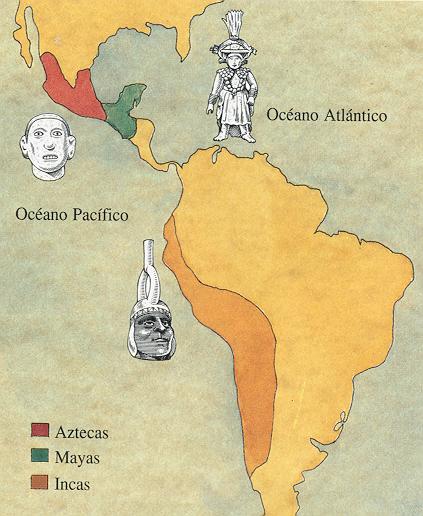
The Aztecs
- The Aztec empire was a tribute empire based in Tenochtitlan, which extended its power throughout Mesoamerica in the late postclassic period. It originated in 1427 as a triple alliance between the city-states Tenochtitlan, Texcoco and Tlacopan who allied to defeat the Tepanec state of Azcapotzalco, that had previously dominated the Basin of Mexico. Soon Texcoco and Tlacopan became junior partners in the alliance which was de facto led by the Mexica of Tenochtitlan.
- The empire extended its power by a combination of trade and military conquest. It was never a true territorial empire controlling a territory by large military garrisons in conquered provinces, but rather controlled its client states primarily by installing friendly rulers in conquered cities, by constructing marriage alliances between the ruling dynasties, and by extending an imperial ideology to its client states.
- Client states paid tribute to the Aztec emperor, the Huey Tlatoani, in an economic strategy limiting communication and trade between outlying polities making them depend on the imperial center for the acquisition of luxury goods. The political clout of the empire reached far south into Mesoamerica conquering cities as far south as Chiapas and Guatemala and spanning from the Pacific to the Atlantic oceans. The empire reached its maximal extent in 1519 just prior to the arrival of the Spanish conquistadors led by Cortés who managed to topple the Aztec empire by allying with some of the traditional enemies of the Aztecs, the Nahuatl speaking Tlaxcalteca.
Mayans
- The Maya is a Mesoamerican civilization, noted for the only known fully developed written language of the pre-Columbian Americas, as well as for its art, architecture, and mathematical and astronomical systems. Initially established during the Pre-Classic period (c. 2000 BC to AD 250), according to the Mesoamerican chronology, many Maya cities reached their highest state of development during the Classic period (c. AD 250 to 900), and continued throughout the Post-Classic period (from the 10th to the early 16th century) until the arrival of the Spanish.
- The Maya peoples never disappeared, neither at the time of the Classic period decline nor with the arrival of the Spanish conquistadores and the subsequent Spanish colonization of the Americas. Today, the Maya and their descendants form sizable populations throughout the Maya area and maintain a distinctive set of traditions and beliefs that are the result of the merger of pre-Columbian and post-Conquest ideas and cultures.
Incas
- The Inca Empire, or Inka Empire (Quechua: Tawantinsuyu), was the largest empire in pre-Columbian America. The administrative, political and military center of the empire was located in Cusco in modern-day Peru. The Inca civilization arose from the highlands of Peru sometime in the early 13th century. From 1438 to 1533, the Incas used a variety of methods, from conquest to peaceful assimilation, to incorporate a large portion of western South America, centered on the Andean mountain ranges, including, besides Peru, large parts of modern Ecuador, western and south central Bolivia, northwest Argentina, north and central Chile, and southern Colombia into a state comparable to the historical empires of Eurasia.
