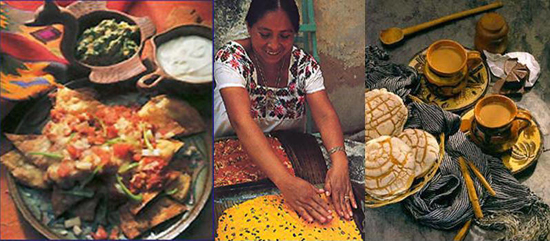
Mayan Cuisine
Ancient Maya cuisine was varied and extensive. Many different types of resources were consumed, including maritime, flora, and faunal material, and food was obtained or produced through a host of strategies, such as hunting, foraging, and large-scale agricultural production. Plant domestication focused on several core foods, the most important of which was maize.
Much of the Maya food supply was grown in forest gardens, known as pet kot. The system takes its name from the low wall of stones (pet meaning "circular" and kot "wall of loose stones") that characteristically surrounds the gardens.
The Maya adopted a number of adaptive techniques that, if necessary, allowed for the clear-cutting of land and re-infused the soil with nutrients. Among these was slash-and-burn, or swidden, agriculture, a technique that cleared and temporarily fertilized the area. For example, the introduction of ash into the soil raises the soil's pH, which in turn raises the content of a variety of nutrients, especially phosphorus, for a short period of time of around two years. However, the soil will not remain suitable for planting for as many as ten years. This technique, common throughout the Maya area, is still practiced today in the Maya region. Complementing swidden techniques were crop rotation and milpa farming, employed to maintain soil viability and increase the variety of crops.
Staples
Maya diet focused on four domesticated crops (staple foods): maize, squash, beans (typically Phaseolus acutifolius or Phaseolus vulgaris) and chili peppers. The first three cultivars are commonly referred to in North America as the "Three Sisters" and, when incorporated in a diet, complement one another in providing necessary nutrients.[3] Among the three, maize was the central component of the diet of the ancient Maya, and figured prominently in Maya mythology and ideology. Maize was used and eaten in a variety of ways, but was always nixtamalized. Nixtamalization (a term that derives from the Nahuatl word for the process), is a procedure in which maize is soaked and cooked in an alkaline solution. This releases niacin, a necessary B vitamin (vitamin B3) that prevents pellagra and reduces incidents of protein deficiency.
Once nixtamalized, maize was typically ground up on a metate and prepared in a number of ways. Tortillas, cooked on a comal and used to wrap other foods (meat, beans, etc.), were common and are perhaps the best-known pre-Columbian Mesoamerican food. Tamales consist of corn dough, often containing a filling, that are wrapped in a corn husk and steam-cooked. Both atole and pozole were liquid based gruel-like dishes that were made by mixing ground maize (hominy) with water, with atole being denser and used as a drinking source and pozole having complete big grains of maize incorporated into a turkey broth. Though these dishes could be consumed plain, other ingredients were added to diversify flavor, including chili peppers, cacao, wild onions and salt.
Several different varieties of beans were grown, including pinto, red and black beans. Other cultivated crops, including fruits, contributed to the overall diet of the ancient Maya, including tomato, chili peppers, avocado, breadnut, guava, soursop, mammee apple, papaya, pineapple, pumpkin, sweet potato, and xanthosoma. Chaya was cultivated for its green leaves. Chayote was cultivated for its fruit, and its tender green shoots were used as a vegetable. Various herbs were grown and used, including vanilla, Dysphania ambrosioides, achiote (and the annatto seed), Canella, Piper auritum, avocado leaf, garlic vine, "Mexican" oregano, "Mexican" anise, and allspice.
Meats
Hunting supplied the Maya with their main source of meat, though several animals, such as dog [pek] and turkey [ulum], may have been domesticated. Animals hunted for meat, as well as for other purposes, include deer, manatee, armadillo, tapir, peccary, monkey, other types of fowl, turtle and iguana. The Maya diet was also supplemented by the exploitation, at least in coastal areas, of maritime resources, including fish, lobster, shrimp, conch, and other shellfish.
Other
The Mayans are believed to be the first people to have discovered and cultivated the cacao plant for food. They ground the cocoa beans up and mixed them with chili peppers, cornmeal and honey to create a drink called xocolatl (which is Nahuatl). Just the rich and noble could drink this. They also used cacao beans as a ceremonial sacrifice to their gods.
