Enchilada
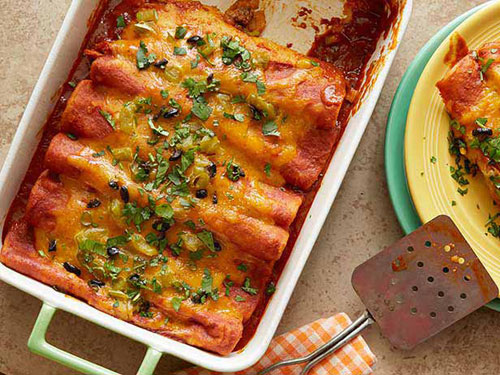
An enchilada is a corn tortilla rolled around a filling and covered with a chili pepper sauce. Enchiladas can be filled with a variety of ingredients, including meat, cheese, beans, potatoes, vegetables, seafood or combinations. Enchilada is the past participle of Spanish enchilar, "to add chili pepper to", literally to "season (or decorate) with chili."
Restaurants often serve enchiladas with a side of Mexican Black Beans and rice. Yellow Rice is a good choice.
History
Enchiladas originated in Mexico, where the practice of rolling tortillas around other food dates back at least to Mayan times. The people living in the lake region of the Valley of Mexico traditionally ate corn tortillas folded or rolled around small fish.
Writing at the time of the Spanish conquistadors, Bernal Díaz del Castillo documented a feast enjoyed by Europeans hosted by Hernán Cortés in Coyoacán, which included foods served in corn tortillas. (Note that the native Nahuatl name for the flat corn bread used was tlaxcalli; the Spanish give it the name tortilla.) The Nahuatl word for enchilada is chīllapītzalli [t͡ʃiːlːapiː't͡salːi] which is formed of the Nahuatl word for "chili", chīlli ['t͡ʃiːlːi] and the Nahuatl word for "flute", tlapītzalli [t͡ɬapiː't͡salːi].
In the 19th century, as Mexican cuisine was being memorialized, enchiladas were mentioned in the first Mexican cookbook, El cocinero mexicano ("The Mexican Chef"), published in 1831, and in Mariano Galvan Rivera's Diccionario de Cocina, published in 1845. An early mention, in English, is a 1914 recipe found in California Mexican-Spanish Cookbook, by Bertha Haffner Ginger.
Varieties
In their original form as Mexican street food, enchiladas were simply corn tortillas dipped in chili sauce and eaten without fillings. They now have taken many varieties, which are distinguished primarily by their sauces, fillings and, in one instance, by their form. Various adjectives may be used to describe the recipe content or origin, e.g. enchilada tapatia would be a recipe from Jalisco.
Enchiladas con chile colorado (with red chile) are made with traditional red enchilada sauce, composed of dried red chili peppers soaked and ground into a sauce with other seasonings. However, red enchilada sauce may also be tomato-based with red chilis added.
Enchiladas con mole, instead of chili sauce, are served with mole, and are also known as enmoladas.
Enchiladas placera are Michoacán plaza-style, made with vegetables and poultry.
Enchiladas poblanas are soft corn tortillas filled with chicken and poblano peppers, topped with oaxaca cheese.
Enchiladas potosinas originate from San Luis Potosi, Mexico and are made with cheese-filled, chili-spiced masa.
Enchiladas San Miguel are San Miguel de Allende-style enchiladas flavored with guajillo chilies by searing the flavor into the tortillas in a frying pan.
Enchiladas suizas (Swiss-style) are topped with a white, milk or cream-based sauce, such as béchamel. This appellation is derived from Swiss immigrants to Mexico who established dairies to produce cream and cheese.
Enchiladas verdes (green enchiladas) are made with green enchilada sauce composed of tomatillos and green chilis.
Enfrijoladas are topped with refried beans rather than chili sauce; their name come from frijol, meaning "bean".
Entomatadas are made with tomato sauce instead of chile sauce.
Gravy-style enchiladas are the dominant variety found throughout South and Central Texas. These have a gravy-like chili sauce over either cheese-filled or beef-filled corn tortillas, and are topped with a layer of cheese.
Enchiladas montadas, stacked enchiladas, are a New Mexico variation in which corn tortillas are fried flat until softened but not tough, then stacked with red or green sauce, chopped onion and shredded cheese between the layers and on top of the stack. Ground beef or chicken can be added to the filling, but meat is not traditional. The stack is often topped (montada) with a fried egg. Shredded lettuce and sliced black olives may be added as a garnish.
Enchiladas Duranguenos are made with red chile sauce stuffed with queso cotija and minced onions. Some people use parmesan cheese instead of queso cotija because it is cheaper.
Fillings, toppings and garnishes
Fillings include meat, such as chicken, beef or pork, seafood, cheese, potatoes, vegetables, and any combination of these. Enchiladas are commonly topped or garnished with cheese, sour cream, lettuce, olives, chopped onions, chili peppers, salsa, or fresh cilantro.
