Feliz Navidad (Happy Nativity)
December has been a celebratory month in Mexico since pre-Hispanic times, when the winter solstice, one of the two most important holidays of the year (the other being the spring solstice) was celebrated by the Aztecs. After the Conquest, a new set of holidays came to be observed, always festive and always featuring traditional food and sweets. Also see Mexican Holiday Sweets.
In Mexico, the Christmas season is a month-long fiesta, starting with the feast of the Virgin of Guadalupe on December 12th, and continuing through the posadas, Noche Buena and Navidad, right up to the Three Kings Day on January 6th. The usually bustling Mexican markets become even more so in December, when the mountains of fruit for ponche navideño (Christmas punch) compete with a wild array of tinsel-y decorations for shoppers' attention, and the excitement leading to the posadas and pastorelas builds up. The culmination of all this preparation is, of course, Noche Buena — Christmas Eve — when one of the most festive dinners of the year is served.
Celebration of The Virgin of Guadalupe
The celebratory season begins with the feast day of Nuestra Señora de Guadalupe, the country's patron and the object of thousands of pilgrimages to her Basilica in Mexico City. On December 12, and for several days before, pilgrims and their children gather in the church's atrium.
Las Posadas (The Inn) - December 16 - 24
Since Mexico is a predominantly Catholic country, and proud of it, Christmas there revolves around the birth of Christ, or "El Niño Jesús." The festivities and traditions bear little resemblance to ours in the United States. Santa Claus and Christmas trees aren't a big deal-except perhaps in the larger cities. The focus is religious; the atmosphere joyous. It's one of the major fiestas of the year and just about everyone takes off the last two weeks of December-to spend time with their families, to visit old friends, to make new friends and to celebrate.
The Christmas season jumps into gear on December 16, with Las Posadas nine days in a row of candlelight processions and parties seemingly invented by the early Spanish missionaries solely to comfort and convert the former Aztecs. The tradition of the nine days of processions (Posadas) began soon after the arrival of the Spaniards in Mexico. Clever San Ignacio de Loyola created the custom to teach the story of the birth of Jesus and more importantly to coincide with the nine day Fiestas of the Sun, which celebrated the virgin birth of the Aztec Sun god, Huitzilopchtli, from the 16th through the 24th of December. Special permission was received from Rome to celebrate nine “Christmas Masses” to represent the nine months of Mary’s pregnancy.
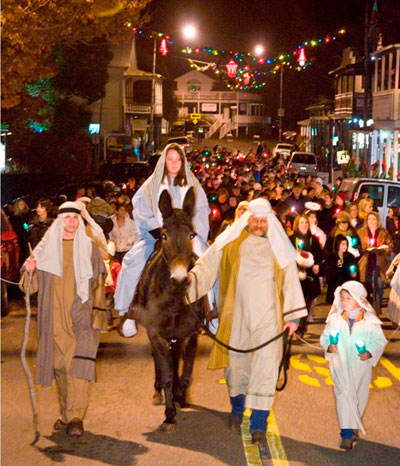
After sunset each night, in villages, towns and cities throughout the country, children gather to reenact Joseph and Mary's journey to Bethlehem. The procession is led by a young Virgin Mary, often atop a live burro, with a tiny Joseph at her side. They're followed by children dressed as angels, The Three Kings or "Reyes Magos" and an assortment of shepherds and livestock.
Each sponsoring household is responsible for erecting a scene outside of their doorway, from the bible, that taught a specific lesson. As the group of children at the front and the adults following, paraded down the decorated street carrying candles, they came across the little doorway scene. Carols were sung, a lesson about the particular scene was read and little Mary and Joseph asked the people in the scene if there was room for baby Jesus to be born. They are turned away. This continues and they're refused admittance at the second home as well. At the final home, they are told that while there is no room for them in the inn, they are welcome to take shelter in the stable. At this point, the doors are thrown open and the children are bid a jubilant welcome. Everyone kneels around a manger scene, or "Nacimiento." Prayers and songs are offered in thanks to God.
Time of the Piñata
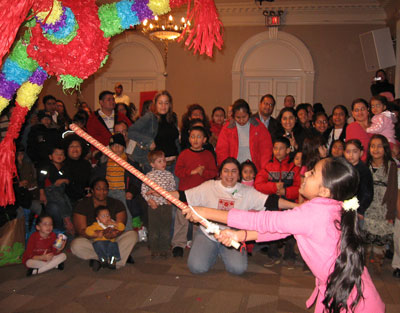
Immediately after this in every Posada, is the time of the "Piñata," a papier maché container filled with candy and toys. Although the Piñata originated in China, the traditional party favorite of Mexican children travelled along the trade routes to Italy where it was named pigata or pineapple in Italian, then to Spain in time to be taken to the new world by the missionaries. In every Mexican village during the holidays, every few blocks there is a housewife making all sizes and designs of piñatas from fringed crepe paper and cardboard glued to a clay jar (cantero).
The piñata is hung from a tree or from the ceiling, and one at a time, the children are blindfolded spun around and given turns to try smashing the Piñata open. When it breaks, fruit and candy scatter to the ground and the kids dive in, scooping up as many as they can. Punch, tamales and fritters called buñuelos are enjoyed by all. The punch, flavored with seasonal fruits like tejocote (hawthorn fruit) inevitably shows up at the Noche Buena (Christmas Eve) dinner as well, along with the eggnog-like rompope and a variety of other seasonal specialties.
The serious symbolism of this simple party toy, the piñata, is very typical of Mexico as there is always more to understand than appears on the surface. The decorated clay cantero represents Satan who often wears an attractive mask to attract humanity. The most traditional style of Piñata looks a bit like Sputnik, with seven points, each with streamers. These cones represent the seven deadly sins, and the breaking of the Piñata with the ensuing shower of sweets and fruits and nuts vividly shows the triumph of good over evil and the unknown joys and rewards which will be given in heaven to the good and faithful. The blindfolded participant represents the leading force in defying evil, faith, which must be blind, and is guided only by the voices of others crying “ arriba, abajo, atras” (up, down, back).
Mass of the Rooster - Christmas Eve
Pastorelas
When the missionaries arrived in Mexico, they often used exaggerated outdoor plays to teach many of the Christian legends and ideals to the Indians. Thus were born the Pastorelas, the wonderfully naïve, irony packed story of the birth of the Christ Child.
Today Pastorelas continue, with the script improvised by the participants. Especially fun are the simple country shepherds traveling to visit the newly born child in the manger, and the many encounters they have with Lucifer, his attractive disciples, and the ultimate battle of good and evil. Each year, amidst the jokes, jeers, laughter, songs, slang, bawdy humor, discussions, cigarettes, tequila, even ladies of the evening, it is a fight to the finish between Lucifer and the Archangel Gabriel. Even if you don’t understand Spanish, the broad acting, fun and laughter will give you the overview of this very typically Mexican tradition.
Nacimientos
Nacimientos have traditionally been the main decorations in local homes, businesses and churches, and what tributes they are. Using moss, sawdust, sand, and painted paper, multi-tiered bases are created to resemble hills, deserts, rivers and lakes. Whole villages appear on tabletops, and more characters and scenes are added each year Dozens of figures are lovingly arranged around December 14th, and kept on display until February 2.
Look for purely Mexican traditions and twists in the nacimientos, like the rooster who crowed to announce the birth of the child, fish in the river (from the lovely Mexican carol of the same name— Los Peces en el Rio), Lucifer lurking in his cave to tempt the shepherds from their journey, the infidels in Egypt camping with their tents and pyramids. These are representations of complete villages, with wells, vendors with carts of fruits and vegetables, playing children, musicians, dancers, mutton and pork roasting on spits, even women making tortillas.
Just six years after arrival of the Spaniards in Mexico, Father Pedro de Gante began the celebration of Christmas with the “Misa de Gallo” (The mass of the rooster) Held at midnight, the mass quickly became very popular with the newly-converted Indians. To sustain the newly converted Indian Catholics with the comfort and continuity of the more familiar fiestas for the God of the Sun Huitzilopochtli, Father Diego de Soria and other priests added the familiar skyrockets (cohetes,) torches, sparklers (Luces de Bengala), the Pastorelas (see sidebar), the arrival of the Posadas from the various neighborhoods, displays of live nacimientos (nativity scenes in which people play the roles of Mary, Joseph and the Baby Jesus), piñatas, ponche (Christmas punch with a fruit base), groups of Indian dancers, tamales, and more to the Christmas celebration.
Christmas Eve in 1999 in Ajijic and Chapala will be much the same. More than 750 years after St. Francis of Assi’s first nacimiento in 1223, the patio of the main church of San Andres and in the plaza in Chapala will be filled with live nativities representing countries around the world, and areas of Mexico. Mary, Joseph, the baby, an angel and two shepherds will be dressed to reflect each region, as will a few well placed props. Expect to see wooden shoes and tulips, cotton snow on bushes with an igloo, Aztecs and other Indians, or “Africans” with wild animals. Each creche features a live cooing baby in the manger.
During the evening, the last Posada will arrive at the Church, to visit each manger. A group of local residents will honor the babe with traditional Indian dances while musicians play their gift and Mexicans and Anglos exchange greetings of Feliz Navidad and Merry Christmas, with hugs and abrazos, and feel the spirit of love and peace.. Be prepared to smile throughout the night as sounds of the celebrations of the Mexican community continue with music and joy.
At midnight on Christmas Eve or "Noche Buena," the birth of Christ is proclaimed with fire works, the ringing of church bells and the blowing of whistles. After the final Posada procession, the people surge into the churches to attend the Mass of the Rooster or "Misa de Gallo." Afterward, families head home for an exotic Christmas feast of dishes like tamales, rice, chiles rellenos, menudo or roast pig or turkey, along with hot fruit or cider punches and other spirits such as rompope.
The dishes served at this meal vary from region to region: mole and romeritos in the central regions, tamales in the north, pozole in the western part of the country, and chocolate with churros and buñuelos in the south. But most often in modern day Mexico, a turkey is the main attraction, no matter what regional dishes accompany it. Stuffed with either ground meat, olives and raisins, or with a chestnut dressing, the Christmas turkey is a European preparation of a New World bird, far different in culinary character from the turkey served in the dark, rich wedding moles.
The bacalao, or dried, reconstituted codfish traditionally served as a first course, is also European in origin and can be either exquisitely well prepared or terribly salty, depending upon the cook. The best ones we've had in Cholula were reflections of the Spanish influence on Mexican cooking, soaked to remove all traces of the salt in which they were cured, and flavored with olives, tomatoes and chiles.
The ensalada de Noche Buena — Christmas Eve salad — is a baroque but attractive combination of beets, lettuce and seasonal fruit, open to interpretation, depending on the availability of ingredients and the whims of the cook. It most often varies according to region, with more tropical variations found in the warm coastal areas.
Families gather around their personal nativity scene, or "Nacimiento" a recreation of the stable where Jesus was born, complete with Mary, Joseph, the baby in the manger, angels, the Magi or "Los Reyes Magos, the ox and ass, shepherds and their flocks and even perhaps a serpent representing the forces of evil lurking in the shadows. The nativity scene is constructed with loving care throughout the days preceding Christmas Eve, and is not completed until that night. It is here that each family pays homage, once again, to the miracle of Christ's birth. The evening ends with the opening of gifts, another Piñata and sparklers for the kids.
It is not unusual for Christmas dinner and festivities to last until four in the morning, and this is why Christmas Day itself is a quiet non-event in most Mexican towns. Like New Year's, Independence Day and saints' days, it is celebrated on the eve of the calendar date, which makes a certain amount of sense, given that the holiday actually does start at midnight.
Day of Epiphany (Jan 6th) - Three Kings Day
On January 6, during the fiesta to honor the arrival of the Three Kings at the manger, a special ring-shaped bread called the “Rosca de Reyes" (Baby Jesus Cake) will be served. Baked into the bread is one or more small plastic figures of the Child God. The guests who find these images in their serving of bread are named the Godparents of the Christ Child from the Nacimiento. It is then their responsibility to host a party on February 2, El Dia de Candlelaria or the Day of Purification, the final celebration of a Christmas holiday which began on December 12 with the beginning of the celebration of The Virgin of Guadalupe.
Day of Calendaria (Candlemas)
In Latin America, Iberia & France....the celebration of Jesus' birth ends on February 2nd (40 Days) with the Jewish tradition of his presentation to Temple. At the time of the birth of the Christ Child, Jewish tradition and law forbade women access to the Temple for 40 days after the birth of a child. Mary and Joseph would have presented the Baby Jesus, the Child God in the Temple then on February 2. In many villages, the Child from the Nativity scene is dressed in a long white gown and bonnet, placed on a small chair and taken to the church to be blessed on February 2. In the newer church in Chapala, this custom is still practiced, with tiny clothing and shoes and accessories available at the church.
In Mexico, this day might as well be ranamed, Day of the Tamale. As everyone in Mexico celebrates with Tamales (in France it's Crepes). This is noteworthy because the Spanish Colonial Governments regulated the consumption of Tamales, for their association with Pre-Hispanic rituals & deities. As is typical of their governing style...they chose to Co-Opt the tradition.
