Baklava
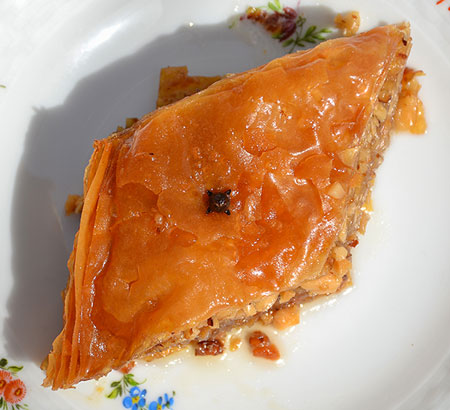
Greek Baklava
Baklava, originating from the Ottoman Empire, is a dessert of the Middle East and Mediterranean, and it has numerous variations depending on the country of origin. Turkey, Syria, Lebanon, Greece, Jordan, Israel, Afghanistan, Georgia, Iran, Armenia, and many other countries and regions all have a variation of this pastry, which is made with buttered layers of phyllo dough and ground nuts (usually pistachio, walnuts, or almonds, or a combination) and covered in a sweet, often honeyed, syrup. Other flavorings include cinnamon, cloves, rose water, cardamon, clove, and orange rind.
Baklava types vary by nationality, primarily in their syrup, nuts, and overall sweetness. Turkish baklava is known for its intense sweetness, sometimes just sugar and water, thin layers, and pistachio filling, which gives the baklava a distinctive green hue, while Greek baklava uses honey-based syrups with notes of cinnamon and cloves, typically featuring walnuts, sometime almonds. Arabic baklava, often the most traditional, uses floral water-flavored syrups (like rose or orange blossom) giving it a fragrant, floral aroma, with finely ground nuts, such as pistachios, walnuts, or almonds, and is delicate in sweetness. In Saudi Arabia, baklava is often flavored with cardamom and saffron, giving it a distinct and luxurious taste. These spices elevate the traditional flavors and add a regional twist.
Greek Baklava
Make just 2/3 recipe for 9x9 inch pan.
1 pound package phyllo dough, defrosted slowly in the frig (about 36 sheets)
1/2 cup butter, melted
1 Tbsp. water
Whole cloves
(optional), for decorating
Nut Filling:
3 cups walnuts (about 3/4 pound), or pistachios
1/4 cup sugar
1 1/2 tsp cinnamon
Honey Syrup:
1 cup sugar (try 3/4 cup - had too much syrup)
1 cup water (try 3/4 cup)
Lemon rind, from 1 lemon
1 stick cinnamon
2 whole cloves (could use 1 or 2 more)
1 cup honey (try 3/4 cup - try cutting back even more)
1 Tbsp. brandy (optional)
juice from 1 lemon (2 - 3 Tbsp.)
Grind the nut filling ingredients together and set aside. Preheat oven to 325 degrees.
Brush a 13 x 9 inch baking pan with melted butter. Place 2 folded phyllo leaves in pan and brush with butter. Repeat. Sprinkle with 1/2 cup of the nut mixture. Add 2 more leaves and butter. Do this 5 more times ending with phyllo and butter. You should have 7 layers of phyllo and 6 layers of nuts.
Cut into the traditional diamond shapes by cutting 6 lengthwise strips (5 cuts), then cutting 9 diagonal strips. Stick cloves in each diamond, if desired. If you don't use the cloves, you could sprinkle the top of each piece after pouring the syrup over with some finely chopped pistachios. Alternatively you can cut triangle shapes by cutting into squares, then cutting each square in half from corner to corner.
Bake in preheated oven about 50 minutes until golden brown. While the baklava is baking, prepare the honey syrup. Boil the sugar, water, lemon rind, cinnamon and whole cloves for 20 minutes. [Tyler Florence adds 2 large strips of orange rind to the syrup.] Remove from the heat and stir in the honey, brandy if using and the lemon juice. Keep warm.
{I have read several times to prevent soggy baklava, the syrup should have completely cooled and the baklava hot out of the oven.]
Immediately pour the warm honey syrup over. Let stand 4 - 6 hours to absorb the syrup. Claudia Roden, author of Book of Jewish Food, shares a highly “unorthodox secret trick” of her aunt Latifa’s – she returns the syrupy baklava to the oven for five minutes, explaining that “the pastry made this way is among the best I have eaten”.
Cover once baklava is at room temperature. Do not chill, again to avoid soggy baklava.
Note: Phyllo sheets can dry out so quickly as to become brittle and useless. Remove the number of sheets you will need from the package and set them to the side covered with wax paper and a damp kitchen towel to provide moisture. Rewrap tightly and refrigerate or refreeze the phyllo you are not using.
