Falafel
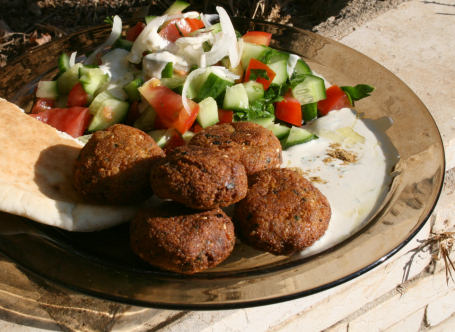
Falafel is a traditional Arab food. It is a fried ball or patty made from spiced fava beans and/or chickpeas. These fried vegetarian fritters are often served along with hummus and tahini sauce (known as a “falafel plate”) as a mezze.
According to The Encyclopedia of Jewish Food by Gil Marks, “The first known appearance of legume fritters (aka falafel) in the Middle East appears to be in Egypt, where they were made from dried white fava beans (ful nabed) and called tamiya/ta-amia (from the Arabic for ‘nourishment’); these fritters were a light green color inside.
To make Falafel Burgers, mix the falafels as below, but shape into patties. Fry in a frying pan instead of deep-frying. Serve in toasted pita bread halves and add the same condiments as Falafels in pita bread below. Or serve in a hamburger bun with lettuce, tomato and other fixings.
How to Eat Falafel
In many countries falafel is a popular street food or fast food. Falafel is usually served in pita bread, either inside the pita, which acts as a pocket, or wrapped in a flat pita (this how they are usually served). The falafel balls, whole or crushed, may be topped with salads, pickled vegetables and hot sauce, and drizzled with tahini-based sauces. Falafel balls may also be eaten alone as a snack or served as part of a mezze.
Good additions to falalfel wrapped in pita bread: Hummus; tahini sauce; tzatziki with dill; baba ganoush; shredded red cabbage, fresh parsley, diced tomatoes and cucumber.
Tip for Making Falafel
You will need to soak dried chickpeas overnight for your falafel to turn out right; canned beans are too tender and contain too much moisture to achieve the right consistency. Your falafel will not form properly and they’ll turn out a bit mushy. Try to grind canned chickpeas, form them into balls, and deep-fry them, and they completely fall apart in the oil. Also, don’t cook the beans, because this will result in a mushier and denser falafel, which is not the proper texture. The common solution for this type of recipe is to add some extra starch in the form of flour. Flour-bound falafel certainly holds together, but you end up with dense, pasty balls.
Falafel Balls from Scratch
Recipe from http://arabic-food.blogspot.com/
There are many falafel recipes. Each country has its own way of preparing falafel, and in every country you can find many versions of recipes. We will suggest one falafel recipe which is very popular in the Middle East.
1 Kg (2.2 pounds) of dried chickpeas, soaked in water overnight (but not cooked)
1 big head of garlic - cut and peel cloves
2 onions cut to quarters
1/3 cup chopped parsley
1/2 cup chopped coriander (if you like)
1 teaspoon baking soda
1 tablespoon cumin spice
1 tsp ground coriander (from other recipes)
1 tablespoon paprika
1 tablespoon hot paprika
Salt, pepper
Oil for deep frying (some use only about 1 1/2 of oil and flip them half-way)
The night before, get the chickpeas soaking in water.
Wash the soaked chickpeas and put them in a food processor with the garlic, onion, parsley, and coriander. Grind until you get a rough moist texture. Add a little water if needed.
Put the mixture into a large bowl; add baking soda and the rest of the ingredients.
Warm the oil in a wide pot to 350° F.
Make falafel balls with a falafel maker or form the mixture into small balls by hand, about the size of a ping pong ball. Slightly flatten. Fry until you get a golden shade. Take the balls out with a slotted spoon and drain.
Serve hot!
Recipe does not say how many this makes.
SESAME FALAFEL VARIATION: After forming the balls or patties, dip them in sesame seeds prior to frying. This will make the falafel coating crunchier and give it a slightly nutty flavor.
HERB FALAFEL VARIATION (GREEN FALAFEL): Add 1/2 cup additional chopped green parsley, or cilantro, or a mixture of the two prior to blending. Spinach is another option for making green falafel.
TURMERIC FALAFEL (YELLOW FALAFEL): Add 3/4 tsp turmeric to the food processor prior to blending.
Falafel
from https://downshiftology.com/
Bonus – I’ll show you how to make both fried falafel and baked falafel so you can choose your favorite method!
I’ve enjoyed falafel on numerous trips through Egypt, Israel, and Jordan — from sit-down restaurants to bustling street corner vendors (which are about as authentic as they come). And while each experience has had some slight variations and tweaks to the recipe, after eating my way through Tel Aviv several years ago I figured out what truly makes a great falafel. Here’s my secret:
- Use lots of herbs - double the amount you’d find in more Americanized versions
- Add a touch of green chili pepper. A small green pepper imparts a special kick that’s “a little something extra.” When I first saw a falafel vendor add this, I realized what had been missing from other recipes.
- Don’t forget the tahini sauce.
1 cup dried chickpeas, soaked overnight (don't use canned chickpeas)
1/2 cup roughly chopped onion
1 cup roughly chopped parsley, about a one large bunch
1 cup roughly chopped cilantro, about a one large bunch
1 small green chile pepper, serrano or jalapeno pepper
3 garlic cloves
1 teaspoon cumin
1 teaspoon salt
1/2 teaspoon cardamom
1/4 teaspoon black pepper
2 tablespoons chickpea flour (or other flour)
1/2 teaspoon baking soda
oil for frying
Soak your dried chickpeas overnight or for at least 8 to 12 hours. Note that the chickpeas will triple in size, so cover them with plenty of water. Then drain and rinse them.
Add the chickpeas, onion, parsley, cilantro, garlic, green pepper, and spices to a food processor. I recommend roughly chopping up the onion, herbs, and pepper before adding for the best texture. Then, pulse the food processor but do not blend completely. The final mixture should resemble coarse sand.
Transfer the falafel mixture to a bowl and add the chickpea flour and baking soda. Stir together, then cover or add a lid and refrigerate the mixture for 30 minutes to one hour.
Shape the falafel. Use your hands, an ice cream scoop or falafel scoop to form the falafel into balls or patties. If you find the mixture is too wet, you can add another tablespoon of chickpea flour. If it's too dry and crumbly, you can add a teaspoon or two of water or lemon juice.
Cook the falafel. Once the falafel are formed, you can cook them by your preferred method mentioned above. To deep fry the falafel, add about 3 inches of oil to a pot on medium heat. Heat the oil to 350°F (175°C). Cook the falafel in batches (about 6 to 8 at a time) for 1 to 2 minutes or until golden.
Remove the falafel. Use a skimmer to check the color of the falafel and make sure they don't overcook. Then remove them to a paper towel-lined plate.
Serve the falafel immediately, while warm and crispy on the outside. They're delicious served with tahini sauce as well.
Makes 18 falafel balls
Any leftovers can be stored in an airtight container in the fridge for 4 to 5 days. While you can easily reheat cooked falafel in the microwave, they’ll be crispier on the outside if you reheat them in a 400° (200°C) oven for about 10 minutes.
Can you meal prep falafel? Yes! Make the dough mixture and then freeze it for up to 3 months. Thaw the mixture in the fridge, stir it, then form in balls or patties and cook. Alternatively, you can freeze pre-shaped raw falafel and fry or bake straight from frozen!
Cooking Tips
- If your falafel breaks apart, it’s probably because the mixture wasn’t processed to a fine enough texture. You can pulse the mixture a bit more, or if they’re too dry, add more water to help bind them together.
- If your falafel mixture is still wet after chilling, mix in a bit more chickpea flour before forming into balls.
- If you can’t have cilantro, you can use parsley on its own or swap in another tender herb.
