Seven-item Scandinavian Cookie Plate
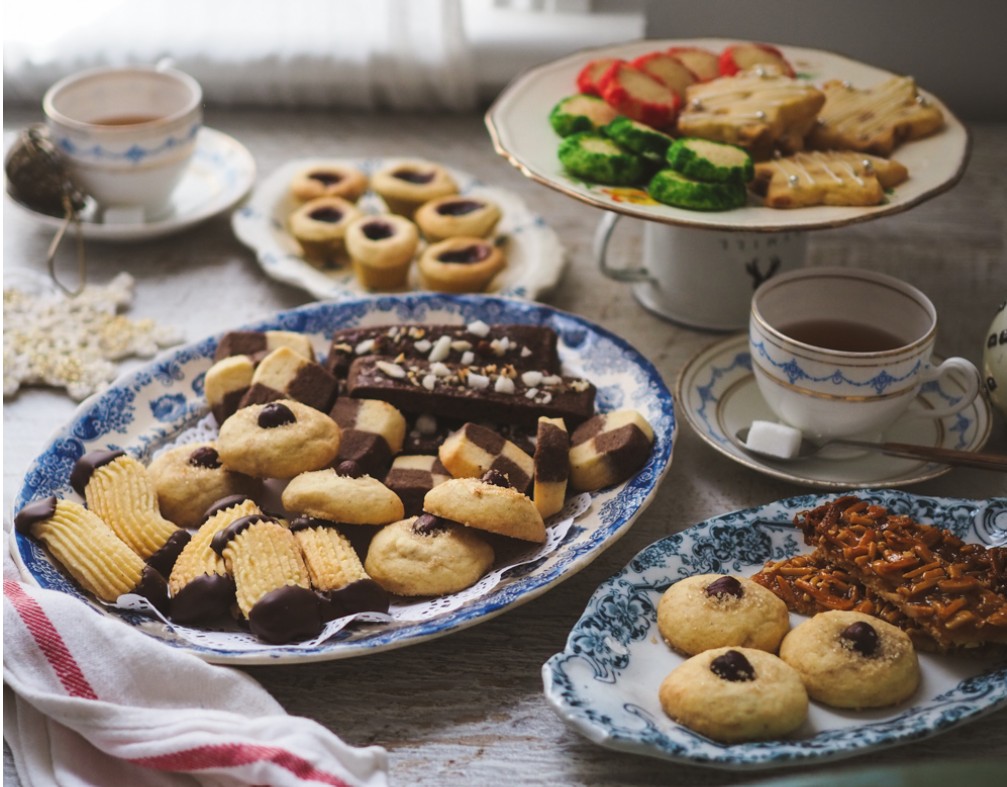
A seven-item Scandinavian cookie plate is a tradition of serving seven different types of cookies at Christmas or during coffee-and-cake gatherings. The number seven is associated with luck and mythology in both Scandinavian countries. In Sweden, it was believed that serving fewer than seven cookies would be considered stingy, while serving more than seven would be considered showy.
Norway
The Norwegian tradition is called syv slags kaker, which means "seven sorts of cookies". Some popular cookies include Berlinerkranser (butter cookies), Krumkaker (cone-shaped cookies), Sandkaker (tart-shaped cookies), Sirupsnipper (syrup diamonds), and Smultringer (little donuts).
Sweden
The Swedish tradition is called Sju Sorta Kakor, which also means "seven sorts of cookies". The cookies are typically made from a shortbread dough called mördeg. Some popular cookies include Dreams (melt-in-your-mouth cookies), Chocolate slices (Chokladsnittar), and Nut biscuits (Nötkakor).
The seven types of cookies concept is so ingrained in the culinary heritage of Sweden that it has its own dedicated cookbook – “Sju Sorters Kakor”. First published by Ica Provkök in 1945, this much-loved baking bible has been reprinted and modernised several times over the years. The latest edition – which hit shelves in 2015, with a further update in 2017 – has been edited by top patisserie chef Mia Öhrn. Respectfully, she’s gone about tweaking the content to align with modern culinary habits and standards. For instance, she swapped the inclusion of margarine with butter and added a recipe for custard made from scratch. As for the Swedish cookies that she considered deserving of a place in "Sju Sorters Kakor", Caramel slices (‘Kolasnittar’) and Raspberry caves or Raspberry thumbprints ('hallongrottor’) have made their way into the iconic book.
Baking as many as seven kinds of Swedish cookies might seem quite an undertaking, but it’s easier than it sounds as many are made from the same basic dough. The so-called ‘mördeg’ is similar to shortbread dough – flour, butter, sugar – sometimes with added egg. Armed with this versatile all-rounder, small tweaks will make a big impact on both taste and appearance. Displayed en masse, this contrasting collection of Swedish cookies makes for an irresistible kaleidoscope of colour, shape and flavour.
Basic Dough for Sju Sorta Kakor
This makes enough dough for each of the seven varieties
4 cups/600g/21ozs. plain flour
300g/10.6ozs. caster or superfine sugar
450g/1lb. butter, cubed, room temperature*
2 large egg yolks (reserve 1 egg white for brushing)
1 tablespoon vanilla bean paste
Pinch salt
2-3 tablespoons water
The butter should not be melted but should be soft enough and you should be able to press it down easily with your finger*
Place the flour and sugar in the bowl of a stand mixer and use a hand whisk to combine. Add the butter, egg yolks, vanilla bean and salt and fit with a beater attachment. Beat the mixture for 1 minute adding water 1 tablespoon at a time until you get a soft, cohesive dough. Remove from the bowl and divide into 7 portions. My total dough was around 1380g/3lbs so each portion was around 200g/7ozs. Wrap in cling film and place in the fridge for 60 minutes.
Here are seven kinds of Swedish cookies:
Recipes made from Basic Dough are from https://www.notquitenigella.com/
Brussels cookies ('Brysselkakor')
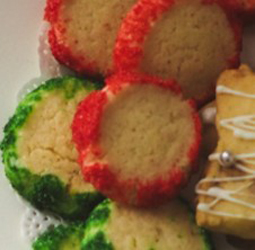
High on impact but simple to make, the delicately vanilla-infused ‘Brysselkakor’ – or ‘Brysselkex’ as they’re also called – are flat and round, framed by a halo of pink. This shot of vibrant colour is achieved by covering the cookie dough rolls in pink sugar (dyed with a couple of drops of red food colouring) before slicing the rolls up into individual biscuits.
1 quantity of dough (around 200g/7ozs.)
4 tablespoons of white sugar, divided
Red and green food colouringPreheat oven to 180C/350F and line a baking tray with parchment. In two small cups or bowl mix 2 tablespoons of sugar with a couple of drops of red colouring and then repeat with the green colouring (be sparing with the colouring, a little goes a long way).
Roll the dough into two logs 1 inch in diameter wrapping them up in cling film and place them in the fridge for 20 minutes to firm up. Unroll the cling film and spread out the coloured sugar on the film and roll the dough log in the coloured sugar. If the dough is too soft place back in the fridge. You want the dough to be firm when you slice it. Cut into thin slices with a sharp knife around 3/4cm or 0.3in thick and place on the tray. Bake for 10 minutes.
Chocolate slices ('Chokladsnittar')
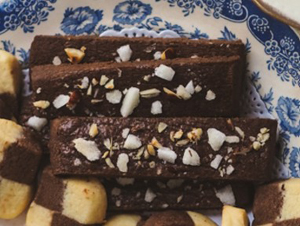
One for the chocolate lover, this angular-cut biscuit is rich in flavour and high in contrast visually, courtesy of the “pearl sugar” sprinkled across the body of the cookie. Fret not if you can’t get hold of Swedish pearl sugar, colourful sprinkles work just as well.
Finska Pinnar (Finnish Sticks), as she calles them on https://www.notquitenigella.com/
1 quantity of dough (around 200g/7ozs.)
1 tablespoons cocoa, sifted
Egg white for brushing
3 tablespoons pearl sugar*
2 tablespoons finely chopped toasted hazelnutsPearl sugar is a popular item in Scandinavian cooking. It can be difficult to source but a quick way to make pearl sugar is to take white sugar cubes and place them in a zip lock bag and hit with a meat mallet. Crush until you get smallish lumps.
Preheat oven to 180C/350F and line a baking tray with parchment. Place the dough with the cocoa in the mixer and beat until cocoa is combined. Roll out onto between parchment or cling film until it about 1/2cm/0.2in in thickness. Brush with egg white, sprinkle with pearl sugar and hazelnuts and then bake for 15 minutes. Cool for 15 minutes and then cut into 2cm/0.8 inch slices with a sharp knife.
Raspberry caves ('Hallongrottor')
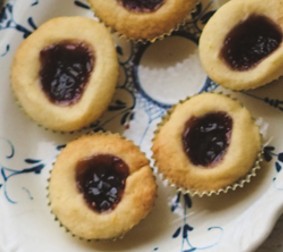
A plump cookie with a heart of scarlet-hued raspberry jam, these cookies are among the ones you’re most likely to come across in cafés and homes alike. Genius in their simplicity, the raspberry caves are easy and quick to make.
1 quantity of dough (around 200g/7ozs.)
3 tablespoons raspberry jamPreheat oven to 180C/350F and line a baking tray with parchment and have some small chocolate paper cases ready. Roll the dough into walnut sized balls and then place into the paper cases. With a floured thumb push down to create a cave or deep hole but don't go all the way to the bottom. Fill with jam and bake for 20 minutes.
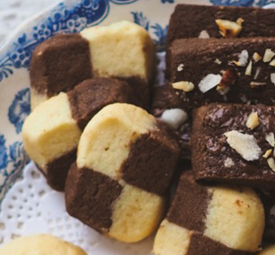
Chessboards ('Schackrutor')
These two-tone, melt-in-the-mouth shortbread cookies make any Swedish fika arrangement look and taste wonderful. They incorporate both chocolate and vanilla cookie dough, assembled in a layered fashion before each biscuit is cut to reveal a chessboard design. The result is delicious and stylish in equal measure.
1 quantity of dough (around 200g/7ozs.)
1/2 tablespoons cocoa, sifted
Egg whitePreheat oven to 180C/350F and line a baking tray with parchment. Place half of the dough with the cocoa in the mixer and beat until cocoa is combined and not streaky. Roll out the vanilla dough between parchment or cling film into a small rectangle around 1cm/0.4in thick. Repeat with the chocolate dough. Brush the vanilla dough with the egg white and then place the chocolate dough on top. Cut the dough into 1cm logs. Take two logs and place the dough with the opposite colour to make a chess board pattern and place in the fridge to firm up for 20 minutes. Cut into 1cm/0.4in slices and place on the parchment. Bake for 10 minutes.
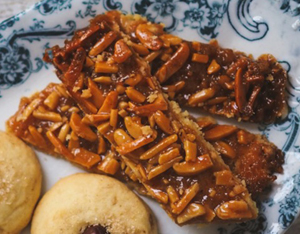
Caramel Almond Cookie
1 quantity of dough (around 200g/7ozs.)
75g butter
4 tablespoons sugar
2 tablespoons honey
1 tablespoon flour
1/2 cup slivered almonds, toastedPreheat oven to 180C/350F and line a baking tray with parchment. Roll out onto between parchment or cling film until it about 1/3cm or 0.13inch in thickness and around 20x15cms or 8x6inches wide. Place in the fridge until needed. Melt the butter in a small saucepan and add the sugar and honey and bring to a simmer. Add the flour and allow to thicken and stir in the almonds. Cool for 5 minutes. Then pour over the dough and bake for 30-35 minutes until the caramel is sticky and not soft in the centre.
Important: allow to cool completely before cutting. Then cut the dough into two rectangles and then slice up into 2cm/3/4inch slices on an angle.
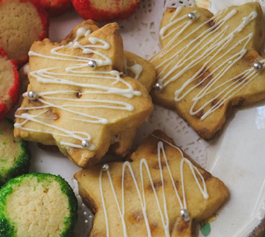
Butterscotch Shortbread Stars
1 quantity of dough (around 200g/7ozs.)
1.5 tablespoons butterscotch chocolate chips (or white or peanut butter)
30g/1oz. white chocolate
Silver cachous/nonpareilsPreheat oven to 180C/350F and line a baking tray with parchment. Mix the dough with the chocolate chips and roll out between cling film or parchment to around 3/4cm or 0.3in. Place in the fridge for 10 minutes and then cut out star using a star cutter. Bake for 15 minutes.
Melt white chocolate and place in a small parchment piping bag or zip lock bag with the end snipped off. Pipe lines across the stars and add silver cachous/nonpareils before the chocolate sets.
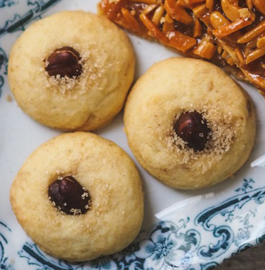
Cardamom Hazelnut Cookies
1 quantity of dough (around 200g/7ozs.)
1/2 teaspoon ground cardamom (freshly ground ideally)
Egg white for brushing
3 tablespoons raw or coffee sugar
Whole toasted hazelnutsPreheat oven to 180C/350F and line a baking tray with parchment. Place the dough with the cardamom in the mixer and beat until cardamom is combined. Shape into walnut sized balls and place on tray and flatten a little. Brush with egg white, sprinkle with raw sugar and place a whole hazelnut in the centre and bake for 15 minutes.
Others Favorities
Dreams ('Drömmar')
A most distinctive, melt-in-the-mouth biscuit, this almost meringue-like treat gets its texture from ‘hjorthornssalt’ raising agent (powdered ammonium carbonate). Infused with vanilla extract, it has a subtle kind of sweetness.
Swedish Dream Cookies - Traditional (Drömmar)
Swedish Dream Cookies w/ Coconut
Oat biscuits ('Havrekakor')
Irresistibly crunchy, these golden-hued biscuits have a definite place in the Swedish biscuit hall of fame. Easy to make, raisins can be added for extra texture and flavour, and you may want to dip a section of the cookie in melted chocolate or drizzle across the surface. Plain or jazzed up with raisins and chocolate, they’re a Swedish fika ("coffee break") hit.
Nut biscuits ('Nötkakor')
Plump and with a deliciously chewy texture, this enduring Swedish fika classic consists of three ingredients – ground hazelnuts, sugar and eggs. The mixture is shaped into little balls, each one decorated with a whole hazelnut. Dip a section of the cookie in melted chocolate for an extra indulgent treat.
