Bannocks
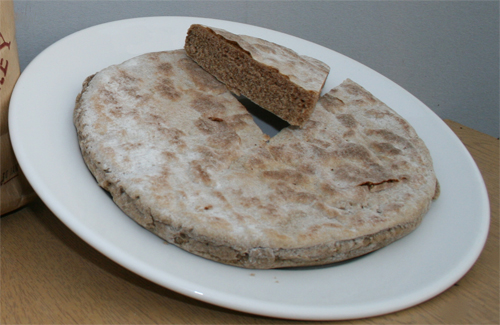
Bannock made with bere meal, an ancient form of Barley now grown only in the Orkneys.
It is thought Bere was brought to the Orkneys in antiquity by the Danes and is still grown there.
The bannock, from the Gaelic bhannag, bannach, or bonnach, is a flat, sometimes unleavened bread that originated in Scotland. Although commonly made of oats, bannocks can be made from barley, ground dried peas, wheat, or a combination of grains. In the west of Scotland, bannock has continued to be made with oats, and there can be little distinction between bannock and oatcakes.
Historically, the Scots cooked bannock on a griddle called a "bannock stone" (clach bhannag in Gaelic), which was a flattened piece of sandstone. This was put on the ground in front of the fire to heat up, and then used for cooking in the days before ovens were available. Bannocks were originally made without any leavening. Later, yeast was used and starter dough from the previous batch was used. By the early nineteenth century, baking soda with an acid added (such as found in buttermilk) was used, and later baking powder became a common leavening agent. Today it may also be baked in an oven.
Many variations exist, both in Scotland from where it originates and in other countries. Particularly well-known is the Selkirk bannock, which is more like a fruitcake. The different varieties of bannock have historical religious and cultural connections, as do many food products. In Scotland, four main variations of bannock were historically tied to the druidic divisions of the year: Imbolc (February 1st), Beltane (May 1st), Lammas (August 1st), and Samhain (October 31st). Thus, special bannocks were made for each of these celebrations.
Beltane bannock
In parts of Scotland, the Beltane bannock is still a popular custom. It is said that eating one on Beltane morning, guarantees abundance for one's crops and livestock. Traditionally, this bannock is made with animal fat (such as bacon grease), and it is placed in a pile of embers, on top of a stone, to cook in the fire. Once it has become blackened on both sides, it can be removed, and eaten with a blend of eggs and milk.
Selkirk bannock
The most famous of all bannocks is the Selkirk Bannock. The first such bannock is said to have been made by a Robbie Douglas who opened his shop in Selkirk in 1859. When Queen Victoria visited Sir Walter Scott's granddaughter at Abbotsford she is said to have refused all else with her tea save a slice of the cake - ensuring that the bannock's reputation was enshrined forever. Robbert Burns also mentioned the bannock in his Epistle to James Tennant of Glenconner, in reference to Alexander Tennant.
The Selkirk bannock is unlike the traditional oatcake bannock, being more of a fruitcake. It is made with wheat flour, butter, and many sultanas: in fact, the sultanas should make up almost half as much in weight or volume as flour. Some versions add candied peel as well. The bannock has a flat bottom and rounded top, and is glazed with milk and sugar. It was initially only made for festive occasions such as Christmas.
Bannock is basically simple to make; it is just bread dough, fried or cooked on a griddle. The result is a flat bread, similar to a large oatcake. The most authentic version is a round or oval piece of unleavened dough, cooked on a griddle. The middle will rise or puff up a little.
The essential ingredients of bannock are:
Flour (wheat, barley, or oatmeal)
Baking powder
Water
Salt
Lard or fat
The ingredients are mixed and kneaded. Then the dough is formed into small cakes and dusted lightly with flour. The cakes are then fried in a greased frying pan, which is shaken to prevent sticking. They are turned when a bottom crust has formed.
