Pan de Cristal
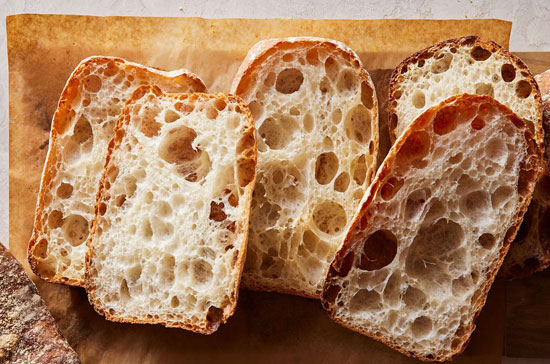
From poster Abelbreadgallery at https://www.thefreshloaf.com/
If you have visited Barcelona or the Catalonia region, maybe you have tasted Pan de Cristal, which is the local version of the ciabatta bread. I say it's a version because there are many things that make this bread so special. The main difference is that the crust is thinner, crispier and more delicate than a ciabatta, and the crumb is lighter and more opened than a ciabatta. And, how do you get this? More water (around 110-120% hydration), and just a small quantity of sugar and olive oil. Sugar makes the crust thinner and crispier. That's why this bread is called Pan de Cristal (Glass bread), because it's so delicate that when you want to slice it, it breaks like a cup of glass. Olive oil not only brings mediterranean aroma and flavour, but also changes the structure of the crumb.
The real one contains oil and sugar. In fact in some places in the Catalonia region they add 50% lard pork and 50% olive oil. The addition of fat and sugar is increasing the crustiness, make the crust thinner and make the internal structure of the crumb more regular. Of course olive oil gives a very nice taste.
This bread was developed around 10 years ago [2004] by a local bread company. The name is copyrighted. The atributes of this bread make it very special for sandwiches and tapas with tomato spread, olive oil, serrano ham, etc. The shape is long and wide, quite flat. So you don't really have to shape, just divide, and stretch with your fingers and let the magic happen.
You can use sourdough, yeast, or a combination of both, which is the best option in my opinion. According to my experience, you get better results working this dough in the straight way, without retarding in cool room. It's a just personal point of view according to my daily work. 20% sourdough + 5 grams of fresh yeast per kilo of flour and 3 hours of bulk fermentation at room temperature is enough to get a good quality product.
1 kg bread flour, 1.1 to 1.2 lt water, 200 gr sourdough, 30 gr salt, 20 gr sugar, 50 ml olive oil and 2 to 10 grams of fresh yeast . Autolyse is a good system to increase the water absortion of your flour [autolyse is where you mix just the flour and water together to properly hydrate the flour]. Autolyse: 30 minutes or until one day.
Flour: I use Farine de Tradition Française T65, the same flour I use for baguettes. You can also combine with a small % of strong flour (T45), if you are not sure your flour will be able to drink that high amount of water.
For handling the loaves, I suggest you to use coarse semolina to prevent the loaf gets stick in the linen couche. The key trick in this bread is do not touch the dough so much, only few times with decision and delicacy to keep the gas you have created in the fermentation time.
Recipe from https://www.kingarthurbaking.com/
FMM: Modify per the desciption above, using sourdough starter and sugar, and see how it goes.
Prepare yourself for a whole new kind of bread baking adventure. Pan Cristal, otherwise known as Glass Bread, is a traditional loaf from the Catalan region of Spain. The high-hydration dough, which begins with a consistency so liquid it’s akin to pancake batter, stiffens up and becomes beautifully smooth and silky during fermentation. When shaped and baked, the result is a loaf with a shatteringly crispy crust and a beautiful, holey interior.
500g water*
500g King Arthur Unbleached Bread Flour
2.5g (3/4 teaspoon) instant yeast
10g salt
15g olive oil
To make the dough: Weigh your flour; or measure it by gently spooning it into a cup, then sweeping off any excess. (To measure by volume, see "tips," below.)
In a medium bowl, mix the ingredients until thoroughly combined and homogenous. Note: The dough starts off very slack and wet. That’s OK; it will transform itself through time and folds.
Oil a two-quart rectangular baking dish (10” x 7”) with 1 tablespoon of olive oil. If you don’t have a 2-quart dish, an 8” or 9” square pan will work. Don’t worry about any pan you use being oven-safe; you won’t be baking the bread in it.
Pour the dough into the pan. Check the dough’s temperature by inserting a digital thermometer into the center. If it's less than 72°F, move the pan to a warmer spot, e.g., your oven with the light turned on.
Cover the pan and allow the dough to rest for 20 minutes.
Start with a bowl fold: Use your wet hands to grab a section of dough from one side, lift it up, then press it down into the middle. Repeat this eight to 12 times.
Cover the dish and allow the dough to rest for 20 minutes.
Then do a coil fold: With wet hands, reach under the dough and stretch the middle upward until the dough releases from the dish. Roll it forward off your hands, allowing it to fold over (or “coil”) on itself. This is called a coil fold. Rotate the dish 90 degrees (a quarter turn) and repeat. Continue performing this folding action until the dough feels like it won’t stretch and elongate easily, usually four to five times initially. Note: You’ll be doing this three more times, each time building strength and developing the dough.
Cover the pan and allow the dough to rest for 20 minutes.
Repeat the coil fold. Cover the bowl and allow the dough to rest for 20 minutes.
At this point, the dough should be easier to handle and feel tighter. Repeat the coil fold using only two or three folds this time. Cover the bowl and allow the dough to rest for 20 minutes.
Repeat the coil fold one last time, using only one or two folds if the dough is relatively strong. Cover the bowl and allow the dough to rest for about 80 minutes.
To divide the dough: As gently as possible, turn the dough out onto a heavily floured surface, maintaining the rectangle or square shape – be careful not to deflate the delicate dough. Sprinkle a generous amount of flour on top of the dough, leaving no exposed sticky spots. Then, working as gently as possible, use a bench knife or other sharp knife to divide it into four pieces. Gently place two pieces on a piece of parchment, leaving space between them. Repeat with the remaining two pieces of dough, placing them on another piece of parchment.
Allow the loaves to rest at room temperature for 2 hours, uncovered. While the loaves are resting, preheat the oven to 475°F with a baking stone or steel on a lower rack. Allow the oven to preheat for 1 hour to ensure it’s thoroughly heated. The loaves are ready for the oven when there are a few large bubbles on the surface of each loaf and they feel light and airy.
To bake the bread: Carefully slide the two loaves (still resting on the parchment) into the oven onto the preheated stone or steel. If space is tight and the full sheet of parchment won’t fit on the stone or steel, cut the parchment between the two loaves and arrange them as best you can. Allow the other two loaves to continue to rest.
Bake the loaves for 15 minutes, then transfer them to a rack in the upper third of the oven for an additional 13 to 15 minutes. Moving them allows the baking stone or steel to become hot again in preparation for the next two loaves. After a total of 30 minutes of baking, remove the loaves from the oven and allow them to cool on a rack.
Repeat the process with the two remaining loaves. Cool the bread fully before slicing.
Storage information: Wrap the bread loosely and store it at room temperature for up to several days; freeze for longer storage.
Tips from our Bakers
In warmer months (or when your indoor temperature is 70°F to 75°F), the water used should be 80°F to 85°F. In cooler months (when your indoor temperature is around 65°F), use 100°F to 105°F water. The DDT (desired dough temperature) at the end of mixing is 74°F to 76°F.
Depending on the strength of your dough, you may not need to perform all four coil folds. If after the third coil fold, the dough feels relatively strong, tight, and is easy to handle, immediately allow the dough to rest for 80 minutes and skip the final coil fold. This will ensure an open crumb structure.
This bread stales (and its crust softens) quickly due to its high ratio of crust to crumb. Re-crisp the loaf before serving by heating it in a preheated 400°F oven, uncovered, for about 8 to 10 minutes.
This recipe was developed using metric weights, and for best results we recommend measuring by weight. However, we recognize that some bakers prefer to work with volume measurements. So while we strongly recommend measuring by weight, volume approximations for the recipe's ingredients are listed below. Please be sure you understand how to measure your flour the King Arthur way before you start.
2 cups plus 3 tablespoons water
4 cups plus 2 1/2 tablespoons King Arthur Unbleached Bread Flour
3/4 teaspoon instant yeast
2 teaspoons salt
1 tablespoon olive oil
Sample timeline:
12:00 p.m. Mix the dough
12:20 p.m. Bowl fold
12:40 p.m. Coil fold #1
1:00 p.m. Coil fold #2
1:20 p.m. Coil fold #3
1:40 p.m. Coil fold #4
3:00 p.m. Divide
5:00 p.m. Bake
YIELD 4 medium (5” x 7”) breads
