Nam Prik (or Phrik)
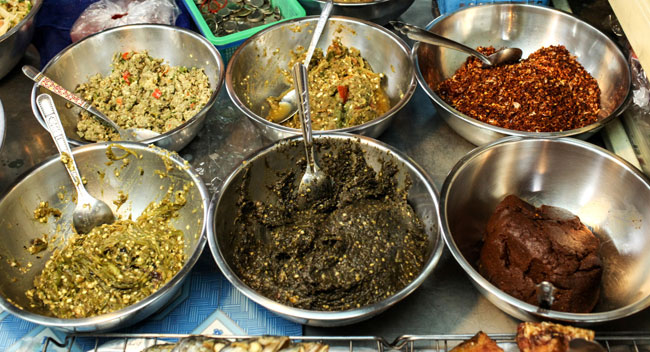
Five chili pastes at the market (clockwise from top center): nam prik sa mun pri (herb paste),
nam prik kha (galangal paste), nam prik tha dang, and two versions of nam prik num.
There are myriad versions of paste. It can form either the base of a soup, curry, or stir-fry or the marinade for chicken, pork, or fish.
The most popular ones include nam prik pla, nam prik kaphi and nam prik pla raa. These are mostly eaten with hot sticky rice or noodles.
Nam prik kapi (Thai: น้ำพ ริก)- The base for many Central Thai dishes is kapi (shrimp paste), which gives a pungent yet slightly sweet flavor to everything it touches. The best kapi hails from Samut Songkhram, a province just south of Bangkok, which is rich in the tiny shrimp that live in the region’s shallow waters. The shrimp are mixed with sea salt, dried for several days, forced through a sieve, and then set aside to ferment for a few weeks before being packaged and sold.
Some of Thailand’s most famous dishes prominently feature kapi. Nam prik kapi, for example, is a chili dip accompanied by fried mackerel, omelet, and boiled vegetables like okra, cabbage, and winged beans. It makes for a well-rounded meal when served with the requisite rice.
The dish is best enjoyed with fried pla thu, fresh vegetables or boiled vegetables and/or rice. “It has a very strong flavour so, for non Thai people, it’s an acquired taste.”
Northern Thais also have their own versions of kapi, which provides the necessary base note to most dishes. Because the region is landlocked, Northern Thais had to rely on crabs in the rice fields to provide the umami usually supplied by kapi. During the rainy season, from June through August, when the crabs are especially numerous, they are pulverized, preserved, and slowly cooked to form nam poo, the distinctive crab paste with a deep-black color that flavors chili dips and salads.
Nam prik long ruea (Thai: น้ำพริกลงเรือ; lit. "In the boat chili paste") - Even royalty ate such traditionally humble dishes as nam prik. The dip called nam prik long ruea was concocted for a Thai princess and included nam prik kapi, syrupy sweet cooked pork, and deep-fried fish floss, resulting in a flavor meant to be equally salty, sweet, and tart. The expected accompaniments are appropriately elaborate: pickled garlic, salted duck-egg yolks, fresh slivers of white turmeric, and fresh coriander leaves. It is an elaborate fried nam phrik using several kinds of fruits such as Garcinia schomburgkiana and Solanum ferox, dried shrimp, sweet pork, and shrimp paste in addition to chilies, garlic and sugar. It is eaten with salted duck egg, fresh greens, and, for instance, sliced Zedoary ("white turmeric").
Nam bu do - In the seafood-rich South, where Malay influence is strong and the food is so spicy it can make you cry, the regional ingredient most analogous to kapi is nam bu do. It is made from fermented fish, salt, and water and bears a characteristic sweet-salty flavor. It is popular as a base in soups, stir-fries, and chili dips, but it is considered indispensable in khao yum, a rice salad mixed with nam bu do, minced lime leaves and lemongrass, shredded coconut, chilies, lime juice, and dried shrimp.
Nam prik pla rah (Thai: น้ำพริกปลาร้า) - In Northeastern Thailand, also known as “Isan,” Laotian influence predominates. The base of every dish in Isan is pla rah, or fermented freshwater fish mixed with rice bran or powder and left to develop a uniquely funky twang. Said to have been created by accident in the Mekong Basin, pla rah is now considered essential; no dish is fully Isan without it. Pla rah also figures in som tum (green papaya salad) and flavors dipping sauces for grilled meat or fish encrusted in salt. Of course it can be made into a chili dip when mixed with shredded cooked fish, chilies, garlic, and shallots.
Nam prik num, Nam prik tha dang (red-eye chili dip), Nam prik ong
It might be in the Northern region, centered around the former Lanna capital of Chiang Mai, where paste-based chili dips fully reign. Despite the popularity of khao soy, or curried egg noodles, the flavors of the North are typically fattier and meatier due to the relatively cooler weather. Dinner tables hold grilled and fried meats (especially pork), minced-meat salads, sausage, as well as bitter or tannic leaves and vegetables foraged from the nearby mountains, generously showered with deep-fried pork rinds for added texture. All of this is frequently seasoned with liberal doses of nam dee (cow bile) or pig’s blood, resulting in a heartier flavor profile that toes the line between salty and spicy against a backbone of bitter.
These types of dishes naturally cry out for chili pastes you can dip your deep-fried pork rinds and fried bits of meat into, as well as for use in marinades, stir-fries, and soup bases. It’s no accident that some of the region’s most famous dishes are chili dips: nam prik num (Thai: น้ำพริกหนุ่ม), made from mashed roasted young chilies, shallots, and garlic flavored with fish sauce and lime juice (Nam phrik num is usually eaten along with vegetables, pork cracklings, and sticky rice.); nam prik tha dang (red-eye chili dip), a fiery mixture of dried chilies, garlic, fish sauce, and lime juice; and the ragulike nam prik ong (Thai: น้ำพริกอ่อง), stir-fried chilies, garlic, shallots, shrimp paste, and ground pork mixed with cherry tomatoes and chopped fresh coriander, which is ubiquitous at every khanthoke (formal Northern Thai) dinner.
Other Nam phrik sauces
Nam phrik kha (Thai: น้ำพริกข่า) is made with roasted chilies, garlic, galangal and salt. This northern Thai specialty is often served as a dip for steamed mushrooms.
Nam phrik maeng da (Thai: น้ำพริกแมงดา) incorporates roasted and pounded maeng da (Lethocerus indicus, a kind of Giant water bug) for its specific taste.
Nam phrik narok (Thai: น้ำพริกนรก) literally translates to "chili paste from hell". It is made with dried chilies, shrimp paste, catfish, shallots, garlic, fish sauce and sugar.
Nam phrik phao (Thai: น้ำพริกเผา) is sweetened with sugar and, among other ingredients, roasted chilies and tamarind. It is popular as a spread on bread or toast. It can also be used as an ingredient, for instance in tom yum or in the Thai salad with squid called phla pla muek.
Nam phrik pla ching chang (Thai: น้ำพริกปลาฉิ้งฉ้าง) is based on small, local anchovies (Stolephorus) popular in Phuket.
Nam phrik pla salat pon (น้ำพริกปลาสลาดป่น), also known as phrik pla salat pon, is a variety of nam phrik with powdered, roasted, dry pla salat (Notopterus notopterus). All main ingredients (the dry fish, red dry chili and garlic) are previously roasted until crunchy. Shrimp paste and sugar are also added, and the mixture is pounded with a mortar and pestle. It is eaten with raw vegetables, and is popular in Khorat.
Nam phrik pla yang (Thai: น้ำพริกปลาย่าง) is mainly minced, grilled fish, usually pla chon, mixed with onion, garlic, powdered chili, tamarind, shrimp paste, fish sauce and sugar.
Nam phrik tai pla (น้ำพริกไตปลา),[24] one of its main ingredients is tai pla, a sauce used in the southern Thai cuisine made with the fermented innards of the short-bodied mackerel.
Nam Prik Hnum
Of this dip (essentially, pounded roasted chillies), that hails from Northern Thailand, Chef Sorlae says: “This is an ancient recipe, which I believe, was a result of the fusion of cultures when the Chinese occupied Northern Thailand in ancient times — this sauce was a result of their experiments. It has a rich flavour, and is traditionally eaten with noodles. In Thailand, they'd also eat it with crispy pork or pork sausage.”
NAM PRIK HNUM (GREEN CHILI DIP)
• Roasted green chili 10-15 pcs
• Roasted garlic .............60 g
• Roasted onion ............ 4-5 pcs
• Salt .............................¼ tsp
• Fish sauce ...................1 tsp1 Roasted green chili, garlic, onion and peeled green chili.
2 Mash all together and add seasoning to taste.
Nam Prik Phool
This is a traditional Thai chilli paste that's eaten with with rice and/or with boiled eggs, Chef Sorlae tells us. “It’s also used in stir-fries and Thai locals would also sauté fried rice in this. It's usually prepared for special family gatherings, as it's a complex recipe: every item has to be roasted and it involves slow cooking. For casual use, in Thailand, one would buy the dip from small eateries rather than make it from scratch.”
Prik Nam Som
“I never use a store-bought variety of this sauce,” says Chef Sorlae, “I use my own special recipe. Traditionally, it’s a chilli-vinegar sauce, that’s not watery at all — its texture is like Indian chutney.” The chef calls this “a Bangkok recipe — popular street food,” and she says, “It’s eaten with rice, the same way Indians eat rice with curd.” Local recipes in Thailand usually contain fish sauce, but you can ask them to prepare vegetarian versions, “and they'll likely oblige because it’s a simple recipe.” It’s a moderately spicy sweet-salty sauce that boasts the exotic flavour of galangal ginger.
Prik Nam Pla
“This watery sauce is a staple ingredient for Thai cooking,” says Chef Sorlae, “To make it, fish is massaged with salt and left to marinate; the water that comes out is then reserved.”
TAMARIND PEANUT SAUCE
Chef Rungtiwa Sorlae shares her favourite recipe:
Ingredients
• Coriander root ......................... 20 g
• Coconut milk ............................50 ml
• Plum sugar ................................1 tsp
• Sugar ........................................½ tsp
• Soya sauce ................................1 tsp
• Fish sauce ................................. 1 tsp
• Tamarind juice ......................... 2 tsp
• Roasted ground peanut ............30 g
• Oil............................................ 1 tabsp
• Onion slice ............................... 10 g
• Garlic and white pepper (to taste)
Method
1 First put oil on the pan and heat it. Add coriander root, garlic, white pepper and onion slice and brown.
2 Add the coconut milk and all the other ingredients; adding the roasted ground peanut last.
