Thai Cuisine
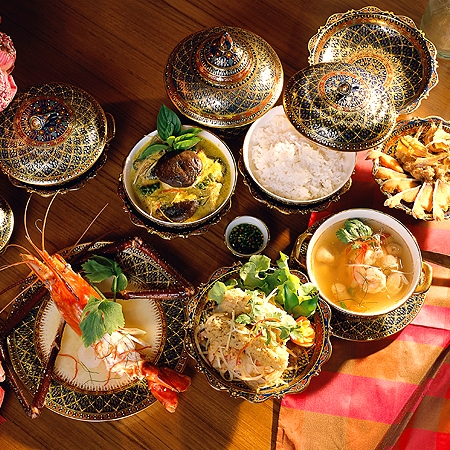
Thai cuisine places emphasis on lightly-prepared dishes with strong aromatic components. Thai cuisine is known for being spicy. Balance, detail and variety are important to Thai cooking. Thai food is known for its balance of the five fundamental taste senses in each dish or the overall meal: hot (spicy), sour, sweet, salty, and (optional) bitter.
What gives Thai food its distinctive character is a kind of harmony in its tastes. You have soups that look plain in colour but the taste combination is sour, salty, hot and aromatic. The use of peanuts and coconut in curries is very characteristically Thai as well. Distinct herbs such as lemongrass, kaffir lime, both the leaf and the fruit, galangal, one in the ginger family, and mix them with the pungent sourness of fresh lime or the pleasurable sweetness of palm sugar. Herbs used in Thai food have a distinctly different aroma from western ones.
Influences
Although popularly considered a single cuisine, Thai food would be more accurately described as four regional cuisines corresponding to the four main regions of the country: Northern, Northeastern (or Isan), Central, and Southern, each cuisine sharing similar foods or foods derived from those of neighboring countries and regions: Burma, the Chinese province of Yunnan and Laos to the north, Cambodia, Laos and to the east and Malaysia to the south of Thailand. In addition to these four regional cuisines, there is also the Thai Royal Cuisine which can trace its history back to the palace cuisine of the Ayutthaya kingdom (1351–1767 CE). Its refinement, cooking techniques and its use of ingredients were of great influence to the cuisine of the Central Thai plains.
The culinary traditions and cuisines of Thailand's neighbors have influenced Thai cuisine over many centuries. Regional variations tend to correlate to neighboring states as well as climate and geography. Southern curries tend to contain coconut milk and fresh turmeric, while northeastern dishes often include lime juice. The cuisine of Northeastern (or Isan) Thailand is heavily influenced by Lao cuisine. Many popular dishes eaten in Thailand were originally Chinese dishes which were introduced to Thailand mainly by the Teochew people who make up the majority of the Thai Chinese. Such dishes include chok (rice porridge), kuai-tiao rat na (fried rice-noodles) and khao kha mu (stewed pork with rice). The Chinese also introduced the use of a wok for cooking, the technique of deep-frying and stir-frying dishes, and noodles and soy products.
Communal Eating
Food is a very important aspect of Thai culture. To appreciate Thai food you have to understand how the locals eat.
The key to a Thai dinner is a communal eating. Many dishes are served for all to share and everyone at the table takes the food from these dishes to eat with rice. Each person at the table does not get his or her own plate of fried fish or spicy pork. Everyone will get a plate of rice and share all the dishes served at the table. It makes the meal more enjoyable because you can sample as many dishes as you like and also creates the opportunity for social interraction.
The concept of eating your meal in three courses -- appetizer, main course, and dessert -- is more of a Western thing. In Thailand, like other parts of Asia, dishes, for the most part, are served as they are cooked, and eaten together. And khanom (Thai desserts) are more of a snack and only occasionally a meal closer. Lee, who went to school in Thailand, recalls carts teeming with khanom rolling around in the middle of the day. "Most of these would be eaten during break. After a heavy meal, traditionally, they're more likely to give you fruits than sweets."
People often ask for chopsticks in Thai restaurants in America. In Bangkok, if you go to a Thai restaurant, there are no chopsticks. Noodle dishes, which are Chinese in origin, call for chopsticks, but for most dishes you should use a good ol' fork and spoon. Before those utensils -- which were introduced by the King Rama IV in the 19th century to "modernize" the country -- Thai people mostly ate with their hands. Even though they adopted the Western utensils, they put their own spin on using them: You hold the spoon in your right hand and the fork in the left hand, and then use the two to scoop food into the spoon to eat. It's way easier than struggling to pick up grains of rice with two sticks.
Regional Cuisines
North - East (Issan)
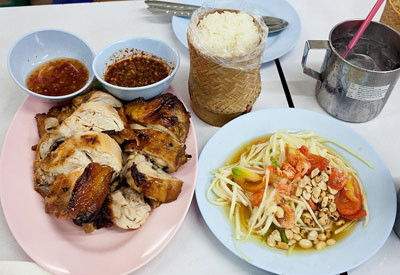
Som Tam (papaya salad), Kai Yang (grilled chicken) and Khao Niaow (sticky rice):
a combination of dishes from Isarn (North East Thailand) which has become
extremely popular in the whole of Thailand. It is eaten as a snack or as a lunch
time meal.
The largest region of Thailand, Issan is where the more traditional values are still upheld, particularly in eating habits. All dishes are simple in both the ingredients and the method of preparation. Mainly, Isaan food is a blend of spicy chilies and sour tamarind, 'makok' or red ant eggs.
The Northeastern Thais, like the Northerners, prefer sticky rice in both sweetened and steamed styles. Served in a basket, locally called 'kratip', sticky rice and kratip have become the cultural symbol of the region.
Northeasterners are well known as experts in preserving fish, extensively used in cooking and seasoning.
The local specialties of raw stuffed fish include 'pla ra', 'pla som' and 'pla daek'.
The world famous Northeastern delicacy is 'som tam', a spicy raw green papaya salad mixed with chilies, garlic, tomatoes, green beans, lime juice and fish sauce with the extra seasoning of stuffed fish and preserved crab. Som tam is usually served with grilled chicken and sticky rice.
The innards of the fish are a delectable food, boiled and seasoned into 'tom krueng nai', a sour and spicy Northeastern style soup. Believe it or not, it is delicious!
Isaan sausage (sai-gok Isaan) is another favorite dish throughout the country. The stuffing is left to ferment with a slightly sour taste. Other mouth-watering plates include 'lahp' (ground spiced meat), 'jaew', (chili dip), 'sup normai', (spicy bamboo shoot salad), and 'gai yang', (barbecued chicken).
Curries with non-coconut milk are also popular in Issan. Northeastern cuisine is known around the country as being particularly fiery and hot.
North
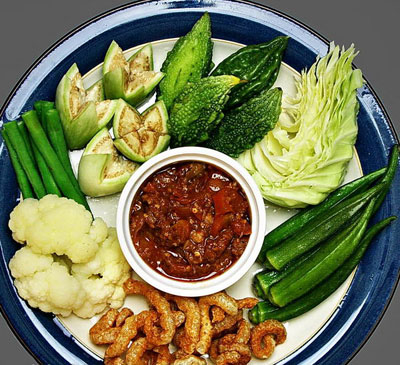
Nam Prik Ong is a very popular Northern Thai recipe. The main ingredient of Nam
Prik Ong is ground pork and the dish is usually served with a selection of lightly
steamed vegetables and crispy pork skins together with a small bowl of "Sticky
Rice". Frequently eaten in Thailand as an appetizer, this dish can also be ordered
as part of any Thai meal.
Nam Prik Ong may be eaten with a spoon but is more often eaten with the fingers
by dipping a small piece of sticky rice or vegetable into the Nam Prik mixture. The
crispy pork skins, known in Thailand as Kaep Moo, add a delightful change of
texture.
Traditionally, local people of the north sit on straw mats and enjoy dining around 'kantoke', a small table made of oak. On the table appears a selection of special dishes, normally comprising curries, sticky rice, various par-boiled vegetables and deep-fried fish with a choice of 'nam phrik' - chili paste dips.
Among the northern dips, 'nam phrik noom' (young chili dip) is perhaps the most popular. Besides, northerners like to accompany their meals with the North's unique preserved meat called 'moo yor' and 'naem' (spicy pork sausages).
Curries such as 'gaeng hang lay' are cooked in rich and creamy coconut milk. This fat gives people warmth in the cool weather of the mountainous region.
The local varieties of 'nam phrik' represent the Thais' typical use of chillis. Northern food always has a side dish called 'kaeb moo' (crispy pork rind) to distinguish the north's recipes from those of other regions.
Northern people prefer to eat sticky rice as the main stock of their diets, same as the Lao do. Chinese influence is reflected in the widespread use of noodles.
The favorite noodle dish of the North is called 'Khao Soi', crispy rice or egg noodle in a rich curry sauce. Originally created by the Chinese living in the hills, khao soi differs from noodle dishes in other regions by the addition of coconut milk to the soup. Another popular dish, 'khanom jeen nam ngeow', directly results from the influence of Mon people in southern Burma.
Among many culinary cultures affecting the north, Burmese seems to be the most obvious influence in most local recipes, especially curries and chilli dips such as 'gaeng aom' (pork curry with innards) and 'nam phrik ong' (tomato chili dip with ground pork).
Recipe for Chicken Khao Soi (chicken and coconut noodle soup)
Central
The central region of Thailand is the most fertile area and is blessed with natural water, mainly from the Chao Phraya River. The fertility of the area is ideal for many crops to be harvested here. Rice is the chief agricultural product in this region but also other fresh produce such as vegetables, fruits and flowers.
This freshness is key to the region's variety of delicious cuisine. Chilli dip or 'nam phrik' is a typical dish served together with fresh vegetables which are in season such as cucumbers, morning glory stalks, makok leaves, cha-om and gratin.
There are many types of chilli paste dips distinguished by the main ingredients or the techniques in making dips. Not only eaten with fresh vegetables, the chilli paste dip is also applied to make many more complex dishes.
The spicy Thai salad or 'yam' also derived from dipping. 'Yam' or Thai-style salad usually refers the dish with has sweet and sour taste and has a great aroma from some herbs such as kaffir lime leaves, and lemongrass.
But whatever techniques are used, they all mostly share the three basic ingredients-flour, coconut and sugar.
Most desserts of the central area are fruits. Apart from eating them fresh, the Thais are creative to apply them to make many delightful desserts. Simply add fresh fruits into light clear syrup and put some crushed ice into it, and then you have another dessert that is easy-to-prepare and very delicious.
South
The southern cuisine is best known for being hot and spicy. The locals believe that living in humid climate along the broad coastline can make them sick therefore the heat from food can protect them from fevers.
This is how the geography affects the tastes of the south. Connected to a Muslim country like Malaysia, the region has inevitably had added Islamic culture into its cooking styles.
There is an extensive use of turmeric that characteristically makes the southern dishes look yellowish such as 'gaeng lueng' (spicy coconut shoot soup), 'khao mok gai' (turmeric rice topped with chicken) and even 'gaeng som' (tamarind-flavored soup).
Southerners' favorite entree is 'gaeng tai pla' (fish viscera curry) which gives a spicy taste from chilies and salty flavor from 'koei' (shrimp paste).
Massaman is another unique curry famous among people in the south. Although Massaman is made from ingredients as basic as those curries found in other regions, it also comprises the five-spice powder strongly influenced from India.
The locals also feature this curry with roasted peanuts, common in most southern dishes. Surrounded by cove and ocean, the southerners are lucky to be able to enjoy fresh seafood throughout the year. They simply transform fresh Phuket's rock lobster, fish, crabs, prawns, squids, clams and mussels into many delicious menus.
Besides grilling, boiling and barbecuing, people season their selected seafood with aromatic herbs and spices. 'goong ga-thi nor mai sod' (prawns and bamboo soot in coconut soup), 'poo pad pong gari' (fried crab with yellow curry) and 'goong pad sataw' (fried prawn with twisted cluster beans) are one of the most famous dishes.
The bitter 'sa-taw' is another identity of southern cuisine.
Recipe for Massaman Curry
