Bánh Mì Sandwich
from Andrea Nguyen, http://www.vietworldkitchen.com/
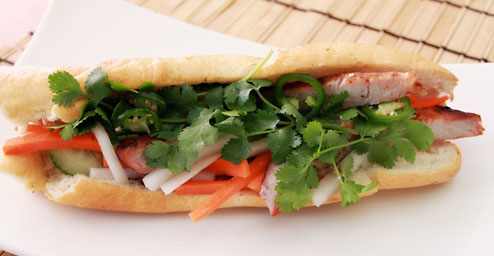 There is essentially one sandwich in Vietnamese cooking and it is quite a tour de force. Evolving from French colonial influences in Vietnam, the french baguette, pate, and mayonaise was combined with classic native Vietnamese ingredients like cilantro, peppers, pickled carrots and daikon as well as the a plethora of meat options that make this sandwich arguably one of the best sandwiches ever invented.
It started out very simply, with baguette smeared with liver pate and that was it. What we know today as banh mi is a light, crispy small baguette that is filled with homemade mayonnaise or butter, sliced chili pepper, cilantro leaves, cucumber, a tangy-sweet daikon and carrot pickle (do chua), and your fillings of choice.
A good banh mi (also called a Saigon sub) begins with good bread. The banh mi baguette is made from wheat and rice flour resulting in crispy flaky crust with a light and airy center. The bread is usually spread with pate and a mayonnaise spread. The variation comes in when you choose what protein component(s) will be center stage.
The classic version, bánh mì thịt nguoi — referred to as the "special" (dac biet) at Vietnamese delis, includes a smearing of housemade liver pâté and thin slices of various Vietnamese cold cuts. Other great banh mi fillings are Viet flavored pork prepared in numerous ways; juicy pork meat ball (xiu mai), grilled pork (Thit Heo Nuong), crunchy julienned pork skin (bì) and pork roll (cha lua). Cold cut combinations (pork roll, ham, and/or head cheese), grilled chicken (ga nuong), sardine (ca moi), scrambled egg (trung chien) and vegetarian (chay) are just a sampling of the plethora of other possibilities.
Also see: Bánh Mì Xiu Mai - Pork meatball sandwich in a Vietnamese tomato sauce
Master Banh Mi Sandwich
The Bread and Protein
Light crispy baguette (not the chewy rustic kind) is essential for encasing without overshadowing the other ingredients. Vietnamese baguette is commonly made with rice and wheat flour, which makes for an airy crumb. You can purchase the baguette at Vietnamese or Chinese markets, Vietnamese bakeries and delis, or make your own Vietnamese baguette. A Mexican bolillo roll works well too. So does regular baguette, though avoid sourdough and the overly crusty type.
The focal point may be leftover grilled or roasted meat, thin slices of Vietnamese steamed pâté (gio lua), or even seared tofu. Yes, purchased chicken liver pate, even liverwurst and German braunschweiger, can be smeared into a banh mi! Because the daikon and carrot pickle can keep for days in the fridge, you can make banh mi whenever the spirit moves you.
Banh Mi Sandwich
For each sandwich:
1 petit baguette roll or a 7-inch section cut from a regular length baguette, purchased or homemade
Mayonnaise, real (whole egg) or homemade mayonnaise
Maggi Seasoning sauce or soy sauce
Your choice of boldly-flavored meat or tofu, sliced and at room temperature
3 or 4 thin seeded fresh cucumber strips, pickling or English variety preferred
2 or 3 cilantro sprigs, roughly chopped
3 or 4 thin jalapeño pepper slices
Everyday Daikon and Carrot Pickle (do chua)
1. Slit the bread lengthwise, and then use your fingers or a bread knife to hollow out the insides, making a trough in both halves. Discard the insides or save it for another use, such as breadcrumbs. (If the bread is light and airy, you can skip this step.) Crisp up the bread in a toaster oven preheated to 325ºF, and then let it cool for a minute before proceeding.
2. Generously spread the inside with mayonnaise. Drizzle in some Maggi Seasoning sauce or soy sauce. Start from the bottom portion of bread to layer in the remaining ingredients. (As with all sandwiches, you’ll eventually develop an order for layering the filling so as to maximize the interaction between flavors and textures.) Close the sandwich, cut it in half crosswise for easy eating, and enjoy.
Bánh Mì Sandwiches served at local Philadelphia restaurants:
All served with sliced fresh chili pepper, fresh cilantro leaves, cucumber, and daikon and carrot pickle (do chua).
Bánh Mì Thit Nguoi - Ham, head-shoulder roll, pork roll, butter, vegetables
Bánh Mì Pate Cha Lua - Pate (can use liverwurst or braunschweiger), pork roll, butter, vegetables (Cha = sausage)
Bánh Mì Thit Nurong - Charbroiled pork & vegetables
Bánh Mì Nem Nướng - use Pork Meatball Bánh Mì recipe or Nem Nướng (Vietnamese Grilled Pork Skewers) and make as above
Bánh Mì Xiu Mai - Pork meatball in a Vietnamese tomato sauce
Bánh Mì Ga Nurong - Charbroiled chicken, vegetables
Bánh Mì Bo Kho - Stewed beef
Bánh Mì Cari De - Lamb curry
Bánh Mì Ca Moi - Fish (sardine), vegetables, soy sauce
Bánh Mì Hot Ga Opla, Pate, Cha Lua - 3 Sunshine eggs, pork roll, pate (breakfast bánh mì)
Bánh Mì Chay (Dau Hu Hay Bi Chay) - vegetarian option with choice of tofu and vegetables
Another list of popular fillings:
1. Chả or Chả Lụa (Pork Roll)- Ground up pork is packed tightly into a roll, and wrapped with banana leaves (and or aluminum foil) then steamed or boiled, hence producing the dense “pork roll”. Sliced thin like bologna, these make up one of the most common cold cuts found in bánh mì.
2. Thịt Nguội (Cured pork cold cuts)- Thịt Nguội (translated as “Cooled Meats”), is the second most common cold cut filling. Usually made of cured pork & layered with strips of fat. Some makers will call it Ba Chị, which is more like pork belly.
3. Giò Thú (Headcheese)-These cuts are usually a Vietnamese combination of pork ears, tendons, skin, fats and other extra pork head meats. It’s all processed together into a roll, then sliced.
4. Dặc Biệt (Special or Combination)- Every menu has a Combination or House Special, which is a combination of at least one of the following: the pork roll, headcheese and/or cold cuts. Some shops offer ham as an offering to the cold cuts, as well as adding their special house touch of other meats.
5. Thịt Nướng (Grilled Pork)- Vietnamese marinated grilled pork. Cuts of pork meat can be anything from pork belly, pork shoulder, pork chops or pork butt.
6. Xa Xíu (Bar-B-Que Pork)- Sweet, pinkish colored pork cooked to the style of chinese bar-b-que. Cuts of pork can also vary like those of grilled pork.
7. Xíu Mại (Pork MeatBalls)- Moist Pork Meatballs cooked in a usually, sweet, often lightly tomato based sauce. Ground pork is marinated Việt style.
8. Bì (Shredded Pork Skin)- Most traditional Bì is a creation of dry, thinly sliced pork skin. To accommodate the more American palettes, some bánh mì creations come with traditional Bì along with more moist, shredded pork pieces.
9. Nem Nướng (Grilled Pork patties)- These versatile, garlic, ground pork patties are popular in many fresh springroll and herb noodle salad dishes. They make a very tasty in bánh mì.
10. Nem Chua (Sour Pork) – Usually eaten as a snack with raw garlic, these little squares of sour pork meat are showing up on banh mi menu’s more often. Starting with mostly raw pork skin and some meat, a seasoning mixture of yeast, vinegar, garlic, fish sauce, salt, sugar & pepper are added. The raw meat mixture is then wrapped (usually in banana leaves or plastic) into small squares are left to pickle and ferment for about 3-7 days. The product is a small, dense square of sour, pickled pork meat with a garlic punch!
11. Gà Nướng (Grilled Chicken)- Vietnamese marinated and grilled brown meat chicken.
12. Thịt Bò Nướng (Grilled/Bar-B-Que Beef)- Vietnamese marinated style beef. Grilled meat options are usually pork, but more places are offering beef as an filling.
13. Cá Mòi (Sardines)- Usually, the sardine selections (bones included, but cooked) are pulled straight from the can. Nothing really homemade. Once favored more by Vietnamese, sardine banh mi are now becoming more popular by non-Vietnamese because of the moist and flavorful fish texture.
14. Paté – Ranging from chicken to duck liver ingredients, pates can normally be a part of every sandwich as a spread, but some menu’s offer pate in larger quantities, making it the main savory filling ingredient.
15. Trưng Chien (Fried Egg)- Eggs are usually prepared as a scramble, well done sunny side up (but cooked on both sides), omelet style or a little bit of all three.
16. Chay (Vegetarian)- Meatless choices can be offered in a combination of the ways:
A. Tofu Chunks – Chunks of tofu are deep fried, then sauteed with a vegetarian, Vietnamese marinade (Soy Sauce, Veggie Oyster or Veggie Mushroom Sauces).
B. Shredded Tofu (Bì Chay) – Like the Bì (Pork skin), this vegetarian version is made with thin slices of dry tofu, then mixed with stir fried sliced jicama, carrots and/or glass vermicelli noodles. This type of filling usually is VERY dry, so ask for some extra soy for added moisture and flavor.
C. Veggie “Ham”- These thinly sliced salmon colored (or cream) pieces of processed bean curd mimic the meat version quite well, but the flavors will dictate the differences. Just try it, you just might like it.
D. Wheat gluten- Gluten pieces are prepared in the same way that tofu usually is.
Classic Condiment Fillings
1. Paté -Chicken or Duck Liver Paté.
2. Homemade Mayo- Sometimes made from an egg yolk & vegetable oil combination, or other shops will even have a store bought mayo or miracle whip. Most shops will have some type of rich, white spread.
3. Fresh herbs. In the U.S., we usually see fresh cilantro sprigs. However other herbs were popular in different regions of Vietnam.
4. Pickled Carrots & Daikon – Usually finely shredded or julienned, these sour, vinegared accompaniments provide the salty, sour layer of flavor.
5. Jalapeño slices or other Chilies. Warning for the lighthearted: Pepper spice potency level will vary heavily. Nibble on a slice from your sandwich first before you bite The jalapeño slice that tasted like a mild cucumber last week, just might pop back and kick you in the ass this time.
6. Cucumber Slices.
7. Light Sprinkle of Soy Sauce.
