Red Devil’s Cake vs Red Velvet Cake
Around 1943, a popular cookbook, "The Joy of Cooking" debuted a Red Devil’s Food cake. The maker of the cookbook, Irma S Rombauer, comically states she doesn't care for the cake. However, Irma felt she had a duty to her customers to include the cake recipe. Many websites claim this cake to be a "red velvet cake," but it is specifically called "Red Devil’s Food" cake in the cookbook. The foodtimeline.org disagrees with these websites. Here is the recipe:
[1946]
"Red Devil's Food
Generally popular--but not with me, which is not to be taken as a criterion.Measure:
1 1/2 cups sifted flour
Resift with:
1 1/2 teaspoon tartrate phosphate baking powder or 1 teaspoon combination type
1/2 teaspoon salt
1 teaspoon soda
Cream until light and fluffy:
4 tablespoons butter
1 cup sugar
Add one at a time and beat well:
2 eggs
Melt: 2 ounces chocolate in 1/2 cup boiling water
Cool slightly, then stir these ingredients into the egg mixture. Add the dry ingredients in about three parts alternately with:
1/2 cup sour milk
Add: 1 teaspoon vanilla
Stir the batter after each addition until it is well blended. Bake it in two greased 9 inch layer pans in a moderate oven 350 degrees for about 25 minutes. Spread the cake with Seven Minute Morocco Icing."
---Joy of Cooking, Irma S. Rombauer [Bobbs-Merrill:Indianapolis] 1946 (p. 542)
“The earliest recipe we found titled "Red Velvet Cake" was published in 1960. Earlier recipes (Red Velvet Devil Cake, 1951) are not the same. While some people hypothesize the color of this recipe was inspired by tomato soup cakes, our survey of historic does not bear this out. The color in Red Velvet cake is achieved by chemical reaction (soda=alkaline;vinegar=acid) AND the addition of red food dye. Someone, somewhere, apparently decided old-fashioned "red" was not "red" enough. Red Velvet cake was popularized by the Waldorf-Astoria recipe legend and as Armadillo Cake in the movie Steel Magnolias. Coincidentally? The earliest recipe we've identified to date was published in Texas. Armadillo is the official small mammal of Texas. Our survey of historic newspapers confirms this recipe spread like wildfire all over the country the summer of 1960.”
from https://www.foodtimeline.org/
And from https://www.yahoo.com/video/red-velvet-cake-different-devils-213816276.html
“There’s a widely believed myth that red velvet is just devil’s food with food coloring. This couldn’t be further from the truth—unique ingredients used in each traditional recipe make them two completely different cakes.
“Devil’s food cake is a dense, rich type of chocolate layer cake. Its name comes from a simple fact: It is, quite literally, the opposite of the light and airy, white or yellow angel food cake. It’s often made with sour cream and coffee to ensure a dense texture and intense chocolate flavor.
“It also typically calls for Dutch-process cocoa (cocoa that has been treated with an alkalizing agent).
“Red velvet cake’s signature tang comes from vinegar, an ingredient that isn’t often found in devil’s food or classic chocolate cakes, and buttermilk. Red velvet recipes almost always call for natural cocoa to enhance its red color.”
Recipes for Red Devil's Cake begin to appear in North American newspapers and cookbooks during the 1930s. Some are specifically called "red devil," others are simply called devil and are undistinguishable unless the cook examined the ingredients.
Red Devil's Cake
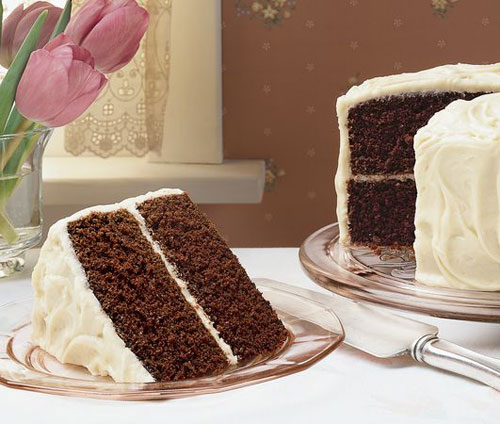
And an early recipe for Red Devil’s Cake from https://www.foodtimeline.org/
[1930]
"There is one cake to which most men are susceptible--devil's food. When women are left to choose, they usually seect the lighter colored varieties. Today we are giving a recipe for red devil's food a dark cake that will appeal to all...The cause of the desirable red color in some devil's food is a question with food chemists. Housewives have believed for a long time that only those cakes that contain soda are red. some chemists, however, do not agree with this theory. Whatever the cause may be we do know that it usually results when sour milk and soda are used. Our recipe includes both. The usual buttermilk sold by the dairymen or your grocery man is sufficently uniform in acidity to produce good results."Red Devil's Food Cake
2 cups pastry flour
1/2 cup cocoa
3/4 cup fat [half butter]
1 1/2 cups sugar
2 eggs
1/2 cup sour milk
1 teaspoon soda
1 teaspoon vanilla
12 cup boiling waterSift flour, then measure. Resift with cocoa twice. Cream fat until plastic. The add sugar gradually, creaming thoroughly. Add well beated eggs and beat hard one minute. Ad flour-cocoa mixture alternately with the sour milk in which soda has been dissolved, beginning and ending with the flour mixture. Add vanilla and beat vigorously one-half minute. Add boiling water [water must be boiling to make cake red]. Stir until batter is smooth. Turn into layer or loaf pans that have been oiled and lined with paraffin paper. Bake in a moderate oven [350 degrees Fahrenheit] about 35 minutes. Yield: One loaf or 2 layers. One serving: Total 249 calories; Protent, 16 calories; fat, 103 calories; carbohydrate, 130 calories."
---"Three Meals a Day: From the Tribune Cook Book," Meta Given, Chicago Daily Tribune, June 12, 1930 (p. 32)
Red Velvet Cake
"The velvet cake is said to have originated in the Victorian Age and was considered a fancy dessert," Walnock says. (Melissa Walnock is executive pastry chef and the instructor at The Culinary Institute of America's Apple Pie Bakery Café.") The velvet in the name was meant to describe the texture of the cake." Apparently, cooks discovered that adding almond flour, cornstarch, or cocoa to the cake mix would soften the protein in the flour, which resulted in a finer-textured cake than cakes made entirely of regular flour, according to The New York Times.
The recipe rose in popularity during the Depression era as it called for cheap, raw cocoa powder instead of chocolate bars (which were more expensive as they're made with cocoa butter, cocoa solids, and sugar). Eventually, as the velvet cocoa recipe made its way to the southern states, buttermilk was added to the list of ingredients. Once buttermilk was used in the recipe, something interesting started to happen.
The combination of the acidic buttermilk and raw cocoa powder with a neutralizing baking soda spurred a chemical reaction that unleashed the natural reddish colors of the cocoa. So no, the cake wasn't a super bright red that most people accomplish today thanks to food coloring, but it was more of a red-brownish shade than the earthy, deep brown of a regular chocolate cake.
Most cocoa powders sold now are "alkalized" or "dutched." This means they go through a chemical process that lowers their acidity and also decreases their antioxidant levels. This means if you want to make a Red Velvet Cake today, you would need to go out of your way to find raw, cacao powder.
However, it was the Adams Extract company out of Texas that is credited with bringing the red velvet cake you know and love to true popularity. The company sold food coloring and flavor extracts and it was among the first to introduce tear-off recipe cards to encourage the use of their products.
Legend has it that after the owners of the company ate a velvet cake at the Waldorf-Astoria in New York City, they were inspired to replicate the recipe using their own products. It was in the 1940s that Adams Extract printed a red velvet cake recipe, which was a velvet cocoa cake with food coloring, and it took off.
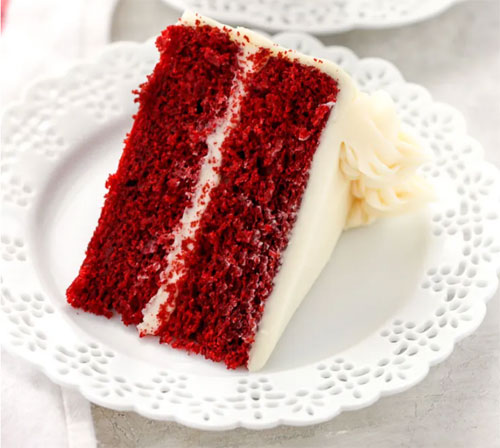
This cake recipe uses an ermine frosting. Red Velvet Cake recipes today often call for a cream cheese frosting.
[1960]
"Red Velvet Cake2 ounces of red food coloring
3 tablespoons cocoa
1/2 cup shortening
2 beaten eggs
1 1/2 cup sugar
2 beaten eggs
1 cup buttermilk
2 1/4 cups cake flour
1 teaspoon salt
1 teaspoon vanilla
1 teaspoon soda
1 tablespoon vinegarMix food coloring with cocoa and set aside. Cream shortening and sugar, add beaten egg, then cocoa-coloring mix. Beat well. Sift flour and salt three times, and along with buttermilk. Add vanilla and beat well again. Remove from mixer and add mixture of vinegar and soda to batter. Mix by hand until blended. Bake in two nine inch pans, greased but not floured, at 350 degrees for 30 to 35 minutes. Cool, then ice.
Icing
1 stick soft butter
1/2 cup shortening
1 1/2 cup powdered sugar
2 tablespoons flour
2/3 cup sweet milk (at room temperature
1 teaspoon vanillaCream butter and shortening with sugar. Add flour, 1 tablespoonful at a time, add sweet milk and vanilla. Beat a long time with mixer until icing is light and fluffy. When cake is frosted, sprinkle with coconut. This cake has a fine flavor and good keeping qualities-- if there's any left to keep. It's best kept in a cool place during the summer. The icing is as light as whipped cream."
---"Recipe of the Week," Mrs. Cagle's Red Velvet Cake," Denton Record-Chronicle [TX], June 16, 1960 (p. 12)
[NOTE: there is no bio note provided for Mrs. Cagle.]
