Swiss Rolls (rolled cakes with filling)
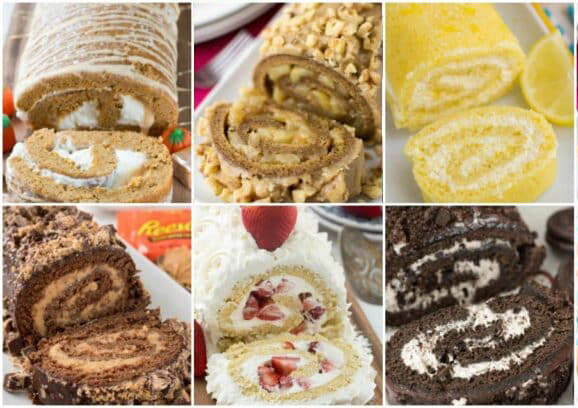
A Swiss roll, jelly roll (United States), roll cake, cream roll, roulade or Swiss log or swiss cake —is a type of rolled sponge cake made of egg yolks, flour, and sugar, baked in a shallow sheet pan, and filled with whipped cream, jam, buttercream, and sometimes chocolate. Depending on where you’re eating these little indulgences, you may also find them filled with fruits like fresh strawberries or pineapple, whipped cream, or more unique flavors like coffee.
They are also typically topped with whipped cream, powdered sugar, and sometimes even tastier options like chocolate ganache.
The origins of the term are unclear; in spite of the name "Swiss roll", the cake is believed to have originated elsewhere in Central Europe, possibly Austria or Slovenia. It appears to have been invented in the nineteenth century, along with Battenberg cake, doughnuts, and Victoria sponge. One theory is that the term "Swiss" refers to the style of the cake, which was popularized in the 19th century by Swiss bakers.Another possibility is that it was named after the Swiss pastry chef who popularized the roll in England.
The earliest published reference for a rolled cake spread with jelly was in the Northern Farmer, a journal published in Utica, New York, in December 1852. Called "To Make Jelly Cake", the recipe describes a modern "jelly roll" and reads: "Bake quick and while hot spread with jelly. Roll carefully, and wrap it in a cloth. When cold cut in slices for the table." The terminology evolved in America for many years. From 1852 to 1877 such a dessert was called: Jelly Cake (1852), Roll Jelly Cake (1860), Swiss Roll (1872), Jelly Roll (1873), and Rolled Jelly Cake (1876). The name "Jelly Roll" was eventually adopted.
The origin of the term "Swiss roll" is unknown. The earliest British reference to a baked item by that name appeared in the Birmingham Journal for Saturday 10 May 1856, page 8, in an advert for Thomas Richards of 71 New Street, Birmingham, where he had '... the patronage bestowed on him for the last fourteen years as the maker of the celebrated Pork Pies, Swiss Rolls, French Pies, German & Genoa Cakes, Grantham and other Ginger Bread for which he defies competition ...' The inference is that Swiss rolls may date to 1842 in England.
The Bûche de Noël is a traditional Christmas cake of French origin. It is a rolled cake, usually chocolate cake, filled with chocolate whipped cream and decorated with icing sugar to resemble a snow-covered tree log.
Why is my Cake Cracking When I Roll It?
- You cannot skimp on beating the eggs. Do a full 5 minutes if you’re using a hand mixer, 3 if you’re using an electric stand mixer. The volume of the eggs directly affects the moistness and sponginess of the cake, which will also affect how much it cracks.
- One source of cracking is an overbaked cake. When the cake is done cooking, the top will spring back into place when it is touched.
- The cake will also crack if there are any thin spots, so make sure that the cake batter is as evenly spread as possible.
- It should also be cooled completely before the towel is unrolled.
- Finally, a 15 x 10 inch jelly roll pan is recommended for cooking, as another pan size can cause the cake to be either too thick or too thin, which can also lead to cracking.
Sponge Cake Roll (Jelly Roll)
Chocolate Mousse Cake Roll
Traditional Pumpkin Roll
Pumpkin-Walnut Roulade w/ Spiked Cream
