Crêpes - The Basics
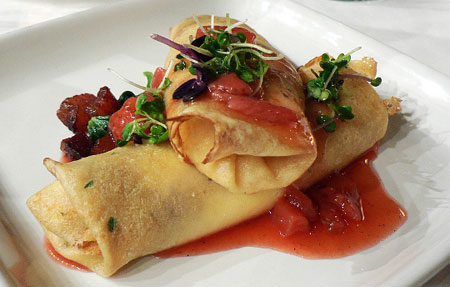
The wonderful wafer-thin French pancakes called crepes fill a niche in contemporary dining. Made with light sauces and fillings, they suit today's passion for healthy fare.
The word crêpe refers both to the individual pancake and the filled creation. Fast to assemble and ballooning with a voluptuous variety of savory fillings - fresh vegetables and herbs, seafood, poultry, and meat crêpes can serve as appetizers, first courses, and entrées. Filled with seasonal fruit, souffles, sauces, sorbets, or ice cream, they become sumptuous desserts.
Turning out a batch of the aromatic butter-browned pancakes is a rewarding endeavor. Assembling them is swift and can often he done ahead. With a stack of these tender discs on hand, you will have myriad serving possibilities for a happy repast any time of day.
Crêpes are ideal to make in advance and refrigerate or freeze, to fill later for a party or informal gathering. They are easy, dramatic, and fun to serve. One option is to stage a kitchen party and let guests spoon on their own fillings.
Crêpes may be made with either plain or sweetened batters. Incorporating different flours into the batter varies the taste. Savory batter can be based on whole-wheat flour or a variety of specialty flours, such as blue cornmeal, buckwheat, garbanzo, or chestnut, all available in bulk in many natural food stores or gourmet markets. Fresh herbs can be used to color and flavor savory crepes. Sweet crepes are enhanced by adding flavorings such as liqueurs, extracts, or fruit zest.
Crêpes star when it comes to versatility. Their fillings can be complex and sophisticated or as simple as a dollop of herb butter, a dice of chilies, or crumbled sheep or goat cheese. Or, for sweet bitefuls, tuck in some grated bittersweet chocolate or white or dark chocolate chips, spread with jam and sprinkle with powdered sugar, or sprinkle with sugar and splash with lemon juice.
Crêpes may be filled and folded in various shapes for a decorative presentation. Ideal to serve around the clock-for morning brunch; an elegant lunch; a midday snack; or a dinner entree, accompaniment, or sweet finale-crêpes are the good cook's best ally. May these recipes bring pleasure to your table.
History
Savored for centuries, crêpes are celebrating a revival today, with crêperies opening throughout France, America, and elsewhere in the world.
The word crêpe is French for pancake, from the Latin crispus, meaning crisp. In France, crêpes were originally called galettes crêpes, meaning flat cakes. The French pronunciation of the word is with a short e, as in bed. Crêpes originated in Brittany, the northwest region of France, where they rarely had fillings and were used as bread. Until about one hundred years ago, all crepes were made of buckwheat flour.
Today, creperies that specialize in serving sweet and savory crepes are found throughout France. The savory pancakes, served as a main course, are usually made of buckwheat flour and called galettes, or galettes sarrasines, while dessert crêpes are made with wheat flour.
Until recently, crêpes were cooked on large cast-iron hot plates heated over a wood fire in a fireplace. The hot plates are now gas or electric heated, and the batter is spread with a wooden spreader and flipped with a wooden spatula.
In France, crepes are traditionally offered on Candlemas and Shrove Tuesday to celebrate renewal, family life, and hope for good fortune and happiness ahead. It is customary to touch the handle of the frying pan and make a wish while the pancake is turned, holding a coin in the hand. In earlier times, in French rural society, farmers offered crêpes to their landowners as a symbol of allegiance.
Crêpes are popular not only throughout France, but elsewhere in Europe, where the pancakes go by other names and adaptations, including Italian crespelle, Hungarian palacsintas, Jewish blintzes, Scandinavian plattars, Russian blini, and Greek kreps.
Crêpes - The Basic Recipe
Makes sixteen to eighteen 6- or 7-inch crêpes, or ten to twelve 9- or 10-inch crêpes.
Also see Alton Brown's recipe for crêpes.
2 large eggs
1 cup milk
1/3 cup water
1 cup all-purpose flour, preferably bleached
2 tablespoons butter, melted, plus 2 or 3 teaspoons butter for coating the pan
In a blender or food processor, blend the eggs, milk, water, flour, salt, and the 2 tablespoons melted butter for 5 seconds, or until smooth. Stir down and repeat if necessary. Or, to mix by hand, sift the flour into a medium bowl and add the salt. Whisk the eggs until blended, mix in the milk and water, and whisk this mixture into the flour and salt; stir in the 2 tablespoons melted butter. Crêpe batter should be about as thick as heavy cream. If it is too thick, thin it with a little water. If it is too thin, additional flour can be added. Different flours have different thickening properties, and moisture in the flour can vary the amount of liquid needed.
Cover and refrigerate for at least 1 hour (though 2 hours is preferable) or up to 24 hours. For the tenderest crêpes, let the batter sit for 2 hours before cooking. The resting time allows the flour to absorb the liquid and the foam to dissipate. Cover and refrigerate the batter if it is to sit for longer than 1 hour.
Cooking the Crêpes
Gently stir the batter if it has separated. Premeasure the batter for each crêpe by either using a ladle or a small 1/4-cup measure for puring. Plan to use 2 or 3 tablespoons of batter for the 6- or 7-inch crêpes and about 1/4-cup for 9- to 10-inch crêpes. Heat the pan over medium-high heat and, once it is hot, coat it with butter or oil. Lift the pan off the heat as you pour the batter into the pan, and simultaneously tilt the pan in all directions so that the batter quickly covers the surface of the pan. If the first crêpe has a hole or two on its surface, quickly add a few more drops of batter to fill them in. Cook until almost dry on top and lightly browned on the edges, about 1 minute.
When the crêpe is almost dry on the top and golden brown on the edges (after about 1 minute), it is time to turn it. Use a small spatula to loosen the edge of the crêpe, then turn it over with the spatula or your fingers. Cook the crêpe on the second side, about 15 seconds longer, or until it is lightly browned underneath. Loosen the edges with a metal spatula and flip the crêpe over using your fingers or the spatula, then cook the other side for about 15 seconds, or until lightly browned. Once cooked, invert the crêpe onto a plate or pie pan.
After cooking the first crêpe, adjust the heat as necessary. Stir the batter between pourings. Repeat with the remaining batter, wiping the pan with butter as needed and stacking the crêpes as they are cooked.
For serving immediately, cover the crêpes with aluminum foil and keep them warm in a preheated 200°F oven. For serving later, wrap them in plastic wrap in quantities intended for each use and slip them in a self-sealing plastic bag. Refrigerate crêpes for up to 3 days, or freeze them for up to 2 months.
Fillings for Crêpes
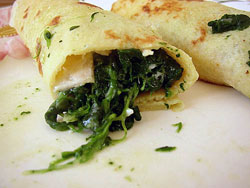
One of the best things about crêpes is how versatile they are. Fillings can be sweet or savory, light or filling, vegetarian or with meat. For a brunch or dinner party, we like to set up a station with lots of different fillings and let guests help themselves to what looks good. Here are some of our favorites:
Sweet: Fresh cut fruit, cooked fruit or fruit puree, jams and jellies, whipped cream, sour cream, ricotta, cream cheese, goat cheese, nutella, peanut butter, maple syrup, dulce de leche, and honey.
Savory: Cooked mushrooms, sautéed veggies, roasted red peppers, pickled vegetables, salad greens and sprouts, cooked beans, pulled pork or beef, seafood ceviche, crab or tuna salad, shredded lettuce or cabbage, whole grain mustard, goat cheese, sour cream, blue cheese, and feta cheese.
Finishing Touches
Fold crêpes anyway you like: in half, in quarters (in half, then half again), rolled up, or like a burrito.
If desired, you can fill and wrap your crêpes and then put them under the broiler for a minute or two. This crisps up the crêpe and gets the filling nice and bubbly.
You can also top the rolled sweet crêpes with ice cream, sweetened whipped cream, a sprinkling of powdered sugar, or a dusting of cinnamon; savory crêpes with melted cheese, a savory sauce, or course-grained salt.
Savory Crêpes
For savory crêpes add 1/4 teaspoon salt to the batter above. Here are some other batter options.
- Herb Crêpes: Follow the savory crêpe recipe and add 1/4 cup minced fresh chives, basil, or flat-leaf parsley to the batter while blending it. Or, for pale green mixed-herb crêpes, use 1/2 cup mixed minced fresh chives, green onion tops, flat-leaf parsley, tarragon, marjoram, and basil.
- Sun-Dried Tomato Crêpes: Follow the savory crêpe recipe and add 1/4 cup minced oil-packed sun-dried tomatoes to the batter while blending it.
- Blue Cornmeal Crêpes: Follow the savory crêpe recipe, but replace the 1 cup all-purpose flour with 2/3 cup all-purpose flour and 2/3 cup blue cornmeal.
- Buckwheat Galettes: Follow the savory crêpe recipe, but replace the 1 cup all-purpose flour with 2/3 cup all-purpose flour and 2/3 cup buckwheat flour.
- Corn Flour Crêpes: Follow the savory crêpe recipe, but replace the 1 cup all-purpose flour with 2/3 cup all-purpose flour and 2/3 clip corn flour (which is more finely, ground than cornmeal).
- Cornstarch Crêpes: Follow the savory crepe recipe, but replace the 1 cup all-purpose flour with 1 cup cornstarch and add 1/8 teaspoon baking soda.
- Garbanzo Flour Crêpes: Follow the savory crêpe recipe, but replace the 1 cup all-purpose flour with 2/3 cup all-purpose flour and 2/3 cup garbanzo flour.
- Chestnut-Garbanzo Flour Crêpes: Follow the savory crêpe recipe, but replace the 1 cup all-purpose flour with 2/3 cup garbanzo flour and 1/2 cup chestnut flour.
- Whole-Wheat Crêpes: Follow the savory crepe recipe, but replace the 1 cup all-purpose flour with 1 cup whole-wheat flour or 1 cup wholewheat pastry flour, or 1/2 cup all-purpose flour and 1/2 cup whole-wheat flour.
- Chestnut Flour Crêpes: Follow the savory crêpe recipe, but replace the 1 cup all-purpose flour with 2/3 cup all-purpose flour and 1/2 cup chestnut flour.
Sweet Crêpes
Recipes with Cheese (good for breakfast):
Crêpes w/ Berries & Ricotta
Cherry-Cheese Blintzes (blintzes are similar to crêpes)
Sweet Cheese Blintzes w/ Apple Butter (blintzes are similar to crêpes)
Recipes for Dessert Crepes:
Caramel Apple Crêpes (with pecans, good in the fall)
Crepes w/ Mascarpone & Cherries (fresh cherries & mini chocolate chips)
Chocolate-Mascarpone Crepes w/ Strawberry Sauce (crepe batter is chocolate)
Crêpes Suzette (orange sauce)
Cherries Jubilee served over crêpes
Darkest Chocolate Crêpe Cake (hazelnut filling)
You can vary the flavoring of sweet crêpes to suit the intended filling: rum with chocolate or nuts, Cointreau with orange or lemon, amaretto with almonds, Frangelico with hazelnuts, framboise with raspberries or strawberries, Cognac or brandy with stone fruits such as peaches or nectarines, and Calvados with apples.
Add these ingredients to the basic recipe for sweet crêpes:
2 tablespoons sugar
1 teaspoon vanilla extract
1 tablespoon rum, Cointreau, amaretto, brandy, or other liqueur (optional)
Or try one of these sweet crêpe batters:
- Espresso Crepes: Grind 2 tablespoons coffee beans to a fine powder and add to the dessert crepe batter when blending it.
- Chestnut Flour Dessert Crepes: Follow the dessert crepe recipe, but replace the 1 cup all-purpose flour with 2/3 cup all-purpose flour and 1/2 cup chestnut flour.
- Chocolate Crepes: Follow the dessert crêpe recipe, but replace the 1 cup all-purpose flour with 3/4 cup all-purpose flour and 1/3 cup unsweetened cocoa. Replace the 2 tablespoons sugar with 1/4 cup sifted powdered sugar.
