Types of Clams
Equivalencies of the Different Sized Quahogs
Little Neck: The smallest size of clam, amounting to 7-10 clams per pound. Great raw on the half shell or steamed.
Top Neck: These are sometimes also labeled as count neck clams, and they equal roughly 4 clams per pound.
Cherrystone: They equal roughly 3 - 5 clams per pound.
Quahog: These big guys are also called chowder clams and weigh in at a mighty 2-3 clams per pound.
5-8 pounds clams in the shell provide 1 pound of meat or 2 pounds chopped clams with liquid
1 dozen quahog clams = 2 dozen topneck clams = 4 dozen littleneck clams = 1/2 cup without juice
10 oz. canned baby clams = 12 fresh clams
6 1/2 oz. canned minced clams = 7 1/2 fresh clams = 1/2 cup drained + 1/2 cup juice
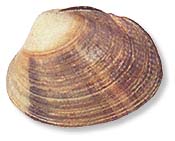
East Coast Quahog
Quahog (Mercenaria mercenaria)
The hard-shelled clam called the quahog is the largest eastern type of clam, ranging from about 1 1/2" to 6" across. Quahogs are quite common throughout New England, north into Canada, and all down the Eastern seaboard of the United States to Florida, but are particularly abundant between Cape Cod and New Jersey where seeding and harvesting them is an important commercial form of aquaculture; for example, the species is an important member of the suspension-feeding, benthic fauna of the lower Chesapeake Bay, while Rhode Island, situated right in the middle of "quahog country," has supplied a quarter of the U.S.'s total annual commercial quahog catch. The quahog is the official shellfish of the U.S. state of Rhode Island. The species has also been introduced and is farmed on the Pacific coast of North America and in Great Britain and continental Europe. It reproduces sexually by females and males shedding gametes into the water.
The clams called cherrystones, topnecks and littlenecks are not different species, but just smaller-sized quahogs: Cherrystones measure 3 to 3 1/2" across, topnecks 2 to 3", littlenecks about 1 to 2" (there is also a West Coast clam called a littleneck, though it's a different species). Full-sized quahogs, 3+", are sometimes called chowder clams, as they can be tough and are best cut up and cooked.
Littlenecks and Topnecks:
The smallest and most tender of the hardshells, averaging about 10 to 12 clams per pound, littlenecks are frequently steamed (called steamers) or served raw on the half shell or, for example, in Clams Casino. In coastal areas of New England, New York, and New Jersey, restaurants known as raw bars or clam bars specialize in serving littlenecks and topnecks raw on an opened half-shell, usually with a cocktail sauce with horseradish, and often with lemon. Sometimes, littlenecks are steamed and dipped in butter, though not as commonly as their soft-shelled clam cousin, the "steamer." Littlenecks are often found in-the-shell in sauces, soups, stews, clams casino or substituted for European varieties such as the cockle in southern European seafood dishes. The name "little neck" comes from Little Neck Bay Long Island.
Raw on the Half Shell (serve with Cocktail Sauce)
*Steamers (Steamed Baby Clams - dip in lemon butter)
Clams Casino (baked whole in shell w/ bell pepper & breadcrumb topping)
*Linguine & Clam Sauce (served in shell w/ pasta)
*Clams d'Angelo (served in shell w/ pasta)
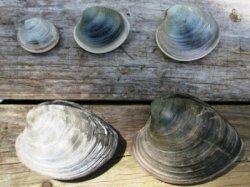
From top left to bottom right:
Littleneck, Topneck, Cherrystone
two Quahog (Chowder clams)
Cherrystones:
Named after Cherrystone Creek on Virginia's Eastern Shore, are larger than littlenecks and topnecks (average 3 to 5 clams per pound) and their meat is tougher. Given their size, they are best used in recipes where the clam is chopped up. Cherrystones are the perfect size for stuffing.
Stuffed Clams (chopped clams mixed with bacon, onion & breadcrumbs, baked in the clam shell)
New England Clam Puffs (chopped clams mixed into a batter and dropped by tablespoons in hot oil and fried)
*New England Clam Chowder
Manhattan Clam Chowder
Quahogs or Chowder Clams:
The largest clams, measuring 3 or more inches in diameter, are the quahogs or chowder clams, which have the toughest meat, and are used in such dishes as clam chowder (see New England Clam Chowder), clam cakes, fritters, clam pies, stuffed clams, or are minced and mixed into dishes that use the smaller, more tender clams.
*New England Clam Chowder
Manhattan Clam Chowder
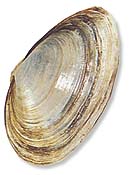
Steamer or Ipswich Clam
Soft Shell Steamer (Ipswich Clam) (Mya arenaria)
Another type of eastern clam is the soft-shelled steamer, which has a long siphon that projects from its thin, brittle shell (thus, the name "soft-shells"). As the name suggests, this type of clam, about 2" long, is usually steamed, but it can also be shucked and then sauteed or deep-fried. In New England, Fried Clams are popular at seaside clam shacks, both as an entrée and as a sandwich. Soft-shell clams, scientific name Mya arenaria, are also popularly called "steamers", "softshells", "longnecks", "piss clams", "Ipswich clams", or "Essex clams".
These clams live buried in the mud on tidal mudflats. They are well-known as a food item on the coast of New England in the Western Atlantic Ocean, however the range extends much farther north to Canada and south to the Southern states. They are also found in the Eastern Atlantic Ocean, for example in the UK, as well as in the North Sea's Wadden Sea (where they are the dominant large clam).
Soft-shell clams can be eaten steamed, fried, or in clam chowder (see New England Clam Chowder). "Steamers" (steamed soft-shell clams) are an integral part of the New England clam bake, where they are served steamed whole in the shell, then pulled from the shell at the table and dipped, first in the clam broth in which they were cooked, to rinse away any sand, and then in melted butter. If serving the clams in a dish, such fried clams, slip off and discard the black sheath surrounding the siphon (the small "neck").
*Steamers (Steamed Baby Clams - dip in lemon butter)
New England Fried Clams & Clam Roll
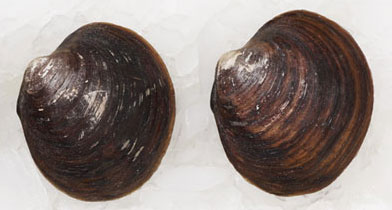
Mahogany clams (Arctica islandica)
Native to the North Atlantic ocean, are a terrific alternative to the ever-popular quahog (Mercenaria mercenaria). Mahogany clam (aka ocean quahog, golden neck, black clam) possess a flavor composition which is similar to that of the quahog, only slightly stronger; and a substantially higher salinity.
Mahoganies 10-13 count (per pound) work well in any pasta dish, especially those that are driven by rich, flavorful, bases. The exaggerated flavors inherent to the mahoganies will complement (rather than get lost in) more robust dishes. Unlike the quahog, which lives intertidally and can be collected by clam digging, this species lives subtidally, and can only be collected by dredging. They grow to sizes exceeding 50 mm shell height.
Surf clam
Also called a sea clam, skimmer clam, or chowder clam, the surf clam is the most common eastern species. Large and comparatively tough, it is commonly cut up and used in recipes; most surf clams are canned.
Shopping
Clams that are sold live offer specific signals of freshness: They should be tightly closed (so that you can't pull them apart), or should close tightly when the shell is tapped; don't buy clams with open or cracked shells. Clams that seem especially heavy for their size should be avoided as they may be full of sand. The protruding necks of soft-shell clams should retract when you touch them.
Freshly shucked clams should smell perfectly fresh, with no trace of ammonia or a "fishy" smell.
While yield depends upon the type and size of the clams (they vary pretty widely) and the season, a pound of live hard clams will yield about 4 ounces of meat, while a pound of live softshells will give about 6 to 8 ounces of meat.
Storing:
Possibly the most perishable of all foodstuffs, clams are highly susceptible to bacterial contamination and growth once they die or get too warm. Therefore, when you buy live clams, it is imperative to keep them cold until you are ready to cook and serve them.
Store live clams in the refrigerator, covered with wet kitchen towels or paper towels. Don't put them in an airtight container or submerge them in fresh water, or they will die. The key is to keep them truly cold: if possible, at 32°F to 35°F. Within that range, clams should keep (in a live state) for about four to seven days. Be sure to remove any that die (look for open shells) during that period so they do not contaminate the remaining clams. Shucked clams should be kept in tightly covered containers, immersed in their liquor; they, too, should keep for up to a week.
How To De-Grit Clams and other Bivalves (mussels, cockles, oysters)
Nothing ruins a bowl of clams, mussels, cockles or oysters like a broth full of grit. Keep sand where it belongs—between your toes, on vacation—by cleaning and purging shellfish properly.
There are various articles on the Internet that suggest ways to do this. In the US, popular methods include the use of cornmeal to get the sand out of clams. Clams purge the sand and grit out by ingesting the cornmeal. In Japan, the most common method is by using simple saltwater. This should only be done immediately before eating the bivalve, as the fresh water will dilute the flavor and eventually kill the bivalve.
Live clams should be refrigerated and cooked within 48 hours of purchase.
Basic Recipe:
clams, or other bivalve
1/2 Tbsp kosher/sea salt (use half for table salt) (You need to make 3-4% salt water)
1 cup water
- Discard any clams that remain open when tapped with fingers.
- Rinse the clams under cold water and scrub them if need be to remove any sand on the shells.
- Measure the amount of water you will need to cover the clams
- To make saltwater, combine 1/2 Tbsp salt for every 1 cup of water needed in a large bowl and mix well until salt is completely dissolved.
- Add the clams. The water should cover them. Refrigerate for 1 - 2 hours. This should give the clams enough time to purge sand and grit.
- Just before cooking, lift the shellfish out of the water by hand, so that the sediment remains at the bottom of the pot. (If mussels are being cooked, they sometimes have small, fibrous “beards,” which should be pinched off.)
- Some cooks place the clams in clean cold water for about 15 minutes to clear the clams of some of the salt.
- The clams are now ready for cooking.
Once cooked, carefully pour the delicious liquid off; any sand released during cooking will fall to the bottom of the cooking liquid, where it should stay.
