Lobster Newburg
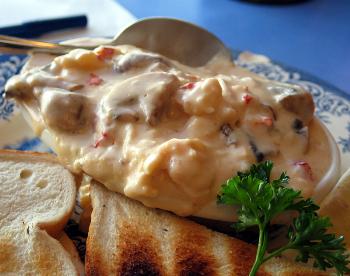
Lobster Newberg is an American seafood dish (often thought to be French) made from lobster, butter, cream, cognac, sherry, eggs and Cayenne pepper. The dish was invented by Ben Wenberg, a sea captain in the fruit trade. He demonstrated the dish at Delmonico's Restaurant in New York City to the manager, Charles Delmonico, in 1876. After refinements by the chef, Charles Ranhofer, the creation was added to the restaurant's menu as Lobster á la Wenberg and it soon became very popular.
An argument between Wenberg and Charles Delmonico caused the dish to be removed from the menu. To satisfy patrons' continued requests for it, the name was rendered in anagram Lobster á la Newberg or Lobster Newberg. When Chef Ranhofer's printed recipe first appeared in 1894 (see recipe below), the lobsters were boiled fully twenty-five minutes, then fried in clarified butter, then simmered in cream while it reduced by half, then brought again to the boil after the addition of the Madeira. Cognac and sherry have replaced the original Madeira, which is too sweet for the modern taste for "dryness".
You will come across this dish made with a variety of ingredients (the picture above includes mushrooms) and by a variety of methods. The following recipe has now become something of a classic.
Instead of serving in a dish or in the tails of the lobster, the lobster and sauce can be spooned over toast points or puff pastry shells. Keep the claw meat whole and serve on top for presentation.
Lobster à la Newberg or Delmonico (Homard à la Newberg ou à la Delmonico)
"Cook six lobsters each weighing about two pounds in boiling salted water for twenty-five minutes. Twelve pounds of live lobster when cooked yields from two to two and a half pounds of meat and three to four ounces of lobster coral. When cold detach the bodies from the tails and cut the latter into slices, put them into a sautoir, each piece lying flat and add hot clarified butter; season with salt and fry lightly on both sides without coloring; moisten to their height with good raw cream; reduce quickly to half and then add two or three spoonfuls of Madeira wine; boil the liquid once more only, then remove and thicken with a thickening of egg-yolks and raw cream (No. 175). Cook without boiling, incorporating a little cayenne and butter; warm it up again without boiling, tossing the lobster lightly, then arrange the pieces in a vegetable dish and pour the sauce over."
-- Charles Ranhofer. The Epicurean. New York: Charles Ranhofer, Publisher, 1894. Page 410, Recipe 1037.
Lobster Newburg
Chef Angus, Grand Rapids Community College
FMM: When we made this we found it needed a little more depth of flavor. We added some paprika, which worked great and gave it a color in align with lobster. We found we needed to add more butter and flour mixture to thicken it. You need just enough thickener so it it is like a gravy - not gloppy, but so it stays on the pastry shells.
2 1-3/4lb live lobsters
Coral and liquid from the lobsters
3 qts Court-Bouillon (see recipe below)
1 cup reduced fish or lobster stock
1 cup heavy cream
6 tbsp olive oil
5 tbsp brandy or cognac
5 tbsp dry sherry
2 tbsp butter
2 tbsp all purpose flour
To taste, salt and white pepper
Clean the lobsters. Heat the court-bouillon to a rolling boil in a large pot. Place one lobster headfirst into the pan and remove after 3 minutes. Repeat with the second lobster, once the water has come back to a rolling boil.
Using a heavy, sharp knife cut each lobster into fairly large pieces. Discard the intestinal vein and reserve the corals and the liquid produced.
Heat the olive oil in a pan. Quickly fry the lobster in their shells, turning continuously, and season. Pour off the oil. Add the brandy and sherry and reduce by two-thirds. Remove the pan from the heat and stir in the cream and reduced fish stock. Cover the pan and simmer, over a low heat, for about 15 minutes.
Remove the lobster from the pan. Remove the meat from the shells and place it in a serving dish. Keep hot. Mix the butter, corals, lobster liquid and flour to a smooth paste. Whisk this into the sauce, a little at a time, and simmer for at least 10 minutes. Reduce further, if necessary, until creamy. Then strain it over the lobster.
Instead of the mixture of butter, coral, liquid and flour, other recipes mix Béchamel sauce and egg yolk into the Newburg sauce. This gives a good consistency, but cannot compare with the flavor given by the coral and lobster liquid.
Court-Bouillon
3 cups Water
1 Carrot
1 Onion
1 sm Stalk of Celery
1 sm Bay Leaf
3 sprigs Fresh Coriander
1 sprig Thyme
To taste Salt and White Pepper
To make the court-bouillon, first bring the water and white wine to a boil in a pot. Trim and chop the carrot, onion and celery. Add to the pan with the coriander, thyme and bay leaf. Season generously with pepper and less so with salt. Simmer for 15 minutes and then bring to a rolling boil.
