History of Bread
Unlike chocolate chip cookies or tomato soup, the invention of bread can't be pinned down to a single person or people; instead, it evolved to its present state over the course of millennia. Although the modern version of sliced bread is a fairly new invention (Wonder Bread began marketing the first sliced loaf of bread in 1930), bread itself is an ancient food with origins dating back more than 22,000 years.
Early Agricultural-based Societies and Unleavened Bread
Bread was central to the formation of early human societies. From the Fertile Crescent, where wheat was domesticated, cultivation spread north and west, to Europe and North Africa, and east towards East Asia. This in turn led to the formation of towns, as opposed to the nomadic lifestyle, and gave rise to more and more sophisticated forms of societal organization. Similar developments occurred in pre-Columbian civilizations with maize and in Asia with rice.
In 2004, at an excavation site called Ohalo II, in what is modern-day Israel, scientists found 22,000-year-old barley grains caught in a grinding stone: the first evidence of humans processing wild cereal grains. But these early "bread" creations were probably more like "flat cakes of ground seeds and grains heated on a rock, or in the embers of a fire," than standard sandwich bread, Howard Miller, a food historian and professor at Lipscomb Universityin Nashville, Tennessee, told Live Science. [Why It Took So Long to Invent the Wheel]
Bread grains, the first plants to be domesticated, were first harvested in the wild by the Natufians. This Mesolithic group of hunter-gatherers lived in the Jordan River Valley region of the Middle East about 12,500 years ago. Natufians were hunters, which one could clearly tell from the bones of gazelles, sheep and hares that littered the cooking pit. But it turns out the Natufians were bakers, too --at a time well before scientists thought it was possible. As early as 1931, two archaeologists, Garrod and Neuville, drew attention to the presence of stone sickles in Natufian assemblages and the possibility that this represented a very early agriculture. "The Natufians are thought to be the first people to make the transition between survival purely on foods that you harvest from nature to becoming farmers who control all aspects of the food supply," William Rubel, a food historian and author of "Bread: A Global History" (Reaktion Books, 2011), told Live Science. "The Natufians had the infrastructure for grinding barley and then making it into bread."
"Finding bread in this Epipaleolithic site was the last thing we expected!" says Arranz-Otaegui. "We used to think that the first bread appeared during the Neolithic times, when people started to cultivate cereal, but it now seems they learned to make bread earlier."
The Natufians had the earliest known agricultural-based society and would process grains into a coarse flour, from which they made a "small, pita-like, unleavened loaf cooked directly on the coals of a fire," Miller said. Over the next several thousand years, agriculture and the cultivation of grains spread across the Middle East and southwest Asia through trade contacts with other hunter-gatherer peoples in the Nile Valley, Mesopotamia and east of the Indus Valley.
"Bread was the evolutionary spark that led to the development of state and large political units," Rubel said. "Bread allowed for the accumulation of surplus, and so the villages got bigger until you had actual cities."
The Bronze Age and Leavened Bread
More than 5,000 years after the Natufians began making flatbread, three civilizations were rapidly growing and expanding during the Bronze Age: the Egyptians, the Mesopotamians (in what is modern-day Iraq) and the Harappans (in the Indus Valley, in what is modern-day Pakistan). All three civilizations, considered the largest in the ancient world, depended on bread.
"Bread was the majority of their calories," Rubel said. "Bread allowed for the building of surpluses and developing of [social] classes. You didn't have a class of full-time artisans until you had bread."
It was around 4,000 BC that the Egyptians developed a variety of wheat that didn’t have to be scorched to remove the husk. This scorching had always destroyed the gluten that gives dough the ability to rise. The first sourdough had to have been made with unscorched grain. The microscopic yeast plant that made the bread rise was Saccharomyces cerevisiae, which is still with us--in fact it’s the same yeast that also makes beer and wine ferment. The sourness was caused by various bacteria called lactobacilli, which produce lactic and acetic acid. These acids give a slight appetizing tang to bread and improve its texture.
The first-known leavened bread made with semi-domesticated yeast dates back to around 1000 B.C. in Egypt, according to Miller. There is extensive evidence of breadmaking in Ancient Egypt in the form of artistic depictions, remains of structures and items used in bread making, and remains of the dough and bread itself. However, scholars debate the exact origin, as evidence suggests that Mesopotamians also produced yeast-risen bread, Rubel said.
In fact, the invention of leavened bread likely has boozy roots. Ancient Egyptians used barley and emmer wheat both to brew sour beer and to make sourdough bread, according to a 1994 study in the journal Egyptian Archeology. The ancient Egyptians could have made beer by baking "richly yeasted dough" into "beer loaves," then crumbling that bread and straining it with water, which would then ferment into beer, according to the book "Ancient Egyptian Materials and Technology" (Cambridge University Press, 2000). The sour bread of the Egyptians was called kyllastis.
It is generally assumed that the earliest forms of leavening were likely very similar to modern sourdough; the leavening action of yeast would have been discovered from its action on flatbread doughs and would have been either cultivated separately or transferred from batch to batch by means of previously mixed ("old") dough.
Gauls and Iberians - Beer Barm
The most common source of leavening in antiquity was to retain a piece of dough (with sugar and water in) from the previous day to utilize as a form of sourdough starter. Pliny the Elder reported that the Gauls and Iberians used the foam skimmed from beer (barm) to produce "a lighter kind of bread than other peoples." Parts of the ancient world that drank wine instead of beer used a paste composed of grape must and flour that was allowed to begin fermenting, or wheat bran steeped in wine, as a source for yeast.
Pliny the Elder described the sourdough method in his Natural History:
In Gaul and Spain, where they make a drink by steeping corn in the way that has been already described—they employ the foam which thickens upon the surface as a leaven: hence it is that the bread in those countries is lighter than that made else- where.” (Pliny the Elder, Historia Naturalis –Book XXVI-12);
“At the present day, however, the leaven is prepared from the meal that is used for making the bread. For this purpose, some of the meal is kneaded before adding the salt, and is then boiled to the consistency of porridge, and left till it begins to turn sour. In most cases, however, they do not warm it at all, but only make use of a little of the dough that has been kept from the day before.” (Pliny the Elder, Historia Naturalis – Book XVIII-26(11))
The barm method appears to be an ancient method developed by Gaelic peoples in the mists of time, and was quite different to that used in Europe, which is to leaven bread with a sourdough or leaven (the French call it 'levain'). When the Romans first conquered Gaul, modern day France, they were astonished by the light sweet bread made by the Celtic inhabitants. Barm bread survived with the Celtic peoples in Britain, Scotland and Éire, but was not common in Europe, being condemned during the 'Enlightenment' as 'unwholesome'. In England noblemen's bread, manchet was always made with the barm method, whereas the commoners' bread maslin was a sourdough.
Without an understanding of microbiology, early bakers would have had little ability to directly control yeast cultures but still kept locally interesting cultures by reusing doughs and starters to leaven later batches. However, it became possible to isolate and propagate favored yeast strains in the same manner as was done in the beer industry, and it eventually became practical to propagate yeast in a slurry with a composition similar to beer wort, usually including malted barley and wheat flour. Such cultures (sometimes referred to in old American cookery as "emptins", from their origins as the dregs of beer or cider fermentation) became the ancestors of modern baker's yeast, as, in general, they were carefully maintained to avoid what was later discovered to be bacterial contamination, including using preservatives such as hops as well as boiling the growth medium.
Curiously, the old method of making a sponge, or thick batter of flour and water with the barm was still used with the new industrially produced yeast, and was re-introduced to Europe from Vienna where the first yeast factories were established. This became popular in France as a 'poolish', the favoured method of making crusty bread such as a baguette. It is interesting that the old method survived the invasions of Romans, Saxons and Normans. It couldn't be ignored really as it made the sweetest lightest bread in the right hands. As with all of these archaic breads, it was highly digestible and nutritious because the ferments were never pure strains like they are today, but included lactic bacteria which also gave the bread good flavour.
Ancient Greece and Rome
Even in antiquity there was a wide variety of breads. In ancient times the Greek bread was barley bread: Solon declared that wheaten bread might only be baked for feast days. The idea of a free-standing oven that could be pre-heated, with a door for access, appears to have been Greek.
By the 5th century BC bread could be purchased in Athens from a baker's shop, and in Rome, Greek bakers appeared in the 2nd century BC, as Hellenized Asia Minor was added to Roman dominion as the province of Asia; the foreign bakers of bread were permitted to form a collegium. In the Deipnosophistae, the author Athenaeus (c.A.D.170 – c. 230) describes some of the bread, cakes, and pastries available in the Classical world. Among the breads mentioned are griddle cakes, honey-and-oil bread, mushroom-shaped loaves covered in poppy seeds, and the military specialty of rolls baked on a spit.
The type and quality of flours used to produce bread could also vary, as noted by Diphilus when he declared "bread made of wheat, as compared with that made of barley, is more nourishing, more digestible, and in every way superior." In order of merit, the bread made from refined [thoroughly sieved] flour comes first, after that bread from ordinary wheat, and then the unbolted, made of flour that has not been sifted." The essentiality of bread in the diet was reflected in the name for the rest of the meal: ópson, "condiment", i.e. bread's accompaniment, whatever it might be.
Sourdough remained the usual form of leavening down into the European Middle Ages until being replaced by barm from the beer brewing process, and after 1871 by purpose-cultured yeast.
18th and 19th Century
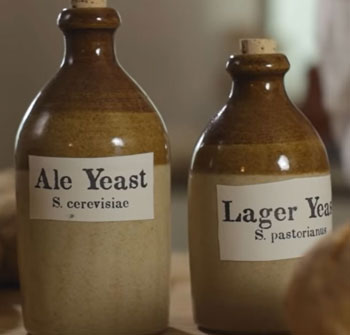
The word leaven, at least in the 18th century, means a lump of old dough. After the initial batch of bread dough is yeasted, we save back a piece of this dough for our next batch, whether it’s the next day or the next week, and as this process continues, each time we make the dough, we save some back for the next batch, and it turns into what we call sourdough.
We know from archeological evidence that yeast has been used for thousands of years for brewing beer and baking bread. By the mid 1700’s, two strains of yeast had been domesticated, ale yeast, used for brewing beer and baking bread, and lager yeast, which the Germans had developed for brewing beer at cooler temperatures for longer periods of time. There is also wild yeast. Wild yeast exists everywhere, in the air, on your skin, even on the grains of wheat themselves.
Now we have to remember that in the 18th century, no one fully understood what yeast was and how it worked. It wasn’t until the mid-1800’s that yeast was proven to be a living organism. Now the difference in taste between bread made with barm and that made with leaven has a lot more to do with bacteria than it does with the yeast that’s involved. Bacteria lives along with yeast inside of every ball of dough. It converts sugars in the dough into lactic acid, so if you let your dough ferment long enough, it doesn’t matter whether you start with a wild yeast culture or a barm, your dough will begin to sour. It’ll begin to take on those characteristics of sourdough bread and even though your dough may not taste exactly the same as some regionally famous sourdough breads, it will be sourdough bread nonetheless.

Now, there were many reasons to use this old dough or leaven. The first one was flavor. It gave a much richer and sharper flavor to the bread, but there were other reasons as well. When barm was in short supply, leaven was used to replace it. In France, Great Britain, and America, because of the importance of ale in the 18th century diet, virtually everyone had access to ale yeast or barm, but there were circumstances when the supplies were very limited. Finally, another reason to use leaven was to preserve yeast from one session to the next. Frequent use of a wood fired oven was impractical and inefficient for the home baker so there needed to be a way to preserve yeast from one baking session to the next.
Many 18th century bread recipes call for the use of barm, which is that soupy yeast mixture that is skimmed off the top of a fresh batch of ale. For the British palate, barm was the preferred form of yeast, because they like the lighter sweeter bread. In fact, there were laws passed that prevented professional bakers from recycling or reusing their old dough, which resulted in a much sharper flavor. In contrast to the British, up until 1670, the French outlawed the use of barm yeast in making bread in favor of the much more flavorful and acidic old dough or leaven method.
By the late 18th century, ale yeast had been further refined by the Dutch for commercial sale, specifically to bakers. Now, while modern commercial baking yeasts have been cultivated into various strains, they still remain the same species of ale yeast.
In the 19th century, bread bakers obtained their yeast from beer brewers, and this led to sweet-fermented breads such as the Imperial "Kaiser-Semmel" roll, which in general lacked the sourness created by the acidification typical of Lactobacillus. However, beer brewers slowly switched from top-fermenting to bottom-fermenting yeast (Saccharomyces pastorianus) and this created a shortage of yeast for making bread, so the Vienna Process was developed in 1846. While the innovation is often popularly credited for using steam in baking ovens, leading to a different crust characteristic, it is notable for including procedures for high milling of grains (see Vienna grits), cracking them incrementally instead of mashing them with one pass; as well as better processes for growing and harvesting top-fermenting yeasts, known as press-yeast.
Besides brewer`s yeast, homemakers in the 19th Century used specially brewed ferments to make yeast. The basis for most of these ferments was a mash of grain, flour or boiled potatoes. Hops were often included to prevent sourness.
During the 19th Century, Austrian chemists developed a system for mass-producing yeast. The yeast was sown in vats containing fermenting brew. When it rose to the top, the yeast was removed and washed, and some of the water was removed by pressure. It was then formed into ready-to-use cakes.
When Charles Fleischmann perfected compressed yeast in 1868, there were obvious benefits. You didn’t have to keep a sourdough (or beer) culture alive. Soon scientists were able to isolate single cells and develop pure yeast cultures that produced more reliable results than sourdough. Yeast researchers also specialized in developing vigorous strains of yeast that raised bread in a fraction of the time.
Refinements in microbiology following the work of Louis Pasteur led to more advanced methods of culturing pure strains. In 1879, Great Britain introduced specialized growing vats for the production of S. cerevisiae, and in the United States around the turn of the century centrifuges were used for concentrating the yeast, making modern commercial yeast possible, and turning yeast production into a major industrial endeavor. The slurry yeast made by small bakers and grocery shops became cream yeast, a suspension of live yeast cells in growth medium, and then compressed yeast, the fresh cake yeast that became the standard leaven for bread bakers in much of the Westernized world during the early 20th century.
In 1834 the steel roller mill was invented, in Switzerland. This was revolutionary in the world of bread baking. Instead of crushing the grain, the roller system broke it open instead, thereby making it easier to separate the endosperm, germ and bran.
20th Century
During World War II, Fleischmann's developed a granulated active dry yeast for the United States armed forces, which did not require refrigeration and had a longer shelf-life and better temperature tolerance than fresh yeast; it is still the standard yeast for US military recipes. The company created yeast that would rise twice as fast, cutting down on baking time. Lesaffre later created instant yeast in 1973, which has gained considerable use and market share at the expense of both fresh and dry yeast in their various applications.
The addition of chemicals came into play in the 20th century. Bread became whiter, softer and lasted much longer. The flour was heavily processed but the government enforced the adding back of minerals and vitamins – the enrichment of the flour. However, in the 1970s US consumption fell. In the US it rose again in the1980s, partly in thanks to bakers going “back to their roots” and producing artisan, rustic, healthier breads without chemicals or additives.
