History of the Carrot
The carrot (Daucus carota) gets its name from the French word carotte, which in turn comes from the Latin carota. It has been known since ancient times and is believed to have originated in Afghanistan and adjacent areas. Our common carrot is called the Mediterranean type, because it has long been known in Mediterranean countries and was probably developed there from kinds carried from Asia Minor.
"Carrot. A root vegetable of the Umbelliferae family--and thus related to parsley, dill, and celery...although originally native to Afghanistan, is now found all over the world in many shapes, sizes, and colors."
---Cambridge World History of Food, Kennth F. Kiple & Kriemhild Conee Ornelas [Cambridge University Press:Cambridge] 2001, Volume Two (p. 1746)"The wild carrot, which grows in much of W. Asia and Europe, has a tiny and acrid tasting root. . . what is puzzling is that it seems to have taken a very long time for D. Carota var sativa, as the modern cultivated carrot is know, to appear. The puzzle is all the greater because archaeologists have found traces of carrot seed at prehistoric lake dwellings in Switzerland. Also, the plant is included in a list of vegetables grown in the royal garden of Babylon in the 8th century BC. Here there is a clue: the plant is not in the list of ordinary vegetables but in that or aromatic herbs. It was probably being grown for its leaves or seeds, both of which have a pleasant carrot fragrance. It seems likely that this had also been the purpose of carrot cultivation in classical times, for there is little or no evidence to suggest that the Greeks and Romans enjoyed eating the roots. Many writers state that the carrot in something like its modern form was brought westwards, at least as far as the Arab Afghanistan, where the very dark red, even purple, carrots of antiquity are still grown. The introduction is variously dated at the 8th or 10th century AD, ie the period of Arab expansion in to the Middle East and C. Asia. This fits well enough with the fact that the earliest surviving clear description of the carrot dates from the first half of the 12th century, and was by an Arab writer...The first sign of truly orange carrots is in Dutch paintings of the 17th century...Cultivated carrots of the European type were brought to the New World before 1565..."
---Oxford Companion to Food, Alan Davidson [Oxford University Press:Oxford] 1999 (p. 140)Carrots are said to have been recognised as one of the plants in the garden of the Babylonian King Marduk-apla-iddina, the Biblical Merodach-Baladan ll, who reigned at Babylon in 721–710 and 703 BC. There is no documentary evidence for this carrot reference. The clay tablet with cuneiform inscription is located in the British Museum. 67 plants are listed and appear in two columns, subdivided into groups, perhaps to represent plant beds. Only 26 plant names have been identified with certainty including leeks, onion garlic, lettuce, radish, cucumber, gherkin, cardamom, caraway, dill, thyme, oregano, fennel, coriander, cumin and fenugreek. Many remain to be identified. Carrot is currently not amongst those identified, though some of the above identified are umbellifers. The tablet also lists utensils and personnel in the garden. If the carrot was used it would probably have been placed amongst the aromatic herbs along with fennel, suggesting that the root was discounted, using only the pleasantly scented flowers and leaves in cooking.
---from http://www.carrotmuseum.co.uk/manuscripts.html
Overview of Wild Carrot and Cultivated Carrots
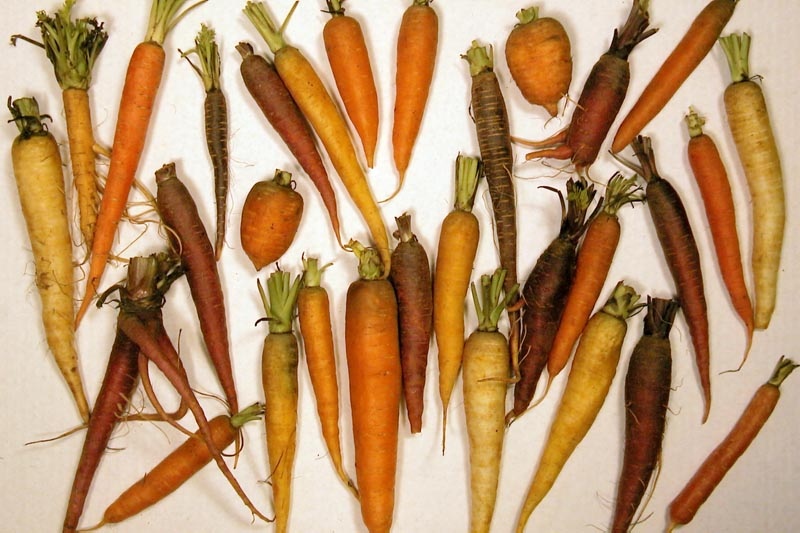
Both the wild and the cultivated carrots belong to the species Daucus carota. Wild carrot is distinguished by the name Daucus carota, Carota, whereas domesticated carrot belongs to Daucus carota, sativus.
The Carrot has a somewhat obscure history, surrounded by doubt and enigma and it is difficult to pin down when domestication took place. The wide distribution of Wild Carrot, the absence of carrot root remains in archaeological excavations and lack of documentary evidence do not enable us to determine precisely where and when carrot domestication was initiated.
Over thousands of years it moved from being a small, tough, bitter and spindly root to a fleshy, sweet, pigmented unbranched edible root. Even before the introduction of domesticated carrots, wild plants were grown in gardens as medicinal plants. Unravelling its progress through the ages is complex and inconclusive, but nevertheless a fascinating journey through time and the history of mankind.
Fossil pollen from the Eocene period (55 to 34 million years ago) has been identified as belonging to the Apiaceae (the carrot family). Wild Carrot is indigenous to Europe and parts of Asia and, from archaeological evidence, seeds have been found dating since Mesolithic times, approximately 10000 years ago. One cannot imagine that the root would have been used at that time, but the seeds are known to be medicinal and it is likely the seeds were merely gathered rather than actually cultivated.
The Wild Carrot is the progenitor (wild ancestor) of the domestic carrot. It is clear that the Wild Carrot and Domestic Carrot are not the same species and both co-exist in the modern world. It is a popular myth that domestic carrot was developed from Wild Carrot, probably because of its similar smell and taste. Botanists have failed to develop an edible vegetable from the wild root and when cultivation of garden carrots lapses a few generations, it reverts to another ancestral type, a species that is quite distinct.
Wild carrot has a small, tough pale fleshed bitter white root; modern domestic carrot has a swollen, juice sweet root, usually orange. Carrots originated in present day Afghanistan about 5000 years ago, probably originally as a purple or yellow root like those pictured here. Nature then took a hand and produced mutants and natural hybrids, crossing both with cultivated and wild varieties. It is considered that purple carrots were then taken westwards where it is thought yellow mutants and wild forms crossed to produce orange. Finally some motivated Dutch growers took these mutant orange carrots under their horticultural wings and developed them to be sweeter and more practical. It's a long story.
Difficulty in Tracing Carrot Through History
Throughout the Classical Period and the Middle Ages writers constantly confused carrots and parsnips. The plants were not confused on purpose, but since we have in many cases only the written word, if the Medieval writer referred to "pastinaca", for example, it is impossible to know if they were carrots or parsnips. Fuchs in 1542 described red and yellow garden carrots and wild carrots, but names them all Pastinaca (Meyer Trueblood and Heller 1999).
Gerard (1633) uses the English name carrot, but calls it Pastinaca in Latin: Pastinaca sativa var. tenuifolia, the yellow carrot and Pastinaca sativa atro-rubens, the red carrot. Gerard distinguishes parsnips from carrots and calling the parsnip Pastinaca latifolia sativa and P. latifolia sylvestris. Gerard notes the name similarity and is dissatisfied with it. He gives daucus as a name for carrot in Galen, but notes that many Roman writers called it pastinaca or other names, which had added to the confusion.
The Names. The herbarists of our time do call the garden Parsnips Pastinaca, and therefore we have surnamed it Latifolia, or broad-leaved, that it may differ from the other garden Parsnip with narrow leaves, which is truly and properly called Staphylinus, that is, the garden Carrot. Some physicians doubting, and not knowing to what herb of the ancients it should be referred, have feigned the wild kind hereof to be Panaci species, or a kind of All-Heal: divers have named it Baucia; others, Branca leonina, but if you diligently mark and confer it with Elaphoboscum of Dioscorides, you shall hardly find any difference at all: but the plant called at Montpellier Pabulum cervinum: in English, Hart's Fodder, supposed there to be the true Elaphoboscum, differeth much from the true notes thereof. Now Baucia, as Jacobus Manlius reporteth in Luminari maiore, is Dioscorides', and the old writers' Pastinaca, that is to say, Tenuifolia, or Carrot: but the old writers, and especially Dioscorides have called this wild Parsnip by the name of Elaphoboscum and we do call them Parsnips and Mypes.
~ Gerard's Herbal CHAP. 405. Of Parsnips.The Names. The plant which is termed in Latin by the name of Pastinaca latiori folii, or the Garden Parsnip, is described of the old writers by another name: this Carrot is called in Latin likewise, Pastinaca sativa, but with this addition tenuifolia, that it may differ from the garden Parsnip with broad leaves, and white roots. Theophrastus in the ninth book of his history of plants nameth this Staphylinus, or Carrot, Daukos, and writeth that it groweth in Arcadia, and saith that the best is found in Spartensi Achaia, but doubtless he meant that Daucus which we call cretensis, that may be numbered among the Carrots: Galen in his book Of the Faculties of Simple Medicines doth also make it to be Daucus, but yet not simply Daucus; for he addeth also Staphilinus or Pastinaca: in High Dutch it is called Geel ruben: in Low Dutch, Geel Peen, Geel Pooten and Geel Worten: in French, Carrotte, and Racine iaulne: in Italian, Pastinaca: in Spanish, Canahoria: in English, Yellow Carrots: the other is called Red Carrot, and Black Carrot.
~ Gerard's Herbal CHAP. 407. Of Carrots.
In 1753 Linnaeus published the "Species Plantarum," and established conventions for the naming of living organisms that became universally accepted in the scientific world, including Daucus Carota. When Linnaeus (1707-1778) created scientific names, he called carrots Daucus carota, parsnips Pastinaca sativa, so the two are clearly different. Before Linnaeus, however, Pastinaca sativa was used for both plants.
Overview of History of Carrots as Food
Classical Era
Temple drawings from Egypt in 2000 BC show a purple plant, which some Egyptologists believe could have been a purple carrot. However Egyptian papyruses containing information about treatments with seeds were found in pharaoh crypts but there is no direct or documentary reference to carrot. Carrots were said to be recognized as one of the plants in the garden of the Egyptian king Merodach-Baladan in the eighth century B.C, once again there is no documentary evidence for this either and many plants shown on the clay tablets held in the British Museum remain to be identified.
The Carrot was well known to the ancients, and is mentioned by Greek and Latin writers under various names, being, however, not always distinguished from the Parsnip and Skirret, closely allied to it. The Greeks had three words: Sisaron, first occurring in the writings of Epicharmus, a comic poet (500 B.C.); Staphylinos, used by Hippocrates (430 B.C.) and Elaphoboscum, used by Dioscorides (first century A.D.), whose description of the plant applies accurately to the modern Carrot.
Wild carrot is more in evidence than cultivated carrots in classical sources. They had edible leaves and thin, strong tasting white roots which were prescribed for medicinal purposes. The carrot was certainly cultivated in the Mediterranean area before the Christian Era, but it was not important as a food until much later. When they were first cultivated, carrots were grown for their aromatic leaves and seeds rather than their roots, much as wild carrot was used. Some close relatives of the carrot are still grown for their leaves and seeds, such as parsley, cilantro, coriander, fennel, anise, dill and cumin. An early form of carrot began to be cultivated in the last few centuries BCE.
Carrot (karo) was first mentioned in the 3rd century BCE by Diphilus of Siphnos.
“Then there is the carrot. ‘This vegetable,’ says Diphilus, ‘Is harsh, but tolerably nutritious, and moderately good for the stomach; but it passes quickly through the bowels and causes flatulence. It is indigestible, diuretic, and not without some influence in prompting men to amatory feelings, on which account it is called a love-philtre by some people.”
~ as quoted by Athenaeus, in Deipnosophistae [The Philosophers’ Dinner-party], 2nd century CE (Diphilus wrote a work entitled, On Diet fit for Persons in good and bad Health, which is frequently quoted by Athenaeus, but of which nothing remains but the short fragments preserved by him.)
The Roman-Greek writer Athenaeus records their health benefits in the text quoted above, including the ability to rouse sexual desire in men. Any aphrodisiac qualities attributed to carrots and parsnips by the Romans are likely due to their phallic shape. In ancient medicine, this was the plant’s “signature”, the physical resemblance between a plant and the part of the human body it could cure or affect. This belief continued well into the Medieval period, when for example walnuts were believed to be good for brain health because a walnut looks like a tiny, wrinkled brain.
During the first century A.D., the Greeks cultivated a variety of root crops that included leeks, onions, radishes, turnips, and a poorly developed variety of carrots in thier kitchen gardens. These varieties are thought to have been 'forked' with white roots, not unlike the roots of today's wild carrot. The unpleasant tasting carrots were rarely eaten but were applied medicinally. Galen, the 2nd century physician at the court of Marcus Aurelius, confirms that carota was cultivated when he wrote that the root of the wild carrot was less fit to be eaten than the cultivated variety. Though the Greeks excelled in cultivating many food plants, they never succeeded in developing the carrot into a flavourful vegetable.
Pliny the Elder (23-79) says:
“There is one kind of wild pastinaca which grows spontaneously; by the Greeks it is known as staphylinos. Another kind is grown either from the root transplanted or else from seed, the ground being dug to a very considerable depth for the purpose. It begins to be fit for eating at the end of the year, but it is still better at the end of two; even then, however, it preserves its strong pungent flavour, which it is found impossible to get rid of.“
In speaking of the medicinal virtue he adds “the cultivated form has the same as the wild kind, though the latter is more powerful, especially when grown in stony places.” Pliny called its root pasticana gallica, “food for Gauls.”
The name Carota, used for the garden Carrot, is found first in the writings of Athenaeus (A.D. 200), and in a book on cookery by Apicius Czclius (A.D. 230). The Romans often ate carrots raw, dressed in oil, salt and vinegar or they cooked them with a sauce made from cumin, salt, old wine and oil.
Apicius (1st century) - These recipes specifically include carrots. An important note here that carrots of the Roman time were NOT orange in colour. This colour wasn't developed until around the 15th-16th centuries. The correct colours for carrots in Roman times were white or purple.
- Caroetae Frictea: oenogaro inferuntur - which was fried carrots served with oenogarum*.
[*oenogarum is an ancient Roman sauce: ‘make an oenogarum for it like this: pound pepper and lovage, pound again, pour on liquamen and wine. Flavour with passum or with sweet wine. Blend it in a little pan; put in a little oil and bring it to heat; when it is simmering thicken it with starch’ ] - Aliter Caroetas: sale, oleo puro et aceto - Another method: (raw or cooked) with salt, pure oil and vinegar.
- Caroetas Elixatus: concisas in cuminato oleo modico coques et inferes. - Boil the carrots and chop. Cook in cumin sauce with a little oil and serve - for those who have colic.
- Carotae et Pastinacae (Carrots and Parsnips) - carrots and or parsnips fried in a white wine sauce. Presumably the vegetable(s) are fried first, and then served with the sauce. [I dont find this in Apicius cookbook, just the three above]
Carrot was mentioned by Greek and Latin writers by various names, but it was Galen (circa second century A.D.) the Greek physician (second century A.D.) who called it Daucus to distinguish the Carrot from the Parsnip. Carrot and parsnip have often been confused in historical references and in many cases were interchangeable, as those early carrots which were "dirty white" were very similar (in looks at least) to parsnip. They are of course from the same family. In classical and mediaeval writings both vegetables seem to have been sometimes called pastinaca yet each vegetable appears to be well under cultivation in Roman times. Since in many cases only the written word exists, if the Medieval writer called the plants "pastinaca", it is difficult to know if they were referring to carrots or parsnips. This confusion remained steadfast until botanist Linnaeus set the record straight in the 18th century with his system of plant classification. Daucus came to be the official name in the sixteenth century. Galen says this about the carrot:
Carrot, wild carrot and caraway The roots of these plants are eaten, but these provide less nutrition than turnips and less in fact than the taro from Cyrene. They are clearly heating and display a certain aromatic quality. As with other roots they are difficult to digest. They are diuretic and, if used excessively, supply an average amount of bad juice. Caraway root contains better juices than the carrot. Some people call the wild carrot daucus, since it is more diuretic, of greater medicinal value and in need of lengthy cooking, if it is intended to be eaten.
When forced through shortage of food, people often boil and eat pellitory, water parsnip, alexanders, fennel, wild chervil, chicory, gum succory, daucus gingidium, wild carrot, and the tender shoots of most bushes and trees; some of these are even eaten when there is no shortage of food, like the top of the date palm which is called the heart.
~ Claudius Galen of Pergamum (130-200?), Extract from Galen on Food and Diet.
There is a long gap of about 900 years between the writings of the Greeks and Romans of the first to third centuries and the next clear records about the carrot. A naturally occurring subspecies of the wild carrot was presumably bred selectively over the centuries to reduce bitterness, increase sweetness and minimise the woody core; this process produced the familiar garden vegetable.
Middle Ages
The Romans invading Britain in the second century AD brought leeks, onions, garden carrots, garlic, fennel, mint, thyme, parsley and coriander to name but a few. After the fall of Rome (395 AD - 476 AD), a period often referred to as the Dark Ages, carrots stopped being widely seen (or at least recorded) in Europe until the Arabs reintroduced them to Europe in the Middle Ages around 1100. Scribes continued to reproduce and embellish previous manuscripts, rather than observing and representing the existing native plants,
The early Middle Ages is a murky period in history for the study of vegetables, but a copy of the Codex of Dioskorides (Dioscorides) dating from 500 to 511 A.D. is illuminated with pictures of plants. The drawings are fairly accurate and convey the important physical characteristics of the vegetables and herbs shown. Thus it is possible to determine that a carrot shown in folio 312 resembles pretty accurately modern day carrot, and more importantly is the earliest depiction of an orange root! The Codex is medical in nature, dealing with the health and dietary aspects of the plants discussed.
This most famous herbal illustrates both cultivated and wild carrots. One illustration, the first clear depiction of an orange carrot, is labelled Staphylinos Keras (or cultivated carrot) and portrays a deeply orange straight root with rosette of leaves that looks very close to our modern carrot. Another, labelled Staphylinos Agrios (wild carrot, which appears to be a primitive type of cultivated carrot), shows a plant in flower with slenderer orange roots. A third, labelled Gingidion, shows a flowering plant with an extremely fine yellow root and has been identified as Daucus gingidium (wild carrot). Elaphoboscom (parsnip) is illustrated separately.
After the fall of Rome, gardens and vegetables are rarely mentioned again until 795 A.D., when King Charlemagne enacted a charter or capitulary entitled "Capitulare de villis vel curtis imperii" or "Capitulare de villis" (Of imperial lands and imperial courts), in chapter 70 of which appears a list of 90 plants and fruit trees recommended to cultivate in the gardens of the Frankish Empire, which covered western and central Europe. Carrots (carvitas) are found in the list of vegetables recommended for cultivation by Charlemagne. Note - Pastinacas (Parsnip) were also shown as a separate plant. Throughout the Dark Ages and early Middle Ages, carrots and parsnips were the main starchy vegetables for ordinary people in Europe, as they were easy to grow and store and a very welcome food to eat during the lean winter months.
Charlemagne's edict tells his subjects what he expects of them:
"We desire that they have in the garden all the herbs namely, the lily, roses, fenugreek, costmary, sage, rue, southernwood, cucumbers, pole beans, cumin, rosemary, caraway, chick pea, squill, iris, arum, anise, coloquinth, chicory, animi, laserwort, lettuce, black cumin, garden rocket, nasturtium, burdock, pennyroyal, alexander, parsley, celery, lovage, sabine tree, dill, fennel, endive, dittany, black mustard, savory, curly mint, water mint, horse mint, tansy, catnip, feverfew, poppy, beet sugar, marshmallows, high mallows, carrots, parsnips, oraches, amaranths, kohlrabis, cabbages, onions, chives, leeks, radishes, shallots, garlics, madder, artichokes or fulling thistles, big beans, field peas, coriander, chervil, capper spurge, clary."
(Citation: Helen Morganthau Fox, Gardening with Herbs for Flavor and Fragrance (New York: The Macmillan Company, 1933, reprinted Dover Publications, Inc., 1970), p. 45.)
Carrot consumption is traced to the hill people of Afghanistan (900 A.D.), who were sun-worshippers and believed that eating orange or yellow coloured foods instilled a sense of righteousness. People also ate yellow and purple conical tap root varieties of carrots in Pakistan.
The Arabs were great ones for writing about everything they were finding in, and bringing home from, invaded regions, including the fat, juicy carrots of Afghanistan. At this time Arab merchants traversing the trade routes of Africa, Arabia, and Asia brought seeds of this purple carrot back home with them. From their villages and cities along the coast of North Africa, Moors brought the carrot up into Spain and to the rest of Europe, probably from Afghanistan. Yellow and purple carrots are first recorded in Asia Minor and the Byzantine Empire (now Turkey) in the 10th century. This was a mutation which effectively removed the anthocyanins which gives the red/purple colour. By the time Ibn al-Awam was writing about carrots in the 12th century, from his home in Andalusia, he not only had several varieties available to him, he had older works to quote from.
In around 950, Ibn Sayyār al-Warrāq's produced a cookbook, the most comprehensive work of its kind. This traditional cookbook with more than 600 recipes using medieval ingredients and dishes from the luxurious cuisine of medieval Islam is also a rare guide to the contemporary culinary culture. He described the carrots used in his recipes thus:
Jazar - carrots. Of the cultivated varieties
1. Red Carrot (jazar ahmar) literally 'red', described as juicy, tender, and delicious. Poets compare it to carnelian, rubies, flames of fire, and coral reeds.
2. Yellow Carrot (jazar asfar), thicker and denser in texture than the red.
3. White Carrot (jazar abyad) similar to parsnips, aromatic, and deliciously sharp in taste. It is also described as having a pleasant crunch.
It is known that purple or red and yellow carrots were cultivated in Iran and Arabia in the 10th century and in Syria in the 11th. By the 12th century carrots were reported in Spain, followed by Italy in the 13th, France, Germany and Holland by the 14th century.
By the 13th century carrots were being grown in fields, orchards, gardens, and vineyards in Germany and France. At that time the plant was known also in China, where it was supposed to have come from Persia. The Spanish introduced the carrot on the island of Margarita, off the coast of Venezuela, in 1565.
English references occur in the 15th century. The word for Carrot appears in the Anglo-Saxon period in England (post Roman to 1066) e.g. The Concise Anglo-Saxon Dictionary, by John R. Clark Hall 1916 dictionary.
By the 16th century nearly all the botanists and writers on gardening, all over Europe, were familiar with the carrot and were describing many kinds, including red and purple kinds in France, yellow and red kinds in England. About 1600, in England, carrots were common enough to be grown as a farm crop as well as in small garden plots. Carrots were valued for their sugar content and sweet dishes like jams, syrups, and desserts, and became part of traditional English cookery during this medieval period.
North America, particularly the parts that would become the Thirteen Colonies, got its carrots somewhat later, after discovery of the New World with the arrival of the first English settlers in Virginia in 1607. It was grown by the struggling colonists of the first permanent English settlement in the New World, at Jamestown, Virginia, in 1609. Twenty years later the Pilgrims, or some of those who followed them closely, were growing it in Massachusetts. The Pilgrims themselves may have introduced it there. Before the middle of the 17th century it was known in Brazil.
Domestication & Root Color
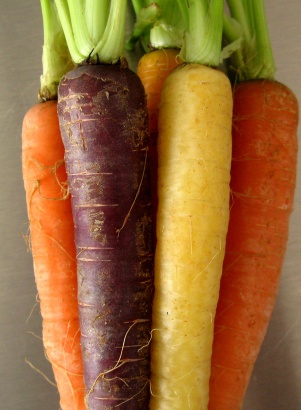
The purple carrot existed in Central Asia for several centuries before it was brought west by the Arabs in about the 10th century. The carrot is believed to originate from Afghanistan before the 900s, as this area is described as the primary centre of greatest carrot diversity (Mackevic 1929), Turkey being proposed as a secondary centre of origin (Banga 1963). The first cultivated carrots exhibited purple or yellow roots. It was not until six centuries after domestication that orange roots appeared consistently in the historical record.
In Europe, genetic improvement led to a wide variety of cultivars. White and orange-coloured carrots were first described in Western Europe in the early 1600s (Banga 1963). Concomitantly, the Asiatic carrot was developed from the Afghan type and a red type appeared in China and India around the 1700s (Laufer 1919; Shinohara 1984).
Carrot domestication took somewhat differing paths east and west of Central Asia. Modern research has shown that there are two distinct groups of cultivated carrots from which the modern orange carrot derives, these are distinguished by their root colours and features of the leaves and flowers.
Eastern carrot (anthocyanin) - identified by its purple and/or yellow branched root, grey green leaves which are poorly dissected and an early flowering habit. Eastern carrot was probably spread by Moorish invaders via Northern Africa to Spain in the 12th century. It is considered that the purple carrot was brought westward as far as the Arab countries from Afghanistan (where the purple carrots of antiquity are still grown).
Western carrot (carotene) - identified by its yellow, orange, white or red unbranched root and yellowish green leaves more clearly dissected and slightly hairy. It is thought that Western carrots originated later in Asia Minor, around Turkey and could have formed from a mutant which removed the anthocyanin (purple colour).
The origin of the cultivated carrot is clearly acknowledged to be purple and in the Afghanistan region mainly because it was known to exist there well before reliable literature references or paintings gave evidence of Western carotene carrots. It is thought the carotene carrot was domesticated in the regions around Turkey. The precise date is not known but thought to be before the 8th century.
It is known that purple or red and yellow carrots were cultivated in Iran and Arabia in the 10th century and in Syria in the 11th. The purple carrot spread into the Mediterranean in the 10th century where it is thought a yellow mutant appeared. The purple and yellow carrots both gradually spread into Europe in subsequent centuries. It is considered that the white carrot is also a mutant of yellow varieties.
Orange carrots probably arrived from mutations of yellow forms, and then from human selection and development, probably in the Netherlands. It is thought that humans made selections from a gene pool involving yellow rooted eastern carrots, cultivated white-rooted derivatives of wild carrot (grown as medicinal plants since classical times) and wild unselected populations of adjacent Daucus Carota subspecies in Europe and the Mediterranean.
The commonly accepted reason why the ancients preferred orange and yellow carrots over the prevailing purple was because the purple turned the cooking utensils purple and the cooking water a muddy colour. This is because the pigment in orange carrots is fat soluble, whereas the purple is water soluble. Apparently historic humans just liked the way yellow and orange carrots looked and cooked better than purple ones.
Some scholars think that orange carrots did not to appear until the 16th century, although there is a Byzantine manuscript of 512 A.D., and an 11th century illuminated script, both of which depict an orange rooted carrot, and suggesting it was around long before.
These scholars say the modern orange carrot was developed and stabilised by Dutch growers in the 16-17th century, evidenced from variety names and contemporary art works. A tale, probably apocryphal, has it that the orange carrot was bred in the Netherlands in the seventeenth century to honour William of Orange. Though the orange carrot does date from the Netherlands in the sixteenth century, it is unlikely that honouring William of Orange had anything to do with it! Some astute historian managed to install the myth that the aboriculturists work on an unexpected mutation was developed especially to give thanks to King William I as a tribute to him leading the Dutch revolt against the Spanish to gain independence from Spain. There is no documentary evidence for this story!
But, it is also quite possible that orange carrots did exist before the 16th century, but there was no word to describe that colour, so carrots were often described as red or yellow and other variations of those colours. e.g. yellow-red. There are compelling arguments for a much earlier, near eastern origin – the Byzantine illustration in the Dioscorides codex, drawn in 512 ad shows quite clearly carrot plants with a thick, orange coloured root, indicating that carotene cultivars already existed at that time.
The first recorded use of orange as a colour name in English was in 1512. The word orange itself was introduced to English through the Spanish word “naranja”, which came from the Sanskrit word nāraṅga, which literally means “orange tree”. The French (or English) dropped the leading “n” and eventually we got the word “orange”. In the early 16th century, the word orange gradually started being used to not only refer to the fruit, but also what we now know of as the colour orange.
There are some documents in the County Hall of Cuevas Bajas (Andalusia) that purport to show the cultivation of an orange/purple variety from Medieval Times and there is a commercial letter talking about the exchange with the merchants of the Silk Route. The Arabs brought this variety (and other types) from North Africa to Andalusia via the Silk Road in the 14th century. So it could well be that the Arabs already had orange rooted carrots and introduced them into Europe at the same time. Then the Dutch developed varieties which better suited their growing conditions.
Whatever the origins, the Long Orange Dutch cultivar, is commonly held to be the progenitor of the orange Horn carrot varieties (Early Scarlet Horn, Early Half Long, Late Half Long). All modern, western carotene varieties ultimately descend from these varieties. The Horn Carrot derives from the Netherlands town of Hoorn in the neighbourhood of which it was probably developed. Horenshce Wortelen (carrots of Hoorn) were common on the Amsterdam market in 1610. The earliest English seedsmen list Early Horn and Long Orange.
The cheap and accessible orange root was constantly popular as a staple food throughout Victorian times and became even more so during the two World Wars when other food sources became scarce.
Research and development continues to take place to produce disease resistant varieties. The current yellow/orange varieties (containing carotene) through gradual selection in Europe, now form the basis of the commercial cultivars around the world, mainly through their superior taste, versatility, nutritional value and cultural acceptance.
Follow its steps through the dark ages and then enlightenment with 17th century herbalists who recommended carrots and their seeds for a wide variety of ailments. Finally after many years as a low class vegetable, mainly used for animal fodder, it came of age during the food scarcity of the two World Wars, and people had to be more inventive with fewer resources.
