A Brief History of Rhubarb in Western Civilization
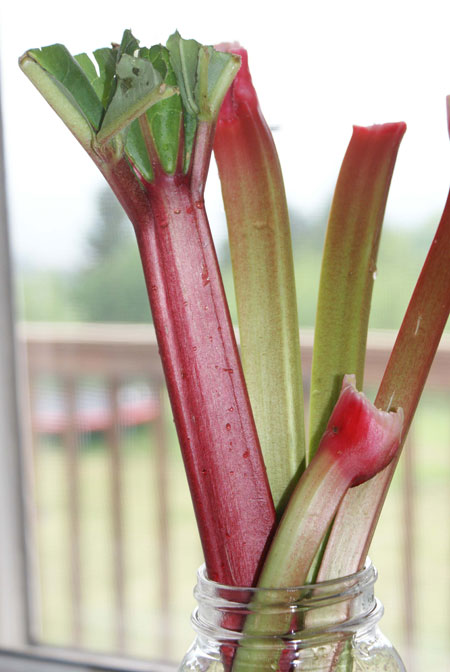
Remove the whole leaf if you are going to use the rhubarb the same day.
If not, leave two to three inches of leaf on the stalk. This keeps
moisture in the stalk so it remains fresh and crisp longer.
First Valued as a Medicinal Plant
Many consider rhubarb a fruit due to the dominance of rhubarb dessert recipes. However, rhubarb is botanically a vegetable. More surprisingly, rhubarb's role in history has been medicinal rather than culinary. Indeed, widespread culinary uses began only two centuries ago.
Rhubarb's medicinal uses began at least 5000 years ago, when Chinese used the dried roots as a laxative. The first documented uses in western civilization are 2100 years ago when rhubarb roots were an ingredient in numerous Greek and Roman medicines. Dried rhubarb roots are also astringent. The astringent effects closely follow the cathartic impact, which made rhubarb roots a popular laxative in days of old. Though uncommoon, dried rhubarb root is still sold as a laxative. Therefore, it is noteworthy that the medical efficacy of rhubarb roots varies significantly by variety. The original Chinese variety remaining the most efficacious while some varieties have no laxative value whatsoever.
Rhubarb was highly prized as an import from Asia in thirteenth- and fourteenth-century medieval Europe. The price in Europe was higher than opium, ten times more than cinnamon, and four times more than saffron, which was the most expensive spice of the time. Why? Because it was very expensive to transport across Asia, and it was wanted for its extraordinary healing properties for many illnesses, including constipation, inflammation, and reducing fevers.
Rhubarb's usefulness as a cathartic was widely valued in Europe for millennia. Unlike some laxatives rhubarb roots are not only effective but their effects are short lived and painless. Important, too, is the fact that cathartics played a more prominent role in medicine in ancient times than they do today. Purging one's system was a common component of many treatments. These factors helped motivate a variety of rhubarb-related activities in post-Renaissance Europe, including exploration to discover the Asian source and subsequent transplanting and experimentation. Although China was eventually discovered to be the source of the original and highest quality plants other varieties were discovered elsewhere in Asia. Many were imported and grown in Europe and Britain.
The Renaissance and the Industrial Age brought attempts to discover the constituent elements of rhubarb responsible for the cathartic and astringent effects. Also, there were attempts to develop tests and procedures to ensure quality. These were rather unsuccessful until modern times. The nature of rhubarb's medicinal values were eventually understood, just in time for hybrid mayhem to cloud the actual origin and non-visible characteristics of many if not all rhubarb plants! Anthraquinones, particularly emodin and rhein, now explain the laxative effects of rhubarb. The chemicals are known to exist in both the roots and the stalks, though the actual concentration varies from species to species and even by the phase of growth.
Valued for Its Culinary Use
There is no record of common culinary rhubarb prior to the 1800s. Widespread consumption of rhubarb stalks began in Britain in the early 19th century with its popular adoption as an ingredient in desserts and wine making. Since then rhubarb's popularity grew to a peak just before World War II in what Foust1 called "rhubarb mania." It was always more popular in Britain and the U.S. than elsewhere but rhubarb also achieved noteworthy popularity in Australia and New Zealand. Culinary uses also spread to northern Europe. At its most popular commercial quantities of rhubarb were grown outdoors as well as in greenhouses and dark cellars. Culinary use dropped dramatically during WWII, possibly as a direct result of the depravations of war, most notably the rationing of sugar.
Rhubarb leaves are toxic and have no safe culinary use for humanity. This is due to high concentrations of oxalic acid, an organic poison and corrosive found in many plants but present in relatively large amounts in rhubarb leaves. Other toxins may also exist. However, based on oxalic acid alone 5 kilograms of the leaves provide a lethal dose to a human. (Although this varies by variety and the phase of growth.) Still, all are advised not to consume the leaves in any quantity whatsoever.
Since WWII rhubarb production has rebounded but to only a fraction of pre-war levels. Today's U.S. rhubarb production is almost exclusively outdoors with relatively little commercial forcing. There are about 1300 acres devoted to rhubarb production, 60% in Washington State with Oregon and California next, and 1/2 acre in Black Forest, Colorado (That's us!). Rhubarb production also resumed in England after the war but, as in the U.S., not at "mania" levels. Forcing, however, is still popular in England with Yorkshire the English leader in rhubarb production.
As mentioned, rhubarb did not enjoy widespread consumption as food until the 19th century. Indeed, the modern market for culinary rhubarb was created virtually from scratch in 1824 by Joseph Myatt, a South London nurseryman with some rhubarb plants, a recipe for tarts, and enough gumption to convince others that the otherwise bitter plant could taste good when combined with something sweet. (Guess what crop Mr. Myatt was best known for producing ... strawberries.) The timing was perfect. Sugar was becoming available and affordable and the rhubarb stalks were otherwise going to waste. There was nothing to lose! Adding to rhubarb's popularity was the fact that it is generally ready for harvest well before most other vegetables. With forcing it can be made available even earlier. It was a welcome, fresh food after a long winter of preserves and meat. With such an explosion in popularity there were many other preservation techniques developed for rhubarb. These included drying, canning and, most recently, freezing.
First Recorded Recipes for Rhubarb
"The rhubarb now eaten as a fruit arrived in the seventeeth century, when John Parkinson received seeds from Italy and planted them in his garden. He described the leaf stalks, some two feet long and the thickness of a man's thumb, and thought a syrup might be made from the juice which would pure more gently than rhubarb from the East Indies or China. The cultivation of garden rhubarb spread in Britain in the eighteenth century, with the encouragement during the later years from the Royal Society of Arts...Garden rhubarb was a new acquisition for tarts. A recipe which appeared in the 1790s advocated slicing the stalks, and then treating them in the manner of gooseberries." ---Food and Drink in Britain From the Stone Age to the 19th Century, C. Anne Wilson [Academy Broadway:Chicago] 1991 (p. 347-348, 352)
A naturlaist, Peter Collinson, worte in 1739 about 'Siberian rhubarb' pie with sugar and cinnamon. However, it was some time before rhubarb recipes becan to appear in English cookery books, perhaps waiting for sugar to be more widely available to sweeten the taste. Rhubarb wasn't discovered as a food by Europeans (or by anyone else, for that matter) until the early part of the 18th century. That is when we have the first recorded descriptions of rhubarb stalks being used for pies and puddings. It was the English who eventually developed recipes for pies, jams, chutneys, and compotes made from rhubarb.
The first recorded recipe that has been found according to Alan Davidson (Oxford Companion to Food) appears to be in this 1806-7 cookbook by Maria Eliza Rundell, for Rhubarb Tart. Page 160 of A New System of Domestic Cookery by Maria Eliza Rundell, 1807.
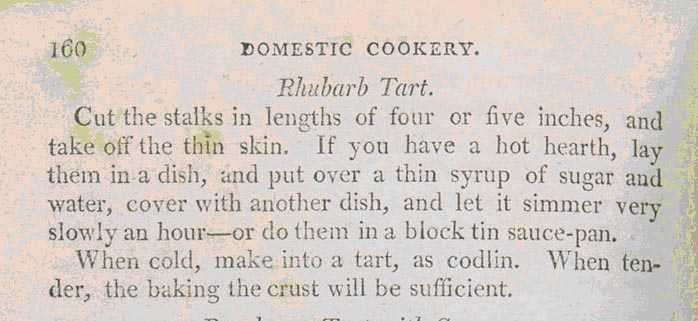
Note: Codlin is greenish elongated English apple used for cooking.
Origin of the Word "Rhubarb"
The word rhubarb is of Latin origin. The ancient Romans imported rhubarb roots from unknown, barbarian lands. The lands were beyond the Vogue river, sometimes known as the Rha River. Rha was first adopted to mean rhubarb. Imported from barbarians across the Rha the plant became Rha barbarum and eventually rhabarbarum, Latin for rhubarb plant. The modern English word rhubarb derives from rhabarbarum.
Rhubarb Species
Rhubarb species can be grouped into two broad categories, all horticulturally classified as members of the genus Rheum. In one category, sometimes collectively called Victoria, the stalk exteriors vary in color from pure green to light red while the interior is green. The varieties in this category tend to be larger, more robust and relatively disease resistant.
The second category consists of pure red rhubarb. These stalks are deep red inside and out. They tend to be smaller, less robust and more prone to diseases. In general the yield per plant per year of red rhubarb is at most half that of Victoria plants. The Victoria group is by far the more common type of rhubarb in the U.S.
Over 100 species of rhubarb are now known, mostly hybrids of the few species imported from Asia after the Renaissance. Rhubarb also grows wild in Alaska and may be native to that region. Varieties vary in appearance, taste, medicinal merit, yields, and date of harvest. There is no known variance in food value among varieties although the pure red is aesthetically preferred for some uses.
