History of Simnel Cake
Word Origin:
Cakes made with fine flour. The word, "simenel," comes into English from the French at the time of the Norman Conquest, 1066.
Simenel, from Old French, from Latin simila fine flour, probably of Semitic origin; related to Greek semidalis fine flour
1830-40; simnel, Middle English simenel < Old French, ultimately < Latin simila or Greek semídālis fine flour. The name may derive from the Roman 'simila conspersa', meaning 'fine flour'.
The Cake is extremely old, known in England at least since the 13th Century (OED), and even turns up in the 1535 'Coverdale Bible' where Ezekiel. xvi. 19 has; "Thou didest eate nothinge but symnels, honny & oyle."
The French version of this cake is more of a Bun or muffin size and decortaed with sugar crosses on top. These were their equivalent of the English Hot Cross Bun. These cakes were baked and sold on Lenten Sundays in both England and France.
Historical References:
The Statute of Bread and Ale (Assisa panis et cerevisiæ) of 1266 specified three (or four) varieties of bread of fine flour, of which the standard form was the wastel; and three qualities of inferior bread, namely bread of whole wheat, bread of treat, and bread of any kind of grain.
In Good Cheer, the romance of food and feasting (1911), Frederick W. Hackwood detailed these different qualities of bread:
Bread was of various degrees of fineness (or “bolting”, as it was called, from the bolting-sieve through which it passed at the mill) and colour.
The finest and whitest was known as simnel bread, or, in the 13th and 14th centuries, as pain demayn, corrupted from panis dominicus, the Lord’s bread, because on each fine loaf was impressed a figure of the Saviour. Only persons of highest rank and most affluent circumstances could afford to consume this class of bread.
The next in quality was the wastel bread, used by the wealthier middle class; the name was from the Old French gasteau, a cake. Then came a quality very little inferior, light bread, sometimes known as French bread, or puffe. Next in quality was cocket, so called because it bore a baker’s seal or cocket, as demanded by the strict regulations of London to warrant its standard of fineness.
Of lower quality was tourte, a twisted bread made of unbolted meal, in general use among the humbler classes and the inmates of monasteries. Trete bread, or bis, or brown bread, was made of wheat meal from which the fine flour at one sifting had been removed. Then came black bread, made of various kinds of grain inferior to wheat.
The fine quality of simnel bread was coupled with that of wastel bread (from Old French gastel - Modern French gâteau), a fact that the following illustrates. In an interview which took place between William king of Scotland and Richard I, at Northampton, a charter was granted to the Scottish king, in which it was agreed that, whenever he should be summoned to the English court for the performance of homage, his daily allowance among other things should consist of twelve simnels and as many wastels.
From The Lay of Havelok the Dane, author unknown.
Composed in the Reign of Edward I, about A.D. 1280.
[Sidenote: He used to sell lampreys at Lincoln, and bring home simnels, meal, meat, and hemp.]
And hwan he tok �e grete laumprei,
Ful we[l] he cou�e �e rithe wei 772
To lincolne, �e gode boru;
Ofte he yede it �oru and �oru,
Til he hauede wol[39] wel sold,
And �er-fore �e penies told. 776
�a{n}ne he com, �e{n}ne he were bli�e,
For hom he brouthe fele si�e
Wastels, simenels with �e horn,
Hise pokes fulle of mele an korn, 780
Netes flesh, shepes, and swines,
And hemp to make{n} of gode lines;
And stronge ropes to hise netes,
In �e se were{n} he ofte setes.[40, 40*] 784
Note on "Horn," _n._ S. 779. [This probably refers to the _shape_ of the simnel. Halliwell says, a Simnel is "generally made in a _three-cornered_ form." Cracknels are still made with pointed and turned up ends, not unlike horns_.]
Associated with Spring
We don't know quite what they tasted like, but we do know that, around the time of Queen Elizabeth I (1533 - 1603), fancy simnel cakes came to be associated with springtime. They turn up in celebrations of Mothering Sunday, Easter, or the day-off from the religious fast of Lent known as 'Refreshment Sunday'. Different regions used to have different versions.
References from the 17th Century onwards show that Simnels were boiled before being baked, though the precise receipt is lost. For instance, A Willet's 'Hexapla in Exodum' of 1608 has; "Cakes tempered with oyle in the frying pan, and wafers boyled in water..like unto our simnels."
In the mid-17th century appeared mentions of rich currant cakes usually eaten on Mothering Sunday.
The word simnel in this sense is first attested in 1648, in the following quatrain from Robert Herrick’s Hesperides:
To Dianeme. A ceremonie in Glocester.
Ile to thee a simnell bring,
’Gainst thou go’st a mothering;
So that, when she blesseth thee,
Half that blessing thou’lt give me.
A definition was given in 1688 in Academy of Armory:
A Simnell, is a thick copped Cake, or Loaf made of white Bread, Knodden up with Saffron and Currans.
And, in Nomo-Lexicon: A Law-dictionary (1670), Thomas Blount indicated:
Simnel (still in use, especially in Lent). Bread made into a Simnel shall weigh two shillings less than Wastel bread.
Wastel being the standard form of fineness, for example the farthing loaf of treat was to weigh twice the weight of wastel, on account of the bran left in it.
And Sir Walter Scott, describing a banquet in Ivanhoe, A Romance (1819), wrote:
Besides these dishes of domestic origin, there were various delicacies brought from foreign parts, and a quantity of rich pastry, as well as of the simnel-bread and wastle cakes, which were only used at the tables of the highest nobility.
Another definition, written in 1851, was:
A rich sort of cake, consisting of a thick crust of saffron-bread filled with currants, citron, and all the usual ingredients of wedding-cake, which is called a simnel.
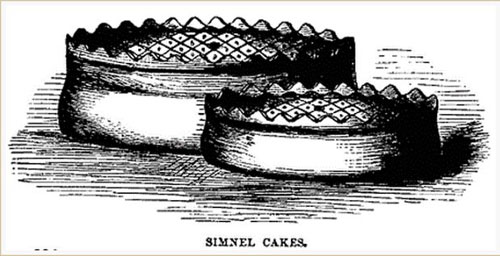
Illustration in the Chamber’s Book of Days
And, in 1879, the Chambers’s Book of Days, a miscellany of popular antiquities in connection with the calendar, explained:
It is an old custom in Shropshire and Herefordshire, and especially at Shrewsbury, to make during Lent and Easter, and also at Christmas, a sort of rich and expensive cakes, which are called Simnel Cakes. They are raised cakes, the crust of which is made of fine flour and water, with sufficient saffron to give it a deep yellow colour, and the interior is filled with the materials of a very rich plum-cake, with plenty of candied lemon peel, and other good things. They are made up very stiff, tied up in a cloth, and boiled for several hours, after which they are brushed over with egg, and then baked. When ready for sale the crust is as hard as if made of wood, a circumstance which has given rise to various stories of the manner in which they have at times been treated by persons to whom they were sent as presents, and who had never seen one before, one ordering his simnel to be boiled to soften it, and a lady taking hers for a footstool.
The 'Copsley annals preserved in proverbs', by Emily Elizabeth Steele Elliott, 1867 has this poem;
'She who would a simnel make,
Flour and saffron first must shake,
Candy, spices, eggs must take,
Chop and pound till arms do ache:
Then must boil, and then must bake
For a crust too hard to break.
When at Mid-lent thou dost wake,
To thy mother bear thy cake:
She will prize it for thy sake
More Modern Versions:
For reasons which are not clear, Simnel became associated with the Spring Festival in general, be it Mothering Sunday, Easter or the Mid-Lent day-off from fasting known as 'Refreshment Sunday', and the name became translated to a number of types of rich Springtime celebration cakes, usually involving marzipan.
There is a tradition throughout Scandinavia and the Baltic of eating a springtime bun filled with marzipan called a 'semlor' in Sweden.
Devizes Simnel Cake
A Springtime celebration cake, made in a star shape.
An early receipt, supplied by the Wiltshire Heritage Museum Library is: "Three and a half lbs plain flower, Three lbs currants, 2 lbs lemon peel, Half oz safron powder mixed with bun powder and egg yoke, Prove well, form into star shapes. Boil, then bake. Glaze"
Shrewsbury Simnel Cake
A Springtime Celebration Cake. Traditionally a light rich fruit cake with saffron, boiled first and then baked. Made with a central layer of marzipan, decorated on top with icing or marzipan and icing or paste balls or points.
Chambers Book of Days of 1869 reports that;
"It is an old custom in Shropshire and Herefordshire, and especially at Shrewsbury, to make during Lent and Easter, and also at Christmas, a sort of rich and expensive cakes, which are called Simnel Cakes. They are raised cakes, the crust of which is made of fine flour and water, with sufficient saffron to give it a deep yellow colour, and the interior is filled with the materials of a very rich plum-cake, with plenty of candied lemon peel, and other good things. They are made up very stiff; tied up in a cloth, and boiled for several hours, after which they are brushed over with egg, and then baked. When ready for sale the crust is as hard as if made of wood, a circumstance which has given rise to various stories of the manner in which they have at times been treated by persons to whom they were sent as presents, and who had never seen one before, one ordering his simnel to be boiled to soften it, and a lady taking hers for a footstool. They are made of different sizes, and, as may be supposed from the ingredients, are rather expensive, some large ones selling for as much as half-a-guinea, or even, we believe, a guinea, while smaller ones may be had for half-a-crown. Their form, which as well as the ornamentation is nearly uniform, will be best understood by the accompanying engraving, representing large and small cakes as now on sale in Shrewsbury.
The usage of these cakes is evidently one of great antiquity. It appears from one of the epigrams of the poet Herrick, that at the beginning of the seventeenth century it was the custom at Gloucester for young people to carry simnels as presents to their mothers on Midlent Sunday (or Mothering Sunday)."
Charlotte Sophia Burne's Shropshire folk-lore: a sheaf of gleanings of 1883 has "'Shrewsbury Simnels' are eaten by many who do not heed the pious habit of 'mothering' which they were intended to celebrate."
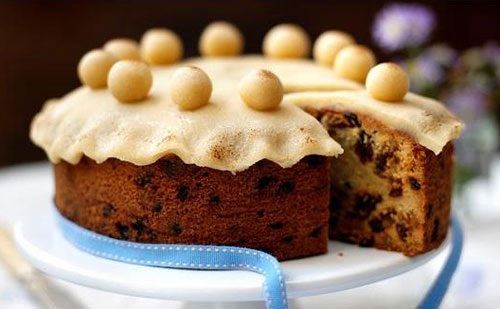
Gloucester Simnel Cake
A Springtime Celebration Cake. A rich fruit cake with almonds, currants. Decorated on top with marzipan, with marzipan balls and crystallised fruits. Recipe for Simnel Cake
Original Receipt from 'Pot-luck; or, The British home cookery book' by May Byron (Byron 1914)
860. SIMNEL CAKE (Gloucestershire)
Take a quarter of a pound of flour, three ounces of mixed peel, quarter of a pound of butter, three good-sized eggs, quarter of a pound of castor sugar, two ounces of ground almonds, three-quarters of a pound of currants. Beat butter to a cream, add sugar and beaten eggs gradually, and work well together. Add flour sifted; beat thoroughly, then add remaining ingredients. Line a tin with greased paper, pour in mixture, and bake in gentle oven from two to three hours. When cold, make some almond paste. Put a layer on top of cake. Form remainder into round balls. Brush the cake over with white of egg and dust with castor sugar. Set in a cool oven till balls are lightly browned, and decorate with crystallised fruits.
Bury Simnel Cake (one of the latest version of the cake in England)
A Springtime Celebration Cake. A rich fruit cake with nuts, cherries and peel (White 1932), covered with icing (often with marzipan) and decorated, often with Springtime fancies and always with 11 sugar or paste balls, possibly representing the 11 Good Apostles.
Although there are several forms of Simnel Cake, it is the rich, highly decorated, Bury form which has become known nationwide. This is possibly because of a series of promotions for the town carried out in the early 19th Century, which included the presentation of a 70lb Bury Simnel to Queen Victoria in 1863 and the monster 170lb Bury Simnel displayed at the 'National Free-Trade Bazaar' held at the Covent Garden Theatre in London in 1845.
