Wedding Cake: A Slice of History
"The Victorian myth of origin
The degree to which the wedding cake and the uses to which it is put in twentieth century Britain have become standardized may well mislead when the past is considered. Even the degree of standardisation already present in the later nineteenth century misled J. C. Jeaffreson whose Brides and Bridals [1872] offered a pioneering account of the history of the cake. Other writers have subsequently followed him, sometimes themselves adding to the confusion by misinterpreting his words in terms of the cakes with which they were familiar in their own day...
...Jeaffreson's history is...an interesting example of the myth-making of its period. Like others...he was led by a sense that, to be properly grounded, contemporary practice must have a lineage going back to ancient Rome. This was to make a link with the region of history so special for the identity of European societies as they developed out of the middle ages as to be labelled classical'. At times and amongst people aware of their own imperial status, such links were at a premium...The story Jeaffreson told began, therefore, with an ancient Roman marriage practice involving the breaking of a cake over the bride's head. It jumped to evidence from the England of a thousand and more years later, for the pouring or throwing of grain, and from this to supposed survivals around Britain as late as his own century of the breaking of biscuit, 'cake' or bread' over the bride...
...It was, Jeaffreson considered, with the arrival in England of French confectionery skills and influences at the Restoration in 1660 that the pile of cakes was consolidated with an overall covering of icing and decoration....There is no doubt that this story is fanciful and wrong, though its subsequent repetition shows that he had created a myth which would appear appropriate to those few who have thought to question the cake's origins."
---Wedding Cakes and Cultural History, Simon R. Charsley [Routledge:London] 1992 (p. 29-30)
Roman Traditions
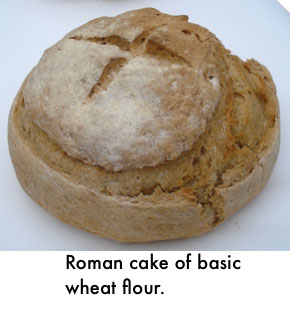
A confarreatio wedding ceremony was a rare event, reserved for the highest echelons of Rome's elite. The Flamen Dialis and Pontifex Maximus presided, with ten witnesses present, and the bride and bridegroom shared a cake of spelt (in Latin far or panis farreus), hence the rite's name.
A more typical upper-middle class wedding in the classical period was less prestigious than a confarreatio, but could be equally lavish. It would have been carefully planned. Some dates were auspicious for weddings but others were avoided as unlucky. Traditionally, high-caste brides were supposed to weave and sew their own wedding garments; a white woolen dress which was very like that of a Vestal Virgin, and a translucent, flame-yellow veil, symbolising chastity and ritual purity. Sometimes the bride and groom exchanged gifts before the wedding.
The night before her wedding, the bride-to-be gave her childhood costume and playthings to her family Lares, to signify her imminent coming of age. On the day of her marriage, she donned her wedding dress, and loosely belted it at the waist. She put on a floral wreath or crown, then covered her head with her flame-yellow veil. A young boy lit a "torch of Ceres" at her sacred household fire, and led the bridal procession to the house of the husband-to-be; En route, the bride gave a copper coin to her groom's neighbourhood Lares (Lares Compitalici), as an acknowledgement that she would soon be part of his community.
When the procession reached the groom's house, water and another torch, lit at the groom's household fire, were brought out to greet it, with the words aquae et ignis communicatio ("I give you water and fire"). The bride's female attendants carried her over the threshold, where she greeted her groom; "ubi tu Gaius, ego Gaia" ("where you are Gaius, I am Gaia"), to which he would reply "ubi tu Gaia, ego Gaius". A wedding sacrifice was offered to Tellus; a sow is the most likely victim. The witnesses, the verbal consent of bride and groom, the sharing of the water and fire and, perhaps, the clasping of their right hands (dextrarum iunctio) testified that the marriage had taken place. It was consummated in the bedroom, supposedly in the dark. The day after the wedding, the husband would hold a dinner party, and the bride made an offering to the Lares and other domestic deities of her new home.
Middle Ages
The tradition of creating special cakes for weddings reaches back to Roman times. A small and basic fruit cake would be made from food that was traditionally offered as an appeasement to the gods – rich fruit, nuts and tiny honey cakes. This cake would be crumbled over the bride’s head so that the gods would bless her with abundance – the tradition known as ‘crowning the bride’. [I can't find reference to this term anywhere else]
The practice of eating crumbs of small wedding cakes spread throughout Western Europe. It was brought to Britain by Julius Caesar in 54 BC and became part of local custom. At first, it was only wealthy families who could afford to adopt the practice, with poorer families scattering grains of wheat or corn over the bride, in the hope for fertility. . In England, the crumbs were washed down with a special ale. The brew itself was referred to as bryd ealu, or “bride’s ale”, which evolved into the word “bridal”.
Chronicles of the period record that in 1487 over two hundred and sixty pounds of “confetti” were consumed at the banquet following the wedding of Lucrezia Borgia and Alfonso d’Este, son of Ercole I, Duke of Ferrara. Sweetmeats were showered over the bride and groom; indeed, it seems to have been the custom to throw the sweetmeats about enthusiastically. Eventually, the sweets were replaced with rice, flower petals, and colored paper, and these new types of confetti continue to be showered over the happy couples around the world.
The wedding cake rite, in which tossed food symbolized an abundance of offspring, changed during lean times in the Middle Ages. Raw wheat or rice once again showered a bride. The once-decorative cakes became simple biscuits or scones to be eaten. And guests were encouraged to bake their own biscuits and bring them to the ceremony. Leftovers were distributed among the poor. Ironically, it was these austere practices that with time, ingenuity, and French contempt for all things British led to the most opulent of wedding adornments: the multi tiered cake.
The legend is this: Throughout the British Isles, it had become customary to pile the contributed small spiced buns, scones, biscuits, and other baked goods atop one another into towering pile, as high as possible. The higher the better, for the height augured prosperity for the couple, who exchanged kisses over the mound. If the bride and groom were able to kiss over the tall stack, it augured a lifetime of prosperity. In the 1660’s, during the reign of King Charles II, a French chef (whose name, unfortunately, is lost to history) was visiting London and observed the cake-piling ceremony. Appalled at the haphazard manner in which the British stacked baked goods, often to have them tumble, he conceived the idea of transforming the mountain of bland biscuits into an iced, multi tiered cake sensation. British papers of the day are supposed to have deplored the French excess, but before the close of the century, British bakers were offering the very same magnificent creations.
Croquembouche was created in the late 1700’s by French pastry chef, Antoine Careme. Already in the history of French weddings there was a tradition of bringing wheat cakes by the guests for the marriage (later sweet buns were given). These buns were stacked as a tall pyramid in between the bride and groom. The challenge was for the bride and groom to kiss each other without disturbing the tall cake mound. If they achieved a kiss, the marriage was said to bring prosperity to them. Imagine the disappointment for those wedding couples whose kiss brought the tower to a cascading fall! It was Antoine Cereme who made a towering cake by coating the buns entirely with a sugar frosting, spun around the entire cone shaped cake, so that it would not fall. Alas, the precussor of a great wedding caterer tending to the needs of a bride! This became very popular throughout France and is known as the French wedding cake. Needless to say, Careme is a prominent pastry chef in French history.
When the Romans invaded Britain in A.D. 43, many of their customs and traditions became part of British life. The Norman invasion of 1066 subsequently incorporated many French traditions into British life. Other changes came about due to increased trade and contact with Europe, but our present-day wedding traditions remain firmly rooted in the past.
17th Century Bride's Pie
In the county of Yorkshire, bride pie was the most important dish at weddings, as it was considered essential to the couple’s future happiness. It consisted of a large round pie containing a plump hen full of eggs, surrounded by minced meats, fruits, and nuts and embellished with ornate pastry emblems. Each guest had to eat a small piece of the pie; not to do so was considered extremely rude and impolite. A ring was traditionally placed in the pie, and the lady who found it would be the next to marry. Bride pie was still being served at weddings in some parts of England as late as the nineteenth century.
The earliest British recipe specifically noted for a wedding is Bride’s Pye, recorded by Robert May in the 1685 edition of The Accomplisht Cook. This was a large round pie with an elaborately decorated pastry crust that concealed a filling of oysters, pine kernels, cockscombs, lambstones (testicles), sweetbreads, and spices. There were also humbler, less expensive versions containing minced meats or just mutton.
Bride Cake
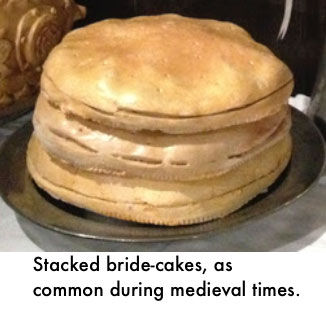
In the seventeenth century bride pie developed into bride cake, the predecessor of the modern wedding cake. Fruited cakes, as symbols of fertility and prosperity, gradually became the centerpieces for weddings. A much less costly bride cake took the simpler form of two large rounds of shortcrust pastry sandwiched together with currants and sprinkled with sugar on the top. Very few homes at the time could boast of an oven, but this type of pastry cake could easily be cooked on a bakestone on the hearth.
Matrimony cake, another Yorkshire specialty, was more like a pie than a cake, being a pastry case filled with a mixture of dried fruits, apples, spices, and breadcrumbs. It may have descended from the bride pie, with the omission of the hen, eggs, and meat, much as modern fruit mincemeat evolved from the original mincemeat containing shredded mutton or beef. With its solid base, smooth filling, and rough top, matrimony cake was said to sum up the complexities of marriage.
The Grooms Cake
Even after it became common practice to ice wedding cakes with sugar in the late seventeenth century, the cake would still be crumbled on the bride’s head… the icing, in fact, making the ritual easier. The sugar would crumble and could be showered over the bride whilst the rest of the cake was left to be eaten.
In the seventeenth century wedding cakes were made in pairs, one for the bride and another for the groom. Groom’s cake, a dark, heavy fruitcake, was served alongside bride cake. Smaller than bride cake and usually not iced, the groom’s cake was cut up into little squares that were then placed in boxes for the guests to take home as a wedding memento and to ensure good luck. At bedtime the recipient of groom’s cake would place the square underneath his or her pillow. This tradition was recorded as early as the seventeenth century but gradually died out, as did the groom’s cakes, which are no longer part of British weddings. However, the tradition has undergone a revival in the United States, where for many years the groom’s cake has served as a wedding favor for guests. Modern groom’s cakes are often shaped and decorated to depict the groom’s favorite hobby—a golf bag, a camera, a chess board.
The tradition of crowning the bride continued until just before the reign of Victoria and it was then that the ‘groom’s cake’, a dark fruit cake, was cut into pieces to be taken home by the guests. The ‘bride’s cake’ (made from a lighter mixture but more highly decorated) would be served as a dessert at the wedding feast.
Cake Icing
Bride cake covered with white icing first appeared sometime in the seventeenth century. It was frosted with the precursor of royal icing, a sort of meringue mixture of whisked egg white and sugar, which was applied to the hot cake straight from the oven and then returned to the oven to firm up. When applied to wedding cakes, this type of icing was known as “bliss.” In 1769 Mrs. Raffald (the most celebrated English cookery writer of the eighteenth century after Hannah Glasse) was the first to offer the combination of bride cake, almond paste, and royal icing. Hannah Glasse, in The Art of Cookery Made Plain and Easy, gave a recipe for the cake that included four pounds of flour, thirty-two eggs, six pounds of dried fruit, and half a pint of brandy. After the cake was baked, it was covered with a pure white, smooth icing made with “double refined sugar,” egg whites, musk, ambergrease [sic], and orange-flower water. The mixture was beaten for two hours, then spread over the cake and dried in the oven until hard. This drying process required constant vigilance to ensure that the iced cake did not color or scorch.
Sugar had been imported to England since the Middle Ages, but by the 1540s it was more readily available and affordable in cones of varying quality, weighing from five to forty pounds. By the 1550s two English sugar refineries were in operation; by 1650 there were at least fifty refineries in London alone. “Double refined” sugar was twice-refined white sugar; powdered icing or confectioners’ sugar was unknown at that time. References to “powdered sugar” refer to granulated sugar that had been pounded fine and sifted through fine gauze or silk. Elizabeth David, in English Bread and Yeast Cookery, notes that caster and icing or confectioners’ sugars became common only in the last decades of the nineteenth century. Triple-refined sugar had an especially white tint and was consequently more expensive.
A pure white color was much sought after, as white icing on a wedding cake symbolizes purity and virginal attributes—a notion first put forward in Victorian times. Before then most bride cakes were white for a more practical reason. Because the ingredients for the bride cake were expensive, especially the sugar for the icing, white icing meant that only the finest refined sugar had been used. Thus a pure white cake was a status symbol, a display of the family’s wealth.
At Queen Victoria’s wedding to Prince Albert in 1840, white icing was used to decorate her cake, and this icing has been known as “royal icing” ever since. The multitiered cake—which by the nineteenth century had gradually acquired the name “wedding cake”—measured more than nine feet in circumference. The London Times of February 1840 described the cake in detail. On the second tier, which was supported by two pedestals, a sculpture of “Britannia” gazed upon the royal couple as they exchanged their vows, while at their feet sat a dog, symbolizing faithfulness, and two turtledoves, symbolizing purity and innocence. There were also several sculpted cupids, including one happily writing the date of the wedding onto a tablet.
The wedding cake that commemorated the marriage of Queen Victoria’s eldest daughter, Vicky, in 1858 was less elaborate. Only the bottom tier consisted of cake; the others were made of sugar icing and were purely decorative, one stacked directly on top of the other. The now-traditional multitiered British wedding cake—a grand affair of heavily fruited cake layers decorated with royal icing and embellished with sugar flowers, doves, horseshoes, and bells—had its origins in the wedding cake made for the marriage of Prince Leopold in 1882. For the first time guests could enjoy a wedding cake made entirely of cake. This cake was also tiered, with each tier comprised of an iced cake stacked rather like a succession of hatboxes. The icing in between had been allowed to harden to prevent the upper tiers from sinking into the lower layers. However, it was to take another twenty years before the tiers of wedding cakes would be separated by columns (often disguised pieces of a broom handle). And it was not until the beginning of the twentieth century that the tiers were separated and supported by columns of hardened icing. These tiered cakes symbolized prosperity and were a status symbol at society weddings, as the less well-off could not afford a pillared and tiered wedding cake.
British wedding cakes remained virtually unchanged from the elaborate Victorian creations until the 1980s, when the intricately piped royal icing began to be replaced by soft icing, draped and frilled and often embellished with sugar-paste flowers. At the same time simpler, American-style layer cakes, such as carrot cake with cream cheese filling or key lime coconut cake with lime curd, came into vogue. Today, there are practically no rules about wedding cakes in Britain. Contemporary cakes can be any of color, flavor, or shape, and the possibilities are endless: a dense, dark chocolate cake with a sumptuous filling; gold, silver, and white iced cakes stacked and decorated to look like a pile of wedding presents; a tower of individual desserts; or a plain, moist sponge cake simply iced and decorated with fresh or sugar flowers. Twenty-first-century weddings are big business for Britain’s £3.5 billion wedding industry. This year over three hundred thousand people are expected to tie the knot, with the average wedding costing an astonishing £12,000. The cost of the all-important wedding cake averages around £300, but of course that depends on the size and design. Wedding cakes, like the bride’s dress, are subject to the vagaries of fashion, and celebrity weddings and cake designers continually strive to set new trends.
The Last Century
Today’s cakes can be eight feet high and covered in flowers, fountains of champagne, figures of the bride and groom or whatever else they fancy.
Since the early twentieth century, cakes have been raised in layers on pillars. Originally it was only royalty and high society who could afford these tiered cakes, with the rest of the country having single cakes decorated with perhaps a vase to add height to the display. The three-tiered round cake became traditional, representing the three rings – the engagement, wedding and eternity rings.
Soon the request for a three-tiered cake became fashionable among the style-conscious middle classes, even if there was more cake than was actually needed for the guests. Consequently, there was often a tier left over and, rather than use it immediately, it would be kept for the christening of the couple’s first child (which would normally be within 12 months of the marriage).
Very little was published on cake decorating between the two World Wars. The Second World War, with its severe sugar rationing in the United Kingdom, reduced the number of books being published on the subject still further and icing practice became very difficult. Mashed potato was used to keep piping skills honed. One pound of icing would be used for a whole cake decorating class, for weeks at a time.
Although there were sugar restrictions in the colonies of the War, they were not quite as stringent as in the United Kingdom. Sugarpaste was the preferred covering of rich fruit cakes in countries like Australia and South Africa. But, in Britain, the master bakers continued with their favorite technique – royal icing. Ronnie Rock, one of the greatest craftsmen in his field, actually ground his own icing sugar to produce the magnificent piece he made for his first post-war exhibition in 1946. It is now displayed in London’s National Bakery School.
The custom of the bride and groom cutting the cake together began in the 1930s when British cakes were encased in several layers. Grooms would ‘help’ the bride cut the cake, using a sword or knife. In those days this would have been unfailing a large hard white cake with some piped decoration. It would perhaps have been decorated with horseshoes (for good luck) and tiny bride’s shoes (representing the giving away of the bride to the groom by her father and the idea of a possession – historically a shoe left on a piece of land symbolized by ownership).
In the last thirty years, there have been many changes in the fashion for wedding cakes. Soft sugarpaste icing became popular and with it the creation of new techniques taken from needlework, such as smocking and ribbon insertion. Sugarpaste is often imagined to be a modern invention but, in fact, the first recipe for sugarpaste was published in 1609 in a book entitled Delights for Ladies. This paste was made from ‘fine white sugar, starch and gum tragacanth’, colored and flavored with pounded flowers.
It is this movement in trends for the decoration of wedding cakes that set the fashions for styles of christening, birthday and anniversary cakes. Today we realize that with imagination and practice, almost anything is achievable.
