Service à la Française
from http://www.hertzmann.com/articles/2004/service/
The method of service in restaurants and at formal dinners in France is not service à la française — service in the French-style. At least not anymore. It was called service à la française 150 years ago, but in the middle of the 19th century the style of service changed to the Russian-style — service à la russe. Going out to dinner was quite different 150 years ago.
Service à la française evolved over time from the method of service used in the Middle Ages by royalty and the nobility. During that period, the only cutlery supplied the diner was a spoon. All the guests, at least each male guest, would bring his own knife, actually a dagger. Female guests would be served by men sitting nearby. The edge of the blade was used to cut pieces of meat off a joint and the pointed end of the knife was used to spear the pieces. Forks hadn’t arrived yet from Italy and fingers were the preferred method of transporting food from a bowl to the mouth. Bowls and platters would be used for serving, but each dinner had a hollowed-out piece of hard, brown bread, a trencheoir, as his or her individual plate. The various courses were brought to the diners in large bowls or platters which served two or more guests. Everybody was not served the same food. What each diner was served, as well as where each guest sat, was a function of his or her relative station in life. The choicer morsels, the rarer ingredients, and the better quality serving bowls went to those diners higher up the pecking order.
As culinary habit and etiquette in France changed from the Middle Ages to the 19th century, multiple pieces of silverware replaced fingers and multiple pieces of fine porcelain replaced hard bread. But one aspect remained the same, the diner’s position in life was still reflected at the table both in placement and in food.
The typical formal dinner in the 19th century, whether enjoyed by the rich or the growing middle class, and whether served in a home or eaten in a restaurant, consisted of three courses, sometimes described as premier service, second service, and troisième service. Up until the 18th century it was still common, as in the Middle Ages, for sweets to be served as part of all three courses, but by the 19th century, the third course was closer to the modern concept of dessert.
The first course would commence with one or more soups. When these were removed, a couple of large plates of roasted or stewed meats, poultry, or fish, called relevés, were presented. These were accompanied by a series of entrées — smaller dishes of meat, poultry, or seafood — plus some entremets, small sweet or savory preparations. (In the Middle Ages, an entremet was entertainment presented between the mets, French for items “placed” before the diner. By the 18th century, these sweet and/or lighter dishes were now intended to provide a break between the larger heavier dishes of the course.) For larger meals, hors d’œuvres were place around the main dishes. Hors d’œuvres, literally “outside (the) work,” were not served before the meal as they are today, but around the main body of the meal.
The second course had the largest dishes of the meal, accompanied by vegetables, salads, and more sweet and savory entremets. By the 19th century, this course would contain the pièce de résistance, the center of the meal. The term apparently comes from the concept that diners had to resist eating too much of the first course in order to save room for this main dish. Also, this was not just a simple roast placed on a platter but an entire architectural construction of a combination of meats or seafood with a multitude of garnishes.
The third and final course was closest to the modern concept of dessert consisting of cheeses, pastries, and fruit. It could also include meat pâtés and other savory preparations. In the 18th century, this course bore more similarity to the earlier courses in that it would be centered on savory dishes with some sweet ones interspersed. The French word dessert evolved from desservir, meaning to “to remove what has been served, to clear (the table).” Also, much like today, the third service was prepared not in the kitchen but in the office, or pastry kitchen.
For all three courses, the individual dishes are placed in the center of the table in a symmetrical pattern with the principal dishes in the center and lesser dishes arranged around the center. Thus the dishes were arranged by size and symmetry. The arrangement was the responsibility of the maître d’hôtel. As the number of guests increases, the amount of each dish is not increased, but the number of dishes is. That is, the variety of dishes in the service increases with the number of guests. The 1748 edition of François Massialot’s Le nouveau cuisinier royal et bourgeois ou cuisine moderne presents sample menus for a variety of possible dinner parties. In his examples, it is not until the party reaches a size of 30 to 35 guests before he begins to double up some of the dishes.
The following is Massialot’s example of a simple dinner for six to eight diners along with the layout of the service plates on the table.
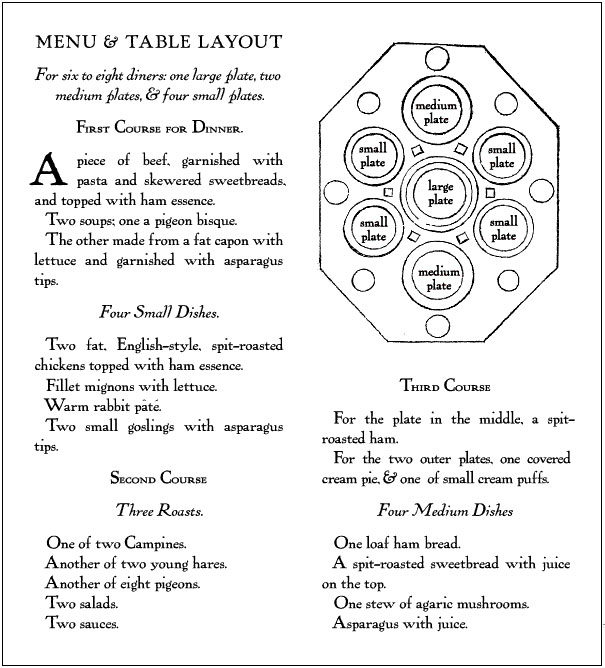 As the number of diners, and thus the number of dishes, grows, the likelihood of each diner being able to taste every dish diminishes. Table etiquette at the time dictated that any diner could ask for any dish to be passed to him or her. After the diner sampled from the dish, it would be returned to its original position on the table. It is not clear whether the diners ever actually passed the dishes to each other, or whether the act was carried out by what today would be referred to as waiters, but in those days they could be the host’s servants or the diner’s footmen. Etiquette dictated that while it was acceptable to obtain one or two dishes that were outside a diner’s reach, the diner should also not make a nuisance filling his plate with morsels that required excessive passing of plates. Besides being set with dishes, the table arrangement also included candles, salt cellars, and decorations. Each diner would also have an assortment of cutlery, plates, and glasses, depending upon need. The table may be set with multiple tablecloths so that as plates were removed at the end of each course, the soiled tablecloth could be removed revealing a clean one below.
By the mid-19th century, service à la française was becoming too burdensome, both in substance and fashion, for everyday dining. As early as the 1830s, Russian Prince Kourakin introduced to Paris society a method of service from his homeland, which the French dubbed service à la russe. Apparently Antonin Carême, arguably the finest chef of the 19th century, had observed this method when he was at the court of Tsar Alexander I in 1818, but he thought it unsuitable for his fellow countrymen. There is some evidence that the real driving force behind service à la russe was Urbain Bubois, a former chef to Prince Orloff in Russia and subsequently chef to the King of Prussia at the time he published, along with Émile Bernard, La cuisine classique: études pratiques, raisonnées et demonstratives de l’école française appliquée au service à la russe in 1864. The book begins with a three-page rationale for using service à la russe but contains sample menus for service à la française, as well. The sample menus include examples for small, intimate parties of ten up to more public banquets of 600 guests.
The main difference between service à la russe and service à la française is a matter of time and space. In service à la française, the dishes, at least in each course, are arranged spatially but presented to guests all at once. In service à la russe, the dishes are arranged temporally, i.e., served in succession, one after another. Plus the dishes are all offered to the guests by waiters, not passed by the guests. Instead of offering each guest a different assortment of dishes, everyone now is offered the same dishes throughout the meal. Also, with service à la russe, roasts are carved in the kitchen or on a sideboard, making it easier for the guests to select the portion they desire. And the food arrives at the table still warm, a problem for service à la française due to the elaborateness of its preparations.
By the last decade of the 19th century in France, service à la française is a memory and service à la russe has become de rigueur.
Service À La Francaise Vs. Service À La Russe
Service À La Francaise
Before the Napoleonic era (1799–1815), European cooks and servers had followed a medieval system of self-service from a selection of dishes displayed in a style known as service à la francaise (French-style dining). In the kitchen, cooks assisted the wait staff in ordering dishes by laying out empty vessels and platters in the pattern they would arrive at the table.
Roasts came from the kitchen largely ungarnished or encircled with kidneys and sweetbreads, artichokes, hard-boiled eggs, grapes, barberries, or dried fruit, as described in Thomas Dawson’s Good Huswife’s Jewell (1596). Stews arrived on a layer of bread cubes called sippets or sops to enable servers to scoop up pieces engorged with juices. (Wilson 1991, 91)
Leading the way in the seventeenth century was the grand salad, a processional showpiece comprised of lemons impaled on rosemary stems topped with cherries atop a bed of shredded greens bordered with egg quarters, capers, and lemon slices. The showy plate evolved into an artful arrangement of shellfish, eggs, pickles, and anchovies called salmigondis, a food miscellany that the English rendered as salmagundi or Solomon Gundy. (Ibid., 92)
Randle Holme’s Academy of Armoury (1688), an inventory for Ham House in Chester, described the addition of the dish ring, an ornate footed stand that elevated platters and bowls to add nobility to their placement. Pictured in Royal Cookery; or The Complete Court-Cook (1710) by Patrick Lamb—long-lived head chef to Charles II, James II, William and Mary, and Queen Anne—tables for weddings, royal feasts, state dinners, and coronations ranged upward to 114 dishes and 83 hors d’oeuvres set precisely according to protocol. An array of dishes for thirty-eight diners required twenty-four hors d’oeuvres and forty-three main dishes. The wait staff spread the table with a surtout (centerpiece or epergne), a central station of salt and pepper, vinegar and oil, and lemons.
An alternate, a dormant, crafted in faience (a type of pottery), porcelain, or silver, was a sizeable dish or socle that supported a focal platter, which typically held a whole fish, bird, or haunch of meat and a moat of gravy or sauce. In Das Menü (The Menu, 1888), the table scientist Ernst von Malortie, chamberlain to the royal court of Hanover, explained that around these hubs, cooks supplied dishes in exact multiples of twelve. Symmetrically arranged, these consisted of a visual display of one hundred or more dishes, tureens, and eye-catching containers designed to display ingredients and serving implements for particular entrées, soup, rôtis, and relevés, for example, asparagus trays, mustard pots, and shellfish platters.
According to individual rank or prestige, diners at Baroque and rococo feasts helped themselves to servings or asked assistance from waiters, who presented sips of wine in glasses held on trays and removed for refilling. If the waiter removed one dish, an assiette volante (flying dish) took its place to preserve a visual and culinary balance. For tidbits that other diners lacked, guests sometimes passed morsels to share the bounty. When the guest of honor or royal host had finished, staff removed the food, regardless of the progress of other diners through their servings.
The faults of service à la francaise were primarily logistical. Contributing to cold food were the long distances that separated cook and plating staff from table. These drafty promenades required an army of waiters, who handled each container once it was potted, pitchered, or arranged on a dish. Because of the vastness of the menu, ample leftovers went back to the kitchen for redistribution via a precise pecking order—lesser officials, house staff, servants, and beggars.
Service À La Russe
Service à la russe, the Russian-style system sometimes called service à l’allemand (the German table service), debuted in France in June 1810 at Clichy. The innovation of Russian ambassador Prince Borisovitch Kourakine (or Kourakin), it quickly shifted thinking about the best way to move cooked food to plates. As described by the food historian Joyce Toomre in the introduction to Classic Russian Cooking (1992), “Instead of placing whole roasts on the table as formerly, meats were now carved at a sideboard and divided into individual portions before being served to the guests; also the dishes and cutlery were cleared by servants after each course and replaced with clean ones.” (Molokhovets 1992, 29) Popularized by Félix Urbain Dubois, the head cook of the Russian Prince Orloff, in 1860, the Russian method rapidly reduced the separation between cook and diner.
Under this simplified table service, guests took their seats at a table decorated with candles, vases of silk flowers, mirrored trays of fruit and attractive sweetmeats, and crystal ornaments, but no substantial food. After the presentation of trays of hors d’oeuvres (appetizers or starters), main courses of food arrived sequentially in a set order already sliced, plated, sauced, and garnished. Staff sometimes paraded a particularly picturesque fish or joint of meat before guests before carting it back to the kitchen for carving and plating. The absence of the geometric arrangement of dishes gave place to an artistic surtout introduced in 1810 by the metalsmith Pierre-Philippe Thomire, the creator of neoclassic extravaganzas that could be broken down, rearranged, and augmented for large banquets.
In restaurants serving à la russe, the end of dramatic presentation allowed cooks to prepare smaller cuts of meat at high heat à la minute (in a shorter period of time). This shift in cooking style lessened waste of food prepared to be admired rather than eaten. Each meal began with a printed or calligraphied menu that described in words what guests would receive. The service of an identical plate to each diner was an outgrowth of the French Revolution. It was the service waiter’s responsibility to alert the kitchen staff to prepare the next course. The busboy patroled the dining room, refilling water glasses and bread baskets and removing soiled dishes. Some of the flamboyant cooks of this belle epoch lent their names to famous à la russe dishes, for example, Adolphe Dugléré, the chef of Café Anglais in Paris in the 1850s, the creator of Sole Dugléré.
By the end of World War I, service à la francaise had virtually disappeared. Charles Ranhofer, the former head cook of Delmonico’s, a revered New York restaurant, explained that restaurants and households employed far fewer staff than in previous times. Young homemakers disdained the pretense of showy table service and preferred intimate dining among friends. A handbook, John Henry Walsh’s A Manual of Domestic Economy (1879), explained with numbered diagrams the setup for a dinner table for eighteen. Amid an array of place settings, a vase of flowers flanked by four china shells marked the center of service. To left and right, paired candelabra and troughs of cut flowers extended decoration. Around the troughs, glass dishes containing fruits, water carafes on velvet stands, and cruets completed the display at the beginning of a dîner à la russe. Such a reduction in finery and food for show enabled Victorian families to entertain on a limited budget.
