How To Use a Bicycle Pump
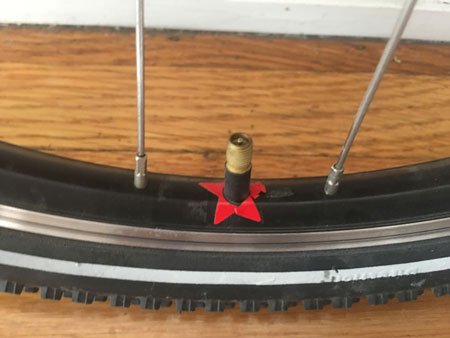
Schrader valve
Bicycle tires (or rather their inner tubes) have two different kinds of valves. They are either a Presta valve or a Schrader valve.
Unscrew and remove the dust cap to view the valve. Schrader valves, which are shorter and wider than Presta valves, are more common than their counterparts since they are also used for cars, motorcycles, and other transportation devices.
These instructions are for a Schrader valve. Different valves require different pump nozzles. Most modern pumps (both floor pumps and hand pumps) will have both, but you have to use the correct one. Other pumps will only accommodate Schrader valves and you may have to get an adaptor* to accommodate a Presta valve (if your tires are Presta).
Step 1. Determine the Appropriate Tire Pressure for Your Tires
The next thing you want to do before starting pumping, is figuring out what the appropriate tire pressure is.
Bike tires (like car tires) measure air pressure in pounds per square inch, or PSI for short. You want plenty of pressure so that you can roll fast, but not so much that you experience a harsh ride.
Also, if you inflate your tires too much, you could actually blow the tire off the rim. (Don’t worry—this is a pretty difficult thing to do).
Inspect the sidewall of your tire to find the manufacturer’s recommended tire pressure. If your tire doesn’t have this (most will), then here are some basic guidelines:
- Road bike tire pressure: 80-130 psi
- Cruiser bike / hybrid tire pressure: 40-70 psi
- Mountain bike tire pressure: 25-35 psi
If you’re a lightweight rider, stick to the lower end of the psi range; if you’re heavier, go higher.
Step 2. Remove the Dust Cap From Your Valve
There is probably a plastic cap covering the top of your valve. Go ahead and unscrew this and remove it. Remember: left-y loose-y, right-y tight-y. Put it somewhere safe so you can replace it again at the end.
Step 3. Place the Pump Nozzle On the Valve
Most floor pumps will have two nozzle holes–one for a Schraeder valve, one for a Presta valve. The big hole is for a Schraeder, the little hole is for Presta.
The pump value should be down (see picture below). Press the appropriate nozzle hole down onto the valve until it’s firmly on the valve. A little air may escape from the tire while you’re doing this. That’s okay.
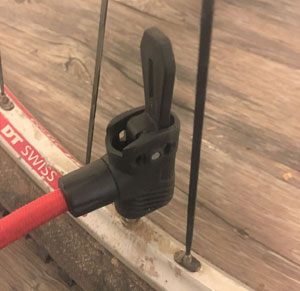
Pump Lever Up
When pumping air into tire
Step 4: Pull Up the Pump Lever So It’s at a 90 Degree Angle
Most air pumps will have a lever that you need to engage. Pull up the lever until you’ve rotated it a full 90 degrees.
It’s worth noting that not every pump is like this. Some professional pumps will have a lever that you push in. That said, the vast majority of commercial pumps are designed to be pulled up.
Step 5: Pump Until You’ve Reached the Appropriate Air Pressure
Put both feet on the base of the pump and use both arms to pull up on the pump and then push down. Continue pumping until the air gauge indicates that you’ve reached your appropriate tire pressure.
Keep an eye on your air pressure the entire time you are pumping.
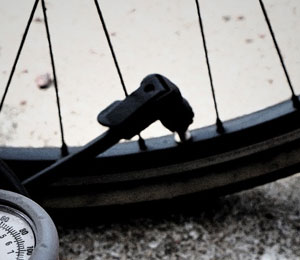
Pump Lever Down
When attaching & removing pump nozzle
Step 6: Push Down the Pump Lever and Remove From the Valve
Push the pump lever back down (90 degrees) and pull the nozzle off your valve. A little air might escape–again, that’s ok.
Step 7: Replace the Dust Cap
If you removed a dust cap at the start put it back on again. You’re done!
