How to Test Christmas Lights With a Light Tester
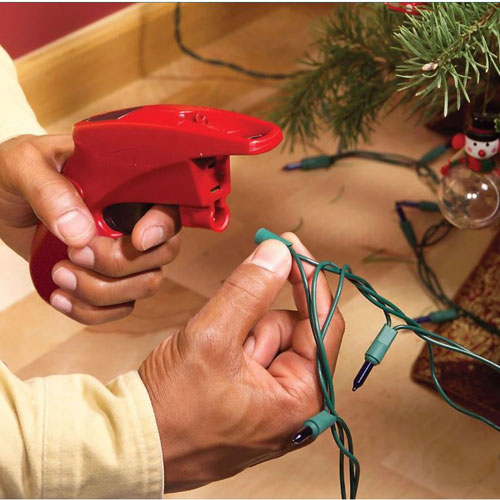
How to Fix the Shunt
A simple tester helps you fix holiday light strings fast.
One broken bulb on a strand of Christmas lights can render the whole string completely useless. Good news, though: there’s a way to test and fix holiday lights without having to check each bulb individually. This will work for outdoor lights as well as the lights for inside. Here, find out why your Christmas lights are not working.
Christmas Light Tester
To quickly identify a bad light on a strand, try using a device like the LightKeeper Pro. It’ll identify and oftentimes fix most problems in miniature and icicle light sets with a few squeezes of the trigger (but not the sets of larger lights or LED lights).
How to Fix the Shunt
Unlike old-fashioned C7 and C9 bulbs, miniature bulbs are low voltage. Household current is too much for individual bulbs, so groups of bulbs are wired together in a series that collectively can handle the higher voltage. The electrical current has to pass through all the bulbs in the series to complete its circuit. Usually a series contains 50 bulbs. A 100-light string has two series; a 150-light string has three series.
If one bulb in a series is defective, loose or missing, the circuit is broken and the series won’t light. In some light strings a burned-out bulb can also cause the series to fail, but better-quality bulbs usually have an extra wire called a shunt that serves as a backup. The shunt is designed to keep electricity flowing through the bulb even if the filament has burned out, so the circuit can be completed.
However, the shunt doesn’t always work right. It has a covering that’s supposed to burn off when the filament fails, but that doesn’t always happen. That’s where a repair device like the LightKeeper Pro comes in handy. It sends a surge of electricity through the circuit that can break down the coating and activate the shunt.
Replace burned-out bulbs even if the string keeps working. Otherwise the other bulbs have to handle the extra voltage, which can cause them to burn out faster.
LightKeeper Pro: Here’s how it works. First, you remove a bulb from an unlit section of your lights. Then you plug the empty socket into the LightKeeper, plug the string into an electric outlet, then squeeze the trigger until the lights turn on. The trigger sends an electric charge through the circuit to repair internal bulb failures. Something called the “shunt” in the bulb is supposed to act as a bypass if a filament fails to complete the circuit. If the shunt fails, it knocks out the lights in the section. The electricity sent by pulling the LightKeeper’s trigger locates and fixes the defective shunt, allowing the rest of your light strand to light up as intended.
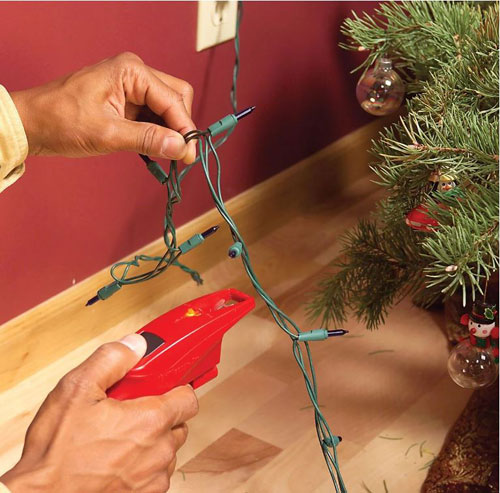
Finding a Dead Bulb
Finding a Dead Bulb
If that doesn’t work, you can also use the LightKeeper to locate and replace any defective bulbs that might be keeping your light strand from illuminating. You just hold down the black button on top of the tester and move the tip along the string. The tester will beep every time it senses a functioning bulb. Note where the beeping stops, then replace the previous bulb closest to the plug in.
How to Test When Half the String is Out
Run the tester along each bulb in the part of the strand that’s not working. As you find bad bulbs, mark them, so that you can circle back and replace them once you’ve tested the strand.
Also, if you run the tester along the wire, when it stops beeping, you could have a break there. You can fix the wire being sure to twist the wire together and wrap with tape so the wires on each side do not touch.
How to Tell If the Fuse is Blown
Lights can also go out if a fuse burns out, but that will darken the whole string.
Another problem you might encounter with holiday lights is a blown fuse. Both traditional incandescent and LED light strands have cartridge fuses. They’re typically located in the cord’s plug, hidden behind a sliding door. You might be able to tell if the fuse is blown just by looking at it; just look to see if the filament inside the fuse is broken. If you can’t tell, just test the fuses by replacing them with new ones and seeing if the lights come on.
How to Test Light Bulbs Without a Tester
Without a light tester, you’ll have to take a more intense approach to find a bad bulb. Remove the bulbs from the part of the strand that isn’t working and keep them together. Using a socket on the strand that works, go through and individually insert each bulb into it. If the bulb lights up, it’s good. Set the good ones aside as you test them. Once you’ve identified the bad bulbs, get replacement bulbs and start putting those back into the strand along with the bulbs you just tested.
Don’t use any light stands that have fraying or exposed wires. That can cause fires along with other dangers. It’s best to replace them with a new set. To help cut down on problems next time you get them out of the basement, be sure to store your Christmas lights so that they don’t get tangled up.
